Join the conversation! SOON (Seriously Optimistic Online News) keeps you connected with everything Innovative Resources – subscribe today!

If your situation is urgent, you can contact these services 24-hours a day, 7 days a week

CLOSE (X)

Putting Conversations About Intimate Partner Violence on the Agenda

Family violence is a serious yet often hidden crime. It is a fundamental violation of human rights and is unacceptable in any form, any community, or any culture. Led by the efforts of specialist services and people, primarily women, speaking out courageously about their experiences, family violence seems to be finally emerging from the shadows as the general public begin to have conversations more widely about it. People are beginning to be more aware of the drivers, patterns and devastating effects. We are learning about the underlying power dynamics and attitudes, particularly towards women, that give rise to it.

In its publication called Family Violence Risk Assessment and Risk Management Framework and Practice Guides (2012) the Victorian Government Department of Human Services defines family violence as ‘ … behaviour that controls or dominates a family member and causes them to fear for their own or another person’s safety or wellbeing. The publication goes on to say, ‘Family violence extends beyond physical and sexual violence and often involves emotional or psychological abuse and economic abuse.’

It’s time to de-bunk the myth that family violence is the problem of ‘that group of other people over there’. The stats from a nine-year trend analysis of the database from the Victorian Family Violence Department of Justice (vol. 4), reveal that family violence occurs in all areas of society, regardless of location, socioeconomic and health status, age, culture, gender, sexual identity, ability, ethnicity or religion. The data also show that while anyone can be a victim or perpetrator of family violence, it is most likely to be committed by men against women, children and other vulnerable people.

There are four key drivers of violence against women according to Our Watch1:

  • Condoning of violence against women
  • Men’s control of decision-making and limits to women’s independence
  • Rigid gender roles and stereotyped constructions of masculinity and femininity
  • Male peer relations that emphasise aggression and disrespect towards women.

With these drivers in mind, Our Watch says that actions to prevent violence against women include:

  • Challenging the condoning of violence against women
  • Promoting women’s independence and decision-making
  • Challenging gender stereotypes and roles
  • Strengthening positive, equal and respectful relationships.

The new card set published by St Luke’s Innovative Resources called No Room for Family Violence reflects these drivers of family violence. It sets out to create conversations where everyone, regardless of gender or sexual identity can recognise abusive and respectful behaviour in an intimate partner relationship, and get closer to articulating what they want more of, what they are concerned about and what they want none of. MORE, CONCERN and NONE—these are the three suits in this card set.
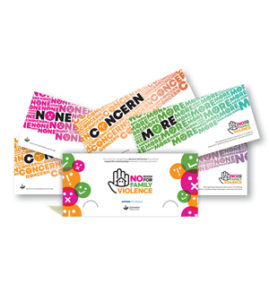
Use these 30 cards to create dynamic, open conversations about intimate partner relationships in schools, sporting clubs, family violence services, refuges and community services, counselling, health education and mental health settings, groups for men, women, couples and parents. Make sure conversations about abusive and respectful behaviour are on the agenda wherever young people or adults gather—this is one powerful way to raise awareness about intimate partner violence and help bring about change.

 [1] Our Watch, Australia’s National Research Organisation for Women’s Safety (ANROWS) and VicHealth (2015) Change the Story: A shared framework for the primary prevention of violence against women and their children in Australia1.https://www.ourwatch.org.au/What-we-do/National-Primary-Prevention-Framework

 

‘While our so-called “panic hormones” are part of our self-defence mechanism and are therefore to be celebrated, a few skills to “unpanic ourselves” and decompress are also crucial to have in our bag of tricks.’

When you think of a meerkat, what image comes to mind? Chances are, you’re imagining one or more meerkats, standing on their hind legs, spines straight, necks elongated, scanning the surrounding environment for possible danger. This posture is known as the ‘raised guarding position’, and several meerkats within a mob will be designated to take turns as sentinel while the others are foraging. A series of barks from the sentinel will send the mob scurrying into the burrows for cover.

Sentinel behaviour has evolved as a crucial survival strategy in many species, including humans. Whether we are acting as a sentinel for others, or we are alone and looking out for our own safety, part of growing towards independence is learning to become aware of our surroundings, and assess them for potential danger. At the first whiff of a threat, our brain triggers a flood of hormones which make us hyper-alert and ready for an immediate reaction to the situation.

Heightened alertness may be perceived as an endearing and even humorous quality in meerkats, but in humans ‘hypervigilance’ can become an entrenched and very uncomfortable way of being. There is nothing endearing or humorous about it. Your body may be on constant alert, taught and tense, eyes darting here and there, scanning for threats, unable to relax, even when no real danger is present. Hypervigilance is an enhanced state of sensory alertness that can increase anxiety and cause exhaustion. It can also interfere with basic functions like sleep and digestion—seriously impacting our physical and mental health.

People can be especially susceptible to hypervigilance if they have experienced trauma. The ‘red alert button’ somehow gets stuck in the ‘on’ position, triggering a sustained stress response. It is not surprising that hypervigilance is one of the central features of post-traumatic stress disorder (PTSD). But hypervigilance can also be more prevalent within certain roles and professions. For example, it can become habitual for some people who oversee others’ safety for extended periods of time, such as parents, teachers, carers, life-guards or emergency workers.

While our so called ‘panic hormones’ are part of our self-defence mechanism and are therefore to be celebrated, a few skills to ‘unpanic’ ourselves and decompress are also crucial to have in our bag of tricks.

Our set of Body Signals® may be of assistance.

Karen Bedford

Author : Body Signals®


For more reading on Body Signals:

Body Signals®: Signposts for Feelings

Body Signals®: Wisdom from Within


#bodysignals #hypervigilance

At this time of year we are often asked, ‘What is your New Year’s resolution?’ And, you know, that can often make us think that we have to change something, or that we need to ‘fix’ something about ourselves.

I have chosen to believe that I am a ‘work in progress’. This doesn’t mean that I need fixing, but that am going to use this time of year to think about what I want more of, and less of, in my life.

As part of the team at Innovative Resources, I have access to all of our valuable resources, and was drawn to the Note to self card set by Gena McLean as I reflected on this. I have always felt a connection to this resource; I think the practice that sits behind its creation (Choice Theory) and its strong link to ‘Mindfulness’ makes it a very useful resource for personal reflection.

To go one step further, Note to self has a card containing the words ‘I am a work in progress’ and three reflective questions on the reverse side. This card is part of the ‘Preservation’ suit, which seems quite appropriate for me at this time.

So in my contemplation of a New Year’s resolution, I am considering the three questions on the reverse side of this card:

  1. What does it mean to be a ‘work in progress’?

For me, this means that I don’t have to strive for perfection. What is perfection anyway?

Being a ‘work in progress’ allows me to think about what I want to concentrate on next that will add to my happiness and good health. And, what it also permits, is that I may have lots of things that I want to do, but I don’t have to do them all at once, and not all this year.

This year I am going to start a new hobby.

  1. In what ways am I learning and growing?

With both my daughters in their twenties now, I am learning what it is like to be a parent of adult children. I hope that I am growing in wisdom and maturity in the way that I present advice and suggestions, and can continue to be their best friend.

This year I am going to learn more about ‘active listening’ and go to at least one music concert or festival with my daughters.

  1. What parts of me do I want to preserve?

‘Preservation is about reminding ourselves that we matter. It’s about choosing to keep our own self safe and intact. Whatever we are going through, whether it is invited or unwanted, it is vital that we look after ourselves. Whatever our starting point, and even while  we are in the midst of challenging transformation, we still have strengths and virtues that need to be protected and preserved.’ (from the Note to self booklet by Gena McLean, p. 15)

This year I am going to step down from two committees that I believe are ready for new people and influences, to allow more ‘me time’.  I am going to use this ‘me time’ to enjoy my new hobby.

We can often be our own hardest task-master and put unrealistic demands on ourselves. Maybe a bit of preservation, consideration of self, and resources like Note to Self can help in setting some positive directions for you this year.

Georgena Stuckenschmidt

It is with great sadness and deep respect that St Luke’s Innovative Resources acknowledges the passing of our friend and colleague, Wayne McCashen.  Wayne died peacefully at home with loved ones by his side on 14 December 2018, aged 68. His beloved family—his partner Baz, and children Shae and Liam, and dearest friends Di and Shan—described Wayne as a gentle, compassionate and respectful man who contributed greatly to community.

Wayne was a social worker, author, trainer and consultant in the strengths approach. He was a pioneer and leader in the development and articulation of strengths-based practice and has written material and developed various frameworks that are used both nationally and internationally. His many years of experience in human services include youth work, family work, community development, staff supervision and management.

Wayne is the author of three books published by St Luke’s Innovative Resources: Communities of Hope and two editions of The Strengths Approach. He also co-authored Name the Frame, a set of card which, while in print for many years, created conversations and reflection on the components of social justice as they can be enacted in communities, organisations and in daily interactions between people.

Since it was first published in 2005, and with a new edition being released in 2017, Wayne’s book The Strengths Approach became the absolute classic in the distinctive style of human service work known as ‘strengths-based’ practice. Pivotal to this approach is human rights, equal partnership and respect between people or ‘power-with’. In this clear, compassionate and practical book, Wayne synthesizes and clearly articulates the principles, tools and frameworks that help create effective, socially-just ways of working with people.  Near the beginning of the book, Wayne writes:

‘The strengths approach is a positive, powerful and profound philosophy for practice that has the power to transform and build interdependence and community. For many it is not only a philosophy for practice but also a philosophy for life, because it is built on attitudes and values so deeply respectful of people’s intrinsic worth, their potential and their human rights.

For Wayne, it was never enough simply to espouse the philosophy of the strengths approach—he led by example, travelling that often challenging road of living it in his life, right in the nitty-gritty context of daily interactions. And, he was passionate in training people all over Australia in this approach.

St Luke’s Innovative Resources is deeply indebted to Wayne’s major contribution to the understanding and articulation of the strengths approach in human services. Our resources and training stand squarely on this solid foundation, and we feel very privileged to have known Wayne, to have worked alongside him, and to have benefitted so fully from his uplifting company.


For many people, Christmas is a time of family and fun. For others, it is a time of loneliness and loss. Do you ever think that everyone except you will be part of a rosy family group gathering around a perfectly basted turkey on Christmas Day? Be assured—even in these seemingly idyllic family scenes we glimpse though lounge room windows, difficult feelings are likely to be bubbling up along with the Christmas cheer. The reality is, every family has its tensions and pressure points—and Christmas can be a powerful trigger.

However you plan to spend Christmas Day, it is worth doing some thinking in advance about your self-care on that day. Here’s an empowering thought to consider: What if how you experience Christmas Day is largely influenced by how you decide to experience it?

A lot of planning and preparation often goes into the logistics of Christmas Day—the shopping, the cleaning, the cooking, the gifts, the scheduling of who goes where when. But it is worth doing some inner planning and preparation as well. Why? Because effective self-care—taking care of your own physical, mental and emotional wellbeing—is supported by the preparation you do in advance.

Here are three cards from our upcoming Self-Care Cards to offer some ideas.

MEANING (What gives your life meaning? Where do your values and beliefs come from?)

We humans have the capacity—some say, the responsibility—to ‘make’ meaning rather than waiting passively for meaning to arrive. In his book The Van Gogh Blues, Eric Maisel calls depression a ‘meaning crisis’ and says we must rush to our own aid by making meaning. Making meaning is connected to our values. If you value spirituality then Christmas Day might have a spiritual meaning you can focus on. If you value being a generous person then it may be meaningful to you to give a gift, regardless of how it is received or whether you get a gift in return.


CELEBRATE (What is worth celebrating? What are you most proud of?)

Even if Christmas Day is fraught with all kinds of dynamics, what can you find to celebrate about your family, the people you are with, your outer surroundings? You could choose to appreciate small details like the colour of the strawberries or the pillow softness of whipped cream or the smell of Christmas spices. Or could you celebrate that you have simply managed to travel through another year? (You know how much courage and effort that took.) Could you celebrate one thing that went well during the year, one accomplishment, no matter how small?


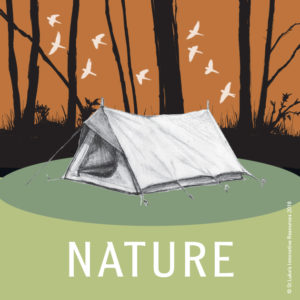
NATURE (How important is spending time in nature for you? What is your favourite outdoor place?)

Humans have sought solace in nature since time immemorial. Whether you are with others or alone on Christmas Day, how can you connect with nature? Can you go outside, take a walk, listen to the sound of birds? If you can’t go outside, is there a vase of flowers, a pot plant or even a picture you can look at? Describe something you see (like a tree, cloud or flower) in great detail to yourself, as if to someone who is blind. Perhaps you could even sketch it? At some point on Christmas Day, look up at the sky, taking in its vastness. Watch carefully for how this may bring a little more spaciousness to your inner landscape.

Karen Bedford

Managing Editor
St Luke’s Innovative Resources

SELF-CARE CARDS available Feb 2019


You’ve probably heard of fight, flight or freeze—the brain’s primal response to threat that floods our system with a cocktail of chemicals to help us react and keep safe. More recently ‘flop’ and ‘be-friend’ have been added to this list. Now, that’s a tidy little bunch of ‘f’ words for you!

And here is one more to add to the collection: FURIOUS.

For many children (and adults too) ‘fight’ is the go-to response and anger is the emotion that is automatically triggered. The root cause of anger is often frustrated desire.  A child who has not yet learnt to self-regulate can go from zero to one hundred in a split second when something or someone gets in the way of what they want, resulting in an outburst of full-blown fury.

Take a moment to tune into what anger feels like in your body; perhaps a tight ball in your tummy, raised shoulders, clenched fists. Perhaps it is accompanied by a sharp intake of breath and ‘the look’. You know the one. Does anger feel toxic to you? Or do you like that firing up of the adrenals? Whatever your personal relationship with anger, other people don’t seem to like it much when you are angry.

Aggression without internal checks and balances is dangerous to others, and to oneself. Many people come to see, sooner or later, that anger is seldom worth the trail of destruction it leaves.  A habit of anger can lead to bitterness and regret, depression and isolation, violence and trauma. Many of our social norms and laws are there to help regulate human aggression. While necessary, external control rarely cuts deep into the territory of truly embodying peace.  It is so much more powerful and transformative to do the hard yards of developing self-regulation. And as adults, we have a responsibility to help children and young people develop this essential aspect of emotional intelligence as well.

Here are some solution-focussed ideas for helping children learn to manage anger:

  • Let children know that anger is a natural human emotion and we all feel angry sometimes. Don’t make children feel ashamed or guilty about feeling angry.
  • Let children see you practise anger management yourself. Children learn by watching the adults around them, so it’s counter-productive to get angry at the child for getting angry!
  • Remember the strengths-based, solution-focussed maxim: ‘The problem is the problem, the person is not the problem.’ So … the child is not the problem, the response to anger is the problem. (And the child is not the anger either.)
  • Let children know that it is exciting, fun and really useful to have some tricks up their sleeve for helping them manage anger.
  • Encourage children to get curious and ‘notice’ things about anger—noticing helps create distance or ‘externalises’ anger so that it becomes something they can get to know and get super-clever with.
  • Encourage children to make up a name for anger like ‘Growly Tiger’ or ‘Stormy Cloud’. Bingo! You have an ‘externalising metaphor’. Then you can ask things like, ‘What would help Stormy Cloud to float away across the sky? (Please see the book Kids’ Skills for a method of working with children to turn problems into skills to be learned. One of the steps is naming the problem.)
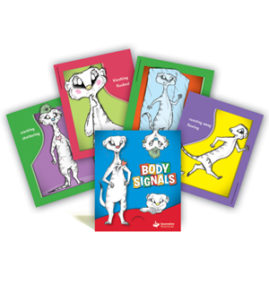
  • Let children know that their bodies are very smart. Their ‘body signals’ are their ‘early warning signs’ and can let them know when anger is about to visit them. Ask them, ‘What happens to your fists, shoulders, tummy and jaw when you are angry?’ (The Body Signals cards with colourful meerkat characters are a great resource for teaching children to recognise their body signals.)
  • Teach children to recognise signs of anger in others. Invite them to make a face to show an angry expression. This helps develop empathy, and also teaches them how to stay safe. ‘What should you do when someone is angry?’
  • Just as aggression is a learned response to anger, assertiveness can be learned as well. Teach children the consequences of aggression. Why doesn’t it work a lot of the time? Teach them other, more effective ways to ask for what they want or say what they need to say.
  • Kids can learn to lengthen that tiny split second of choice that is present before they react. It’s often referred to as ‘impulse control’ or ‘getting in the driver’s seat’ of how we respond to our body signals and emotions. The car is a great metaphor for working with children who are angry because you can talk about crashing cars as well as cars that decide to take another road. (Please see Cars ‘R’ Us.)
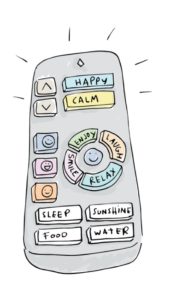
  • Anger can arise as a response to anxiety. Teach children lots of fun, simple strategies for calming down and de-escalating anger and anxiety, such as breathing, counting, movement and tapping, creating a ‘remote control’, Cognitive Behavioural Therapy techniques (CBT) and mindfulness exercises. (Please see Anxiety Solutions for Kids.)
  • Anger can arise through feeling disempowered. People can then try to assert control over others (‘power-over’) in a misguided attempt to wrestle power back to themselves. Create a culture in your classroom or family where kids are noticed, celebrated and praised for putting their strengths and skills into practice. Notice and encourage sharing, negotiation, co-operation, fairness, problem-solving and other skills that build relationships and ‘power-with’. This helps children begin to understand that exercising internal control is an expression of true inner power. (See Strength Cards for Kids.)

True inner power—the essence of connectedness with ourselves and others, and the mark of a healthy relationship with our emotions, including anger.

Karen Bedford

Managing Editor, St Luke’s Innovative Resources

Linda Espie, author of Symbols, formally published by St Luke’s Innovative Resources, has just released a new book, The Soulful Art of Pondering Grief. As a friend and colleague of Linda’s, Karen Bedford, our managing editor was asked to review the book. This is what Karen had to say.

‘Ponder’ is such a beautiful word. Round, deep and slow. Quiet and meandering. Full-hearted and spacious. No wonder this word features in the title of Linda Espie’s new book Pondering Griefa collection of words and images about change and transition. Readers will find qualities of the word ponder abundantly present on every page, as are the different nuances, hues and faces of grief.

Linda is a Melbourne-based counsellor, psychotherapist, educator, photographer, art therapist and author.  In her closing note at the end of the book, Linda says, ‘Respecting grief in all its unfolding and passion has offered me some deeply valued lessons. Though excruciating at times, as well as breathtaking, heart aching, head pounding and confusing, I am thankful for what I have gained in strengths and conviction from my experiences.’

There are 23 key words or themes in the book beginning with ‘Story’ and ending with ‘Courage’.  Each theme inhabits its own double-page spread, featuring one or more visual images (mostly photographs) and a prompt for reflection. This prompt may be:

a quote: ‘It matters if you just don’t give up’—Stephen Hawking

a question: What nourishes you?

a suggestion: What symbols would you use to describe your grief today?

an intriguing statement: Pain is important: how we evade it, how we succumb to it, how we deal with it, how we transcend it.

a sentence starter:  Those moments that …

While this book offers is a rich abundance of threads to follow as you walk through the territory of your grief, the abiding feeling arising throughout these pages is spaciousness, simplicity, silence. And time—time and space to feel and heal, to wonder and ponder. To gather up the sorrows, and when you are ready, if you agree, if you can bear the heart to become that full … the gifts of a grieving heart as well.

Karen Bedford

Linda’s book can be purchased through her website.

Our body signals are the gateway to recognising, interpreting and managing our feelings. That is why Body Intelligence (BQ) is such a fundamental aspect of developing Emotional Intelligence (EQ).

There are times when each of us, no matter how skilled we may be, has trouble recognising how we are feeling. When we have lost touch with our emotions as can happen with trauma, body signals can be a great support in helping us notice and interpret what we are feeling. Even when we are unable say how we are feeling emotionally, most of us can learn to identify and describe what is happening in our body—our ‘body signals’.

The human body is an extremely sensitive instrument. People can pick up subtle changes in personal relationships, in temperature and in atmosphere. We notice changes in tone of voice, facial expressions and gesture. This sensitivity to the language of the body is a highly sophisticated part of what it is to be human—it is at the heart of how we keep safe and build connections with others.

Body signals can be thought of as signposts for feelings. For example, we may not know consciously that we feel unsafe, but our body may be giving us a clear warning sign through a tight tummy, sweaty palms or a beating heart. Or we may be unaware that throughout the day we have accumulated quite a lot of stress, until we notice the tightness in our shoulders when we arrive home.

With practice even very young children can learn to recognise their body signals (and those of others) as strong indicators of emotions. In fact, our bodies are very often our clearest and most honest communicators, especially if we have learnt to disregard, suppress or second-guess our feelings. Of course, we can all do this from time to time, but unfortunately it can become entrenched if abuse has taken place. Therefore, it is through our body signals that many counsellors and therapists are helping children and adults learn (or re-learn) what they are feeling, and establish  appropriate boundaries for personal safety. For this reason, people working in trauma-informed care with children, young people and adults may find Body Signals® particularly useful.

While these kinds of conversations may be at the heart of protective behaviours work in particular, the Body Signals® cards are ideal for opening up crucially important learnings about body signals with anyone. So, teachers, social workers, counsellors and parents will also be among those to use the Body Signals® cards.

Karen Bedford

More reading on body signals® 

For many of us, anxiety sucks. It feels unpleasant, it’s uneasy, uncomfortable and sometimes scary. It comes in so many different forms and no two people will experience it in the same way. Sometimes, it comes in different forms, at different times, and in different situations, for the same person! It’s unpredictable. It can arise when we are stressed or relaxed. It can arise out of the blue. It can be rational or irrational. Sometimes, we are anxious about little things while being fine with genuinely scary things.

There’s no real logic to anxiety or worry except that it’s a part of the human experience and we all go through it at various frequencies and intensities. It’s not just you. Do you know the super-high percentage of people who experience anxiety? According to the National Survey of Mental Health and Wellbeing conducted by the Australian Bureau of Statistics (Summary of Results, 2007, 4326.0, Canberra) anxiety is the most common mental health condition in Australia. It is estimated that on average, one in four people will experience anxiety at some stage in their life and in any twelve-month period, over two million Australians will experience anxiety. But it may be many more than that. The thing with anxiety is that it’s generally invisible. We may know somebody very well and yet their anxiety remains hidden, private and even shameful.

A positive reframe for anxiety

Anxiety is a form of energy that needs a different outlet, a new narrative, a positive reframe. Anxiety can be seen as a sign of strength—of wanting to feel good, of gearing up to do something. The more comfortable you become with anxious thoughts and feelings, the better you feel. And conversely, the more time you spend avoiding anxiety, the greater chance there is of setting up dysfunctional habits in order to avoid feeling it. For example, many people fall into the habit of trying to manage the discomfort of long-term stress and anxiety with alcohol.

How the brain and body respond

Yes, there is always a physiological aspect to anxiety. Certain parts of the brain (such as the amygdala) spring into action, releasing a chain of chemicals commonly known as the ‘fight, flight, freeze’ response. More recently, ‘flop’ and ‘(be)friend’ have been added to this list.
All of these are felt as some kind of stress.

Like a faulty alarm system on a car, sometimes these fear signals trigger in humans for no reason at all. When the car alarm goes off randomly, it’s important to remain calm, know that there is no actual threat, and do what we need to do to stop the alarm sound. Similarly, if you feel your brain hitting the panic button for no good reason, use the same process. Remain calm. Remind yourself that there is no actual threat; it’s just a feeling or thought or both. It’s ok. It passes. Talk to yourself calmly, breathe slowly through your nose, and find a pleasant, distracting activity as soon as you can. Focus on the outside world—for example, things you can see, or count, or list, colours you can name—rather than on the internal state. Remain calm and nonchalant until the wave passes. It will.

With strategies like these, you activate other parts of the brain, such as the hippocampus, that moderate the effects of the stress response by providing a soothing or reassuring antidote.

The purpose of our card sets

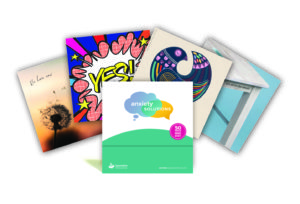
The aim of Anxiety Solutions and Anxiety Solutions for Kids card sets is to provide people with many ‘antidotes’ to the stress response, using a range of creative, cognitive and physical strategies. Some of these will appeal to some brains more than others, and that is fine. Your anxiety or stress pattern is personal to you, and so too are your solutions.

The most effective techniques retrain the brain away from its habitual pattern by using changes in both physiology and focus. That’s what these cards are all about. Giving the mind a new task that will either alter physiology or focus (or both!) so that a person can access a different state, even if it’s just a slight change or improvement.

From Anxiety Solutions

Booklet author: Selina Byrne M.A.P.S.

Our body communicates its wisdom to us long before our conscious mind can get a word in.  That’s why body signals are sometimes called our ‘early warning signs’, and they are an important key to staying safe, and building social and emotional wellbeing.

How are body signals different from body language?

What do we mean by body signals and how are they different from body language? ‘Body language’ is a term that has been around for quite some time. A cursory search through the internet reveals a plethora of material about ‘body language’; how it is essential to communication and how so much of what we say is communicated not by words but by gesture, posture, facial expression, stance and other aspects of non-verbal, physical behaviour.

The human body is an extremely sensitive instrument. People can pick up subtle changes in personal relationships, in temperature and in atmosphere. We notice changes in tone of voice, facial expressions and gesture. This sensitivity to the language and tonal energy of the body is a highly sophisticated part of what it is to be human—it is at the heart of how we build connections with others.

While body language sends powerful ‘signals’ to others, this is not what we mean by the term ‘Body Signals’ in our card set.

A body signal—or a cluster of body signals—is the physiological response of the body to something in the internal or external environment, whether it be a perceived threat or something quite the opposite such as pleasure or comfort. Body signals are visceral responses such as blushing, goose bumps, palpitations, butterflies in the tummy, constricted throat, perspiration, trembling.

In creating this card set we discovered how difficult it is to be cut and dried about where a ‘body signal’ ends and where ‘body language’ begins. They go together. A body signal such as a fluttery, nervous tummy may easily result in a gesture such as rubbing your tummy, or an expression such as a frown.  So, while the forty Body Signals® cards focus on body signals, you will also be able to identify aspects of body language such as gesture, expression and posture. These factors can be used to add layers of richness to your conversation with people about body signals.

The Body Signals® cards are designed for having conversations with children, young people and adults about body signals. Such conversations help people recognise what their body is telling them, and become more skillful at interpreting and acting on the message in an appropriate way. The action required may be as simple and yet as significant as: ‘Tell an adult you trust.’ For example, tell an adult such as a teacher that your tummy is in a knot at school and you need some help.

From Body Signals® Booklet

Author: Karen Bedford

The Bendigo Reconciliation Committee has developed a FREE resource for mainstream community organisations to explore the issue of ‘organisational white privilege’.

The development of this resource grew out of a Conversation Circle arranged by the Bendigo Reconciliation Committee (BRC) and member agencies during the 2018 Reconciliation Week.  This Conversation Circle was a vehicle for dialogue and reflection between Aboriginal and non-Aboriginal people on the theme of building and working in partnership. The ‘Exploring Partnership’ Conversation Circle was one of four Conversation Circles organised during Reconciliation Week. (See attached report on the Conversation Circles held in Bendigo during Reconciliation Week 2018.)

In exploring the issue of white privilege as a key barrier to true partnership, the ‘Exploring Partnership’ Conversation Circle also explored the issue of ‘organisational white privilege’ and its impact on the relationships between Aboriginal and Torres Strait Islander people and mainstream community based organisations.

Whilst it is commonly recognised that white privilege exists for individuals, the issue of white privilege existing for mainstream organisations is not always recognised, discussed or explored. It was agreed at the Conversation Circle that there was a need for a resource that enabled mainstream organisations to start the process of reflecting on their ‘organisational white privilege’, the benefits that exists for organisations by virtue of this privilege and also supporting actions that addressed ‘organisational white privilege’. Over the past few months the Bendigo Reconciliation Committee has worked on the development of this resource.

Please download the resource ‘Identifying and addressing organisational white privilege’.

The aim of this resource is to support organisations in exploring the nature of organisational white privilege, the circumstances in which it exists and provide some questions that organisations could use to explore their ‘organisational white privilege’ and its impact. It is hoped from these discussions within organisations that this will lead to actions that address the impact of ‘organisational white privilege’.

There are positive outcomes for mainstream organisations in starting the journey of exploring their ‘organisational white privilege’. These include:

  • Building the values base of the organisation.
  • Development of a reflective culture within an organisation on the issues of racism and white privilege and
  • Addressing the organisational issues, practices and culture that inhibit cultural safety for Aboriginal people.

In developing this resource the Bendigo Reconciliation Committee recognises that the exploration of ‘organisational white privilege’ can be a challenging space but it is a space we need to go to.

The resource does not include a detailed process for exploring ‘organisational white privilege’. Its focus is more on exploring the issue and posing questions. In light of this we are keen to link up with any organisation that is interested in exploring its ‘organisational white privilege’ and working with people to develop processes that enable these discussions to occur within their organisation. In the future we hope to gather and disseminate ideas and approaches to exploring ‘organisational white privilege’ within organisations.

For further information on this resource and how it could be used, please feel free to contact John Bonnice via Andrew Shirres, (email address below).

Any feedback about the resource will be welcomed.

John Bonnice
Co-Chair, Bendigo Reconciliation Committee

E: Andrew Shirres

Self-care should be seen by practitioners and organisations alike as a fundamental part of human service work, and not just an optional add-on.

People in the ‘helping’ professions—such as social workers, counsellors, teachers, carers, and health professionals—juggle many potential challenges everyday including high workloads, vicarious trauma and emotional exhaustion. Jobs that involve working with people who are facing difficult circumstances magnify the usual challenges of any workplace. If left unchecked, stress can build up, contributing to mental and physical health issues including anxiety, depression, high blood pressure, addictions and burnout.

People drawn to human service professions are often passionate about their work; they are dedicated to supporting others to create positive change. This can have a shadow side. Sometimes it means that staff don’t take enough time to ‘refill the tank’. A depleted practitioner has less flexibility, resilience and capacity to think through challenges. Problems seem more intractable and it’s harder to be hopeful and solution-focussed. This can compromise the practitioner’s capacity to provide an effective service to others while balancing their own wellbeing.

The organisation is significantly impacted as well, with increased sick days and staff turnover, low morale, and less effective outcomes for people accessing services. Sustained stress takes a heavy toll on the organisation, the person and often their colleagues and loved ones as well.

This is why self-care should be embedded within the culture of a human service organisation at every level, with self-care conversations, reviews and plans taking place regularly in forums such as supervision, team meetings and planning days.

Self-Care Cards for Home & Work is set of 50 cards is designed to create reflection and conversations about self-care. Each card features a key topic of self-care and two questions to get the conversation rolling. With illustrations drawn from the world of birds, these cards encourage the art of ‘noticing’; noticing how we are doing, what we are feeling, what our body is telling us, what our own insights—and those of colleagues, clients, friends and family—are revealing about what’s working well and what we could do differently to support self-care at work and at home.