Step aboard the good ship ‘Your Life’ for an exhilarating adventure on the high seas. Sailing, like life itself, is full of ups and downs. From the bliss of steady winds and calm seas to the terror of cyclones; from the relief of seeing the beam of a lighthouse to the anxiety of watching circling sharks; we rise and fall through good times and bad-and we can never be sure what is just over the horizon-shipwreck or buried treasure!
Like the sea we are constantly changing.
Like the sea, life around us is also in continual flux.
One of our sayings at Innovative Resources is that ‘change only happens when it’s noticed’. Just as a sailor needs to be vigilant about even tiny weather changes, so we benefit from noticing change. Positive changes have so much more impact and negative less power if they can be named.
Doom and gloom can descend as suddenly as fog in a shipping channel-paralysing us with fear and obscuring the light we know is out there. The gloom can seem impenetrable and doom our most likely outcome. But, if we want to see the lighthouse beam, sometimes we must be prepared to seek a new position. #UpsandDowns might just prove a means to make that shift; to challenge the fatalism that so often accompanies deficit-saturated thinking.
The 54 Ups and Downs cards portray scenarios any bathtub sailor might experience. And if we want a metaphor reflecting ‘change’ we need look no further that the waves, weather and tides of the ocean. Ray Bowler’s deceptively simple card images depict many of our own responses to the ebb and flow of life.
Extracted from the booklet accompanying Ups and Downs Card set, published by St Luke’s Innovative Resources, 2010
Using the metaphor of a car, imagine James, a nine year old boy (car) who was suffering from severe panic attacks.
I began by asking him about his symptoms (the back wheels), and then asked him what he was telling himself and doing (front wheels) when this happened.
It looked like this:
He was then asked what would happen if this continued. He wrote, ‘I’d not be enjoying life, I’d be unhappy, missing out on fun, and not finding out what I’m capable of.’
I suggested we make a new car and asked him how his body would be responding (back wheels). Then we discussed some ideas for what he would need to be telling himself and doing (front wheels) if he were to be feeling this way.
The new car wheels looked like this:
James wrote that the consequences of this would be, ‘I would be happier and have more fun. When I have a problem or I am worried, I would stop and think about it, instead of getting scared.’
The second car also represents a clear action plan for the person to manage the symptoms and feelings of anxiety.
Cars ‘R’ Us had its origins in Dr William Glasser’s Reality Therapy and Choice Theory.
Reality Therapy is a method of counselling used to assist people since 1965. Choice Theory is a framework designed to improve an understanding of human behaviour. It can be applied to counselling, managing and teaching. While Cars ‘R’ Us represents only a part of the theory, it provides a practical approach to:
understanding ourselves and our feelings
identifying a process for rapid change
empowering people to help themselves
creating a sustainable blueprint to manage future challenges.
So welcome to Cars ‘R’ Us, a powerful therapeutic tool. It has been designed to provide a framework for nearly anyone to do effective therapy with others, or as a self-evaluation kit. It’s also designed as a therapeutic conversation-starter to be used in schools, with families, in counselling situations or in the corporate world. It is deceptively simple but contains the resources for many counselling sessions. It is ideal for working with young people especially at a time when depression and suicide is so prevalent.
The content for this article originates from part of the booklet that accompanies the Cars ‘R’ Us card set, written by Ivan Honey.
They say that in times of transition there is always something to let go of and something to hold onto. Personally, this seems to be my constant state of being! Do you find that fantasies of letting go of bad habits and taking hold of shiny, new, healthy alternatives are nearly always hovering around? Especially after that night on the town or that third piece of chocolate gateau. And—halleluiah—sometimes the will finally kicks in and a lasting change takes hold. This must be celebrated hard because it can be rather rare.
But the fact remains that in times of crisis or significant change, we may not quite know what is worth holding onto and what should be jettisoned.
When major life change comes knocking on our door, we humans can tend to ‘throw the baby out with the bathwater’.
Times of transition are sometimes called ‘liminal’ space—this word comes from the word ‘limen’ which means ‘threshold’. When the past has gone, but the future has not quite arrived, we are in liminal space. Betwixt and between. Such times can be exciting, such as leaving home, moving countries, leaving a job. Or they can rock us to our very core such as separation and divorce, a house fire, the death of a loved one or a protracted illness.
Liminal space can be traumatic but it can also be filled with creative possibility.
Particular times of the day are liminal—dawn and dusk, for example. (No wonder these are such fruitful times for prayer or meditation—also very liminal activities.) Or think of those beautiful, suspended days when summer has passed but autumn has not yet arrived.
Pregnancy is liminal too—you are not yet a mother but you are no longer childless either. Travel is also very liminal—and places such as airports, railway stations, bridges, roads and pathways. You are no longer where you were, but you have not reached your destination either. So next time the kids ask, ‘Are we there yet?’ you can answer, ‘No, kids, we are still in liminal space, and anything is possible.’
Liminal experiences, whether pleasant or traumatic, can be powerful catalysts for personal change.
A new identity can arise—this is the greatest promise of liminal space. Through the fire of change, something outmoded in our way of thinking and being may be burned away, and something new can take hold.
A great thing to do when travelling through liminal times in your life is to gently reflect on what is worth retaining and what has run its course and needs to go. Ask yourself ‘What will I hold onto and what will I let go of?’ It may feel impossible to know, but if you can be patient and aware during liminal times, answers will surely emerge. (Til then, please pass the cake.)
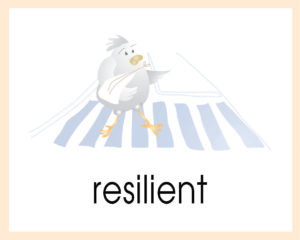
My daughter laughed when I bought my Strength Cards. She said, ‘You’ve always wanted your own, haven’t you?’ She had been using the Strength Cards in a therapeutic setting. My other daughter could tell me the pictures on some of the cards because her teacher had the Strength Cards at school. When I named a strength, such as ‘resilient’, she’d remember, ‘Oh yeah, it had a chicken with a broken wing crossing the road.’
I wanted to keep the cards handy as I’m an emergency teacher. But I especially wanted to have them for home. With seven people in our household we can easily become focussed on what we find annoying about each other. So it’s good to do something every now and then to remind us of the positives in those around us— and ourselves.
The day my Strength Cards arrived, I put up A4 sheets of papers, one with each family member’s name, on a sliding door in our kitchen passageway. It’s a high traffic area in our house. Then I blu-tacked a large selection of Strength Cards onto the door, so people could place the strengths next to individual names to recognise the strengths of family members.
It was very popular and successful too. I was able to speak to the kids individually about strengths and about family member’s strengths without needing to gather the whole family for a meeting. People could move the cards around while they were walking past— it didn’t take any effort or time.
Putting up the cards in a busy pedestrian area also meant that people were constantly reminded of the strengths that other family members saw in them. We could give and receive positive messages without having to do it face to face! And I could highlight when family members used their strengths by saying something like ‘That’s very resilient of you. Do you have that strength card next to your name? Why don’t you go and put it there?’
We had some simple rules to support our focus on personal strengths. For example, it was OK to let people know which strengths you put next to their names, but you didn’t have to. It was also OK to move a card from one person’s name to another, but only after the first person had seen the card and knew that someone had recognised that strength in them. It was even OK to put strengths next to your own name. The one action that wasn’t permitted was to take away a strength from someone’s name because you disagreed that they had demonstrated it. After all, someone else had thought that strength should be there!
It was a great activity which I plan to do again. I currently have just one strength on the door, where family members can reflect on it as they pass. I can use it to draw people’s attention to times when that strength is used or required. ‘Resilient’ is the current one.
This lovely story was sent in to us by Denise McDonough
Share your story with us
#strengthsbasedpractice
Whenever we think about the subject of ethics in human services, the word ‘dilemma’ often comes to mind. Consequently, and for me, sadly, when decisions to questions concerning ethics are called for, human service workers can frequently react with confusion, fear or doubt. A loss of confidence can ensue, where workers look elsewhere for direction (colleagues, policies, procedures and manuals) rather than exploring their own strengths and competencies first—and we begin to hear the word ‘burnout’.
In my current role as practice development coach for St Luke’s (and in past roles as worker, team leader and manager of mental health services) I have noticed that anyone who experiences difficulty in reflecting on practice will often try to address ethical dilemmas by looking towards changes of behaviour in the people they work with rather than in themselves. When these changes don’t occur, work gets even more stressful. Grey areas can then become places to be avoided. I don’t think it has to be so. Why not celebrate ‘the grey areas’? Rather than avoiding questions on ethics, we can embrace them.
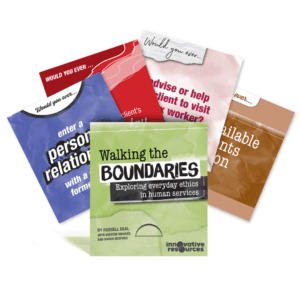
Walking the Boundaries is a resource that can assist workers to move towards grey areas. These cards engender a sense of enquiry and curiosity; they invite us to reflect on our purpose, values, beliefs, blind spots and stories … and in so doing, they are a very useful tool for building practice wisdom.
Exploring everyday ethics provides opportunities to build cultures of positive practice development and ethical decision-making. By drawing upon the experiences, skills, creativity and strengths of a group, tools such as Walking the Boundaries can help normalise the discussion of ethical dilemmas. In this way we can begin to see these quandaries as everyday ones that human services workers have an ongoing responsibility to question and explore. Ultimately, such a dynamic and interactive practice culture helps create support for clients that is genuine, considered and reflective.
Exploring everyday ethics provides opportunities to build cultures of positive practice development and ethical decision-making.
A great deal can be learned through the ‘positive interrogation’ of everyday ethics in human services. Each card in the set features a question that begins with ‘Would you ever … ?’ By asking ourselves or others the question displayed on one or more of the cards, we arrive at a new and perhaps more important question: ‘Why?’
Do we do what we do to accord with agency codes of conduct or to agree with our own ideas about what is the ‘right thing’ to do?
Are these paradigms mutually exclusive or does one inform the other?
Do we do what we do as a response to another action?
The answers to such questions can reveal much. We can discover that what occurs in our work with our clients is as informed by our own assumptions as it is by their actions. We can find that interventions are a combination of multiple sets of values, perceptions of experiences, rich cultures and complex stories.
We can also find that our ethical decision-making process is robust. That we have the values, skills, knowledge and experience to ensure the people we work with have the best support we can provide. We can acknowledge personal agency in decision making and take responsibility for our actions. We can find a way to both accept and look beyond the essential protocols, policies and procedures that can either support or inhibit reflective practice.
I would like to congratulate Russell Deal and his team for coming together to create one of the most useful contributions to practice reflection yet seen. While Russell and his collaborators at Innovative Resources have asked 80 great questions of practitioners, it will be the plethora of responses that Walking the Boundaries invites that will be most important. Thank you, Russell, for inviting us to think, ponder and wonder ‘Would we ever … ?’
Andrew Shirres
Practice Development Coach
St Luke’s Innovative Resources
Might this be a formula for best practice in social work?
Engage
Great practitioners know that it’s not enough to know their disciplines. They need to engage, inspire and enthuse clients by creating conditions in which those clients will want to learn. When they do that, their clients will almost certainly exceed their own expectations and everyone else’s too. Great practitioners do this by bringing the best out in their clients. They do this through a variety of methods.
Enable
Expert practitioners have a repertory of skills and techniques and knowing how and when to use the appropriate technique is what great practice is all about. Like all genuine professions, it takes judgment and connoisseurship to know what works best here and now. Expert practitioners constantly adapt their strategies to the needs and opportunities of the moment. Effective practice is a constant process of adjustment, judgment, and responding to the energy and engagement of the clients.
Expect
Practitioners’ expectations have radical implications for the achievements of their clients. If practitioners convey to clients that they expect them to do well, it’s much more likely that they will. If they expect them to do badly, that’s more likely too. The key to raising achievement is to recognize that practice and learning is a relationship. Clients need practitioners who connect with them. And above all, they need practitioners who believe in them.
Empower
The best practitioners are not only instructors. They are mentors and guides who can raise the confidence of their clients, help them find a sense of direction, and empower them to believe in themselves. Clients who are more confident in their own learning ability “learn faster and learn better. They concentrate more, think harder and find learning more enjoyable”.
Confession…
The words above are not mine. They are unashamed plagiarism. They are taken from the book Creative Schools by Ken Robinson (2015) and they are Robinson’s summary of the components of effective and balanced teaching.
All I did was to substitute practice for teaching, practitioner for teacher and client for student to see how Robinson’s key elements matched with how effective social work practice might be described.
It is not a perfect fit but there is a very strong correlation.
Robinson is an internationally recognized educator, the author of several books including The Element, but is probably best known because of because of his 2006 TED Talk called Do Schools Kill Creativity? which by 2015 had been seen by an estimated three hundred million people worldwide and remained the most watched talk in the history of TED.
Robinson is an articulate voice arguing for creativity and passion in the classroom rather than blind allegiance to standardized testing and instrumental teaching.
By putting his words in the context of social work practice I simply wanted to make the point that there are clear similarities between professions when it comes to describing ‘best practice’. In our social work roles we have a lot we can learn from the worlds of education and teaching. And it is not a one-way street, a strengths-based philosophy of social work practice can inform teaching and is reflected in the popularity that Innovative Resources materials have in schools throughout the world.
If nothing else, strengths-based practice should be known for the value it puts on curiosity.
As the philosophy of strengths-based practice evolves we need to continue to look in diverse places for ideas that can inform and inspire practice. Ken Robinson is one such source of wisdom and inspiration.
Reference: Robinson, Ken. Creative Schools: Revolutionizing Education from the Ground Up. (2015) Penguin, Australia
Article written by Russell Deal
‘Sparkling Moments’ (or Unique Outcomes as they are also called) were so named by Michael White in his articulation of Narrative Work, but the concept readily fits both solution-focused and strength-based approaches.
A Sparkling Moment can simply be defined as any time where the dominance of a problem disappears. These are the cracks in the doom and gloom when the sun shines through. Because no problem holds us in its grip with the same intensity over time it is always the case that there will be moments when we are less oppressed by it’s challenges. Our relationship with our problems is always in a state of flux.
Being reminded to look for any sparkling moments can suggest strengths and solutions to be employed to stay resilient.
Identifying Sparkling Moments is a great strategy for keeping hope alive. The metaphor can be reinforced through a range of activities that fit strength approaches.
Introductions
Starting a session with an individual client, a group of clients or even a team meeting with colleagues by inviting those present to introduce themselves by telling a sparkling moment story is a safe, positive and comfortable opening exercise.
It works well in facilitated groups and can be readily adapted for work with individual clients or families.
It can be as simple as asking: Can you tell us about a sparkling moment that has happened for you since the last time we met? (Or in the last week/month/3 months etc)
by Russell Deal
St Luke’s Innovative Resources, through its strengths-approach training and tools workshops offers participants an opportunity to experience lots of strategies including Sparkling Moments, that can be introduced into conversations with clients and groups.
Share your Sparkling Moment with us!
‘Commonly, parents accessing family services feel they are in a ‘spiralling down’ phase. They can feel worn down by the focus on their faults and deficits—an approach that can easily reinforce a sense of helplessness and ignore the moments when the situation is not so bad.’
The concept for the Positive Parenting Cards was the brain-child of Lorraine Leitch, a member of the Family Support team at St Luke’s in Bendigo, Victoria (now a division of Anglicare Victoria). Lorraine and her colleagues are frequently talking with parents struggling in different ways with the demands and expectations of their parenting role. They work alongside families who have reached the point where they feel unable to parent their child or children adequately. Some have been investigated by child protection because of perceived issues of abuse or neglect. All are struggling to cope with the circumstances in which they find themselves as parents. Lorraine wondered, ‘What kind of tool could be created to invite people to tell their stories of being a parent?’ Out of this reflection arose the idea for a set of conversation-starting cards. She wanted the cards to complement (but not replace) the other tools, practices and forms used in family support work.
The cards were conceptualised as a tool for ‘spiralling up’; a way to encourage parents to share their own experience of being parented and to reflect upon changes they had made, or hoped to make, in the way they parent their own children. Lorraine said, ‘Rather than asking questions, I trialled a series of sentence starters (illustrated with some simple images) aimed at helping parents reflect on what they want their child’s experience of family life to be, what they think the influences on their own parenting are, and what they think their strengths as a parent are.’ She continued,
‘The reflective conversations prompted by the cards have allowed some parents to put new meaning to their experiences of the past, and enabled them to re-story their perception of self and their problems, freeing them to create a new view of the future of their family.’
Lorraine approached Innovative Resources, with her prototype set of cards. What followed was a series of drafts (and re-drafts) of the sentence starters, and an emerging visual style based on the delightful line illustrations produced by Anna Marrone. The criteria that guided the development of the cards included that they be perceived as safe, non-threatening, inviting, gender-inclusive and readily-useable in a broad range of family services, counselling and group work settings.
The 40 cards in the Positive Parenting set are designed to invite conversations about the joys and challenges of being a parent of a child of any age.
Each card has a phrase that works as a sentence starter, such as:
• We really laugh together when …
• As a parent I really enjoy …
• A good thing about my family is …
• I would like our family to be doing more …
How a sentence is finished is entirely up to the user. There are no right or wrong answers. There are no criteria for judging whether one story is better than another.

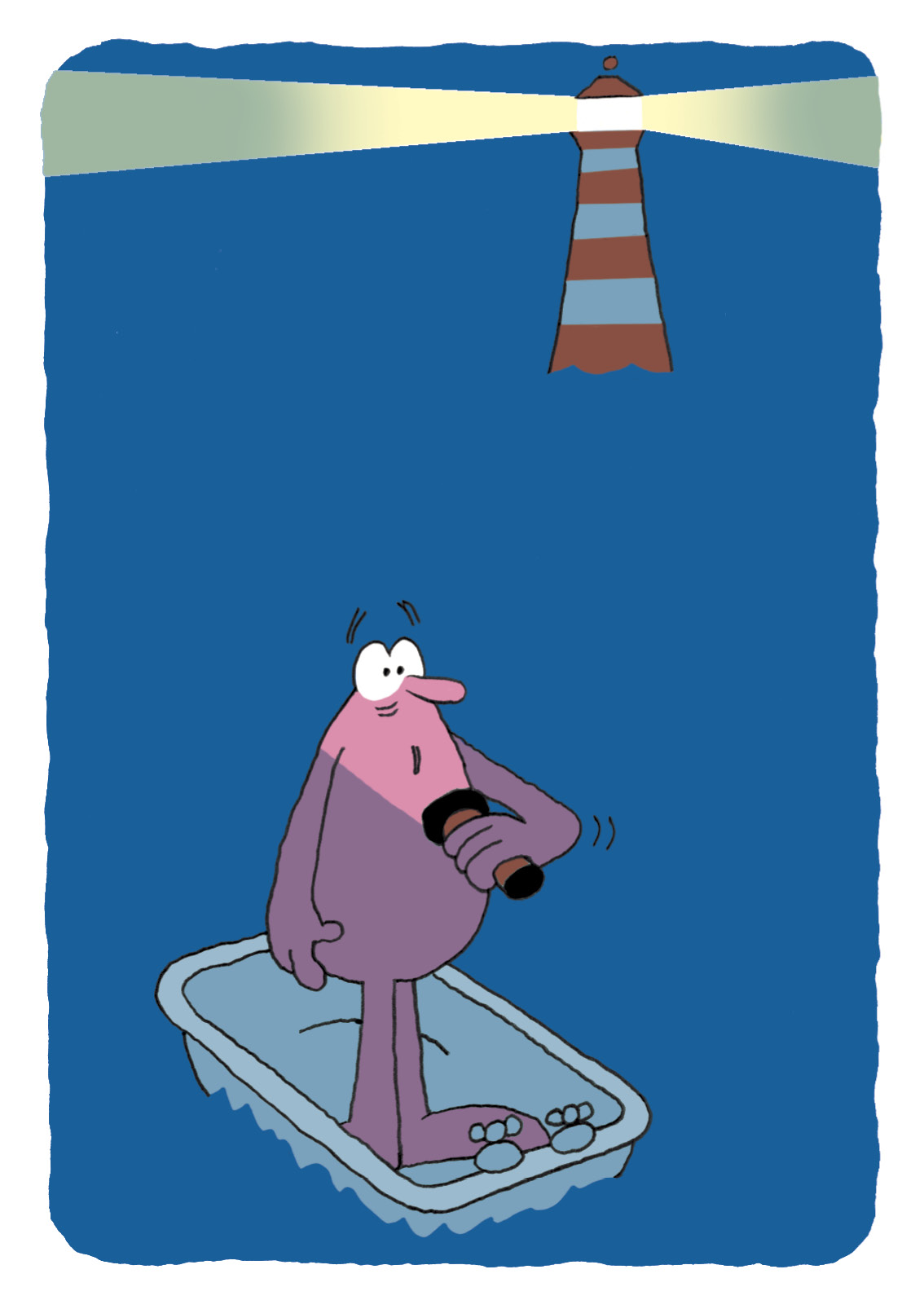
 nd Downs cards portray scenarios any bathtub sailor might experience. And if we want a metaphor reflecting ‘change’ we need look no further that the waves, weather and tides of the ocean. Ray Bowler’s deceptively simple card images depict many of our own responses to the ebb and flow of life.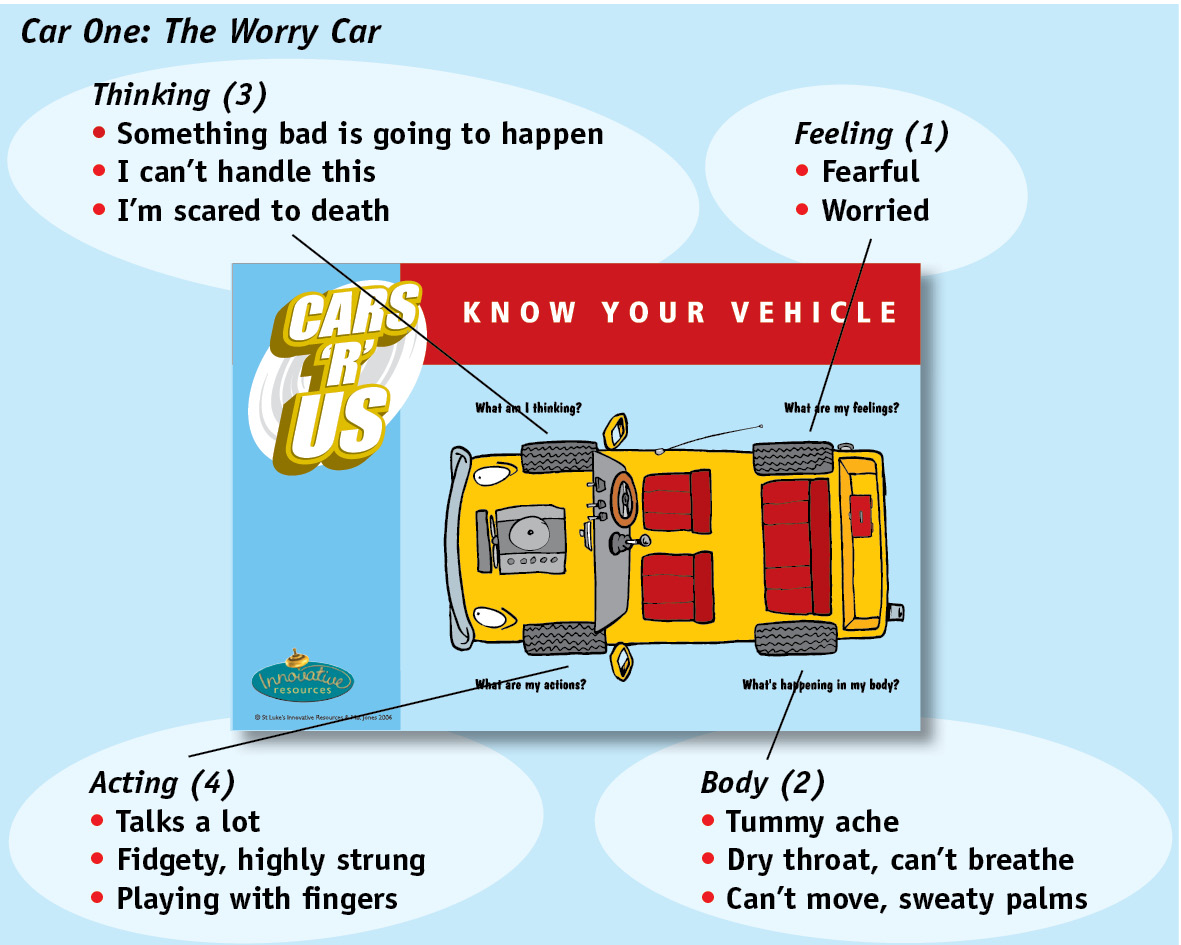

 ce can be traumatic but it can also be filled with creative possibility.