Join the conversation! SOON (Seriously Optimistic Online News) keeps you connected with everything Innovative Resources – subscribe today!

If your situation is urgent, you can contact these services 24-hours a day, 7 days a week

CLOSE (X)

Supporting students with the curveballs of life

In this article we talk to student counsellor, Jack Bornyan, about how he used The Nature of Strengths cards in his work with a secondary student. Jack is currently completing a Bachelor of Counselling and is on placement at a secondary college in Frankston, Australia. He says his role focusses on supporting students to ‘build their resilience, develop healthy coping mechanisms and create strategies for the curveballs of life (in and outside of school)’.

Jack recently entered a SOON competition and won a set of The Nature of Strengths cards. He added them to his growing collection, which includes The Bears, Strengths Cards and Body Signals.

Jack shared some insights about an activity he did using The Nature of Strengths cards with a student accessing counselling services.

‘I had the opportunity to use the cards with a student who was very proactive—he was open for suggestions on new ways to explore his mental health and make his journey easier.

‘I introduced the cards to the student and he was excited to begin. I asked if he could select six cards—that grabbed his attention. We proceeded with the session and card selection.’

Jack said he often finds that students engage more when he combines visual tools with verbal strategies. He also likes to encourage students to notice their strengths.

‘With the demographic that I work alongside, it is important to work with their strengths rather than their deficits as this supports their sense of autonomy. It also helps build a positive client/therapist relationship.’
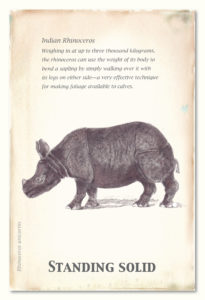
The first card the student chose was ‘Standing Solid’ (Indian Rhinoceros). Jack says this card really resonated with the student.

‘This particular young person holds his values and morals close to him and will stand up for those who cannot stand up for themselves. His needs are placed aside for that moment in time to ensure that the other person is looked after. This also extends to his family and is not just restricted to the school grounds.’

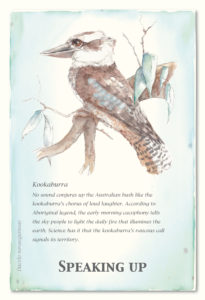
The second card the student chose was ‘Speaking Up’ (Kookaburra).

‘Speaking up is a strength that the student said he would like to develop. As much as he can speak up for those who need assistance, he often finds it difficult to speak up for himself. This is related to fear of judgement and the constant concern of how others are going to perceive him.’

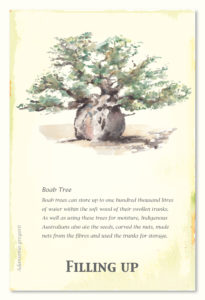
The student then picked ‘Filling Up’ (Boab Tree)—this card enabled Jack and the student to talk about emotions.

‘Bottling up emotions tightly inside is something that comes naturally to some of us as it is a defence mechanism to avoid being hurt or judged by others. Sometimes people wish for issues to disappear—they might ask Why do we have to speak about our problems all the time?

The student then chose two more cards – ‘Taking Time’ (Bristlecone Pine) and ‘Taking Care’ (Nile Crocodile).
‘For the student, these cards related to healing, showing our scars and the struggles that we have been through. We also talked about how it is important to practice self-care activities regularly to ensure that we are looking after ourselves, especially when you are someone who places the needs of other individuals before your own.’

Lastly, the student chose ‘Having A Heart’ (Spotted Hyena) which reflected his desire for people to treat each other with respect and dignity.

Jack said he was moved by a comment the student made towards the end of his placement—the student said he believed the world was full of cruelty but if we could teach everyone to be kinder, then everyone would be happier.

‘That closing statement from my client and the power of emotion behind it gave me shivers towards the end of our session.

‘This client has been on an amazing journey over the past six months. I have witnessed such growth and commend him for trying his best every session.
‘Even though he is exhausted, he is beginning to see the rewards of counselling—he has increased his toolbox of self-care techniques, changed how he responds in challenging situations, is much more skilled at initiating conversations and is better able to recognise and process negative and positive thinking patterns.

‘Thank you, St Luke’s Innovative Resources, for providing such amazing resources and ongoing guidance for a student counsellor like myself.’


The Nature of Strengths   

CAT NO: 4938

AUD $49.50


As we enter the holiday period, we are often inundated with marketing imagery showing happy families celebrating together and children opening an extravagant number of gifts.

This made me reflect on a Christmas Day two years ago that introduced me to the shadow side of the holiday season. I have a great relationship with my children’s mother; although we have not been together for a long time, we co-parent effectively and have always had our children’s best interests at the forefront of our planning and decision making. On this occasion, it was my ex-partner’s turn to have our kids for Christmas Day, so after a frantic opening of presents on Christmas morning, I found myself in an empty house before lunchtime, my Christmas effectively over after month’s of build up.

This was perhaps the loneliest day that I have ever gone through. Now, this feeling only lasted a few hours, but it allowed me to reflect on what it must be like for many people who go through this every year. They may be feeling social pressure to buy gifts they can’t afford or isolated because they can’t spend the holiday season with their children or other family members.
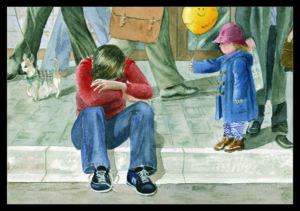
It brought to mind the Christmas table card from Shadows, a resource that I’ve always had an affinity with. This card shows an empty table with a setting for one laid out ready for Christmas Day. One of the reasons that the Shadows card set is my all-time favourite resource is that many of the cards depict scenes that resonate with me—they are scenes from my own life. I often use Shadows as a reflective tool as the images closely align with my reality.

For some people, Christmas can be filled with stress and anxiety instead of joy and happiness. At this time of year, or during any holiday period, it is important to be mindful of people in the community who might be on their own or who don’t have the means to live up to the pressures society places on them. In some situations, giving someone your time, your attention and your good will may not only improve a person’s life, but may even save it.

Compassion speaks all languages, is found in all religions and is completely free of charge.

-Chris Cain, Production and Marketing Manager, St Luke’s Innovative Resources


—using Reflexions and The Bears during a student placement

Recently we spoke to Crystal Gordois, a third year social work student on placement with Anglicare Victoria, who shared some reflections on her decision to become a social worker.  While on placement in the Home Based Care team, she discovered some of St Luke’s Innovative Resources’ card sets and had a go at using them with her team and with a carer she was working alongside.

Crystal says she made the decision to move from a career in early childhood to social work as she had a desire to support young people who were having a tough time.

‘I had a challenging childhood with quite a few family issues, and after working in the early learning field for some time, I began to feel that I could use my early life experiences to really help other young people who were going through similar experiences. So I made the decision to undertake a degree in Human Services and a Masters of Social Work at La Trobe University in Bendigo.

‘I was placed with the Home Based Care team at Anglicare Victoria in Bendigo. The thing I was most looking forward to on placement was seeing how my studies and all the theory translated to working in the field.

‘I was placed in a team of five and shared my time amongst them to get the most varied experiences that I could. I felt that this would give me the best chance of making the most of the experiences that were made available to me.’

The Home Based Care team supports children to live in a safe, secure and nurturing place while their family is unable to care for them. They work alongside both the children and carers.

Early in her placement, Crystal was introduced to St Luke’s Innovative Resources’ card sets.

‘I wasn’t previously aware of the resources, but I was quickly introduced to them by my team leader. My first experience was with a set of the Strength Cards—the team used these cards in their short team catch-up in the mornings called ‘Bump’, where each member of the team took a turn telling the group about their plans for the day, their challenges and if they required assistance.’

Crystal then took the opportunity to use the Reflexions cards herself and facilitated a conversation in a team meeting.  She hoped that by using the cards, the conversation would be enhanced and people would feel encouraged to share their thoughts and experiences more readily.

‘During Home Based Care team meetings everyone identifies a strength and a challenge that they have faced since the last team meeting. I thought this would be the perfect time to add another element and utilise some strengths-based cards.

‘I placed the Reflexions cards face up on a long table and asked everyone to choose two cards that represented their strengths and challenges for that fortnight. We then went around the circle and everyone expressed why they had chosen the cards they had and how these cards represented their strength and challenge.

‘Everyone engaged in this process and it sparked discussions among smaller groups about where else in their practice they could use the cards.’

While on placement, Crystal worked alongside a number of carers and children in care. During one meeting with a carer, she decided to use The Bears cards with the hope that they would lead to a more meaningful conversation.

‘I utilised The Bears cards in my first carer supervision. This took place in the carer’s home. I’d met the carer on a few occasions previously and had noted that they had a really positive sense of self and were very open to communicating about all areas of their life. I chose The Bears cards with the hope that they would allow for deeper conversations to take place and the carer would feel supported and heard.

‘I explained the idea of strengths-based practice and showed the cards to the carer, assuring them that there really was no right or wrong way of using them. The carer was happy with this and engaged well, choosing cards that they felt represented their feelings about their current circumstances.’

Crystal observed that the cards were also useful in sparking conversation between the carer and the child in her care.

‘A child in the care of this particular carer was also present. This added another element to our conversation as the child and carer discussed the question that had been asked and the carer asked the child what they thought. Both the carer and child then chose cards that they thought best reflected their answer to that particular question.’


—an interview with Steve Phillis,  social work educator and senior practitioner

The importance of creating pathways for young people to reconnect with school life in a positive way is reflected in the title of a community-based early intervention and prevention service simply called the ‘Reconnect Program’.

This program is for young people aged 12 to 18 years (or 12 to 21 years in the case of newly arrived youth) who are homeless or at risk of homelessness, and their families. Young people often come to the program needing support around a range of issues, including non-attendance at school, truancy, low self-esteem, and poor connections. Family issues may also be affecting a young person’s capacity to connect with school life.

Steve Phillis, formerly a senior Reconnect worker and family services manager, and now a social work educator at Bendigo TAFE said, ‘The Reconnect Program uses a solution-focussed approach that respects the young person’s uniqueness and complements the skills of that particular individual and their school, family and community.’

Steve recounts a story of how he carried a pack of Reflexions cards around with him so that he could experiment spontaneously with them as the opportunity arose.

Steve said, ‘I was working with a young person who had been falling behind in her work, had low self-esteem and few friends, and was now refusing to attend school. Our second visit occurred in her family home, together with her mum, dad and sister.

‘I scattered the cards on the floor of the lounge room and my first question was: Would you like to pick out three to five cards which may reflect how school is for you at the moment?’


OK Dad, pick a card!

‘The young person’s father showed a lot of interest in the cards, so I said; “OK Dad, pick out some cards that reflect how you feel at work!” This stimulated lots of discussion, broke down boundaries and really loosened us all up. Very soon the sister also picked out some cards. It was so great when this happened because it helped to normalise what the young person was going through.

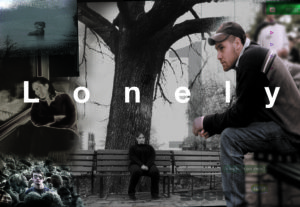
‘The young person then selected four cards that represented how she felt about school. She selected Frustrated, Different, Lonely and Sad. We placed these to one side in a column and then I asked her to think about the exceptions to these. Was there anything good or even a bit OK about school?

‘She then chose four more cards that reflected more positive moments (or even seconds!) at school. These were Easy Going, Excited, OK and Brave. We placed these in a column and talked about each of these little positive glimpses. We then returned to the first set of cards she had selected and explored these “negatives” for a while.’


Moving towards solutions

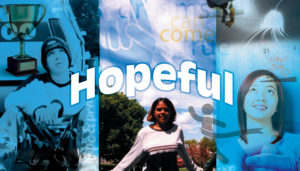
‘I then asked her to select cards that represented how she would like school to be. These cards framed the goal for our work together; they represented where we are heading. The three cards she selected were Happy, Hopeful and Fun.

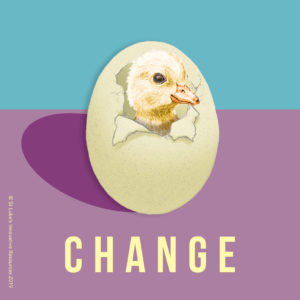
‘We placed these in a column also and then I asked her, “Can you see a card that will help you make a transition from here (indicating the first column) to here (the last column)?” She selected the Able to Change card. We then looked at concrete things that we could work on together to address the present frustrations, to foster more of the positive moments, and to build towards the final goals.

‘I really enjoyed the sense of connection with the whole family that arose through the process of working with the cards. And speaking of connection, there was an extra sense of fun when the young person in question recognised some of the faces shown on the Reflexions cards!’

If someone were to ask each of us what Christmas meant to us, we would probably all have a different answer. We might talk about Christmas trees covered in wonky decorations made by our children, the ‘shushed’ wrapping of presents late at night or Christmas mass at our local church. We might think of our childhood Christmases waking early to catch Santa leaving gifts, a big meal with family or backyard cricket on lazy afternoons. For some of us, Christmas is a spiritual and reflective time of year. For others, it’s a cultural holiday. For those of us who don’t celebrate Christmas, it’s just another day.

Chances are, however you celebrate Christmas, relationships with family and friends feature strongly.

While we often think of Christmas as a time of year when family and friends come together to enjoy each other’s company, in reality Christmas can also be a fraught time, with relationships tested and ‘normal’ life put on the back burner. Rushed last minute shopping, stretched bank balances, a turkey that’s too big for the oven and Uncle George’s uncanny ability to say exactly the wrong thing at the wrong time, can leave even the most patient among us feeling frazzled and irritable.

On top of the regular Christmas stress, Christmas can also be a time when we become acutely aware of the people who are not with us. There may have been a family separation, people living in different parts of the country or world, or someone may have passed away, leaving us with feelings of sadness, isolation, loneliness or a range of other emotions. While we like to think of Christmas as a joyous time of year, the reality can be a lot more complex


So how do we navigate all these relationships and stresses in a meaningful way?

In the months leading up to Christmas, it can be valuable to re-evaluate what is truly important to us and think about what is just ‘window dressing’.

Reducing stress

Being aware of the things that create stress or pressure before they happen can provide an opportunity to consider ways to do things differently. We are creatures of habit and sometimes we do things in a certain way because that’s the way it’s always been done—this is often the case with long-standing family traditions around holidays and celebrations.

When we’re feeling overwhelmed or pressured, it’s easy to transfer some of that stress and tension onto the people we care about, putting pressure on those relationships. By reducing our own stress, we are likely to reduce tension within our relationships also. It might be worth considering:

  • What self-imposed stresses could you remove?
  • What stresses or expectations come in on you from others? Can you reduce or remove some of these stresses?
  • Who are the most important people in your life? What simple things could you do to honour those relationships?
  • What are the pressure points for you at Christmas?
  • Who are you grateful for?
  • Is there something you are likely to feel sad or worried about this Christmas? How could you think about this differently? Who could help?
  • Do you have expectations of others at Christmas? Are these expectations helpful or necessary?

Valuing diversity

Families are often diverse. They can include people who have very different ideas about the world. And that’s without even including all the in-laws! When families get together, it can be a time of great reconnection and joy. But it can also be a time when different values and beliefs bump up against each other. Throw alcohol into the mix and things can heat up fairly quickly.

In my family as a kid, the arguments usually centred on Holdens v Fords, or which footy team was better. These were pretty artificial differences but they still caused sparks…and lots of arm waving.

So how do we manage clashing values and beliefs at Christmas?

Sometimes a good way to do this is to have a time in the day when people reflect on what they value about one another. This places the emphasis on what we have in common rather than our differences. At a certain point in the day, people could be invited to write down one thing they value about each person present. It could take the form of a ‘Secret Santa’ which focusses on what you value about the person.

Or you could ask everyone to commit to a ‘no judgement’ or ‘no criticism’ pact for the day. You could make it fun and include a consequence, like having to make a contribution to a swear jar or wearing a funny hat. If there are kids at your celebration, it can be great to involve them—kids love keeping the adults honest in games like these.

Creating new traditions

In the months leading up to Christmas, it can be worth taking some time to reflect on what a meaningful Christmas and festive season might look like for you and the people you care about. You might consider things like:

  • What do the people you care about value? How could you incorporate this into your celebrations?
  • What could you do that would be nurturing during the festive season?
  • Which of your current traditions serve you well? Which ones create stress and tension?
  • Imagine this was the best Christmas you’d even had. What happened? Who was there? How did you feel?
  • What’s one thing you could you do differently that would increase connection and appreciation?

Once the crazy Christmas push gets into full swing, we often lose the opportunity to reflect on these questions. Now is the time to ask yourself, how can I make sure this festive season is as stress-free, respectful and meaningful as possible for me and the people I care about?


Dr Sue King-Smith

It can be tempting to think that education begins when kids go to school, but in fact it is through play at home in the early years that the very foundations of life-long learning are laid. This is one of the foundations of the HIPPY program (Home Interaction Program for Parents and Youngsters); understanding that education doesn’t start at school, it starts from the day a child is born.

HIPPY is a two-year peer mentoring program that supports parents to become their ‘child’s first teacher’. The program is run in 100 sites across Australia and in 11 countries worldwide. It has a strong emphasis on play-based and place-based learning, encouraging parents to look for opportunities for learning in everyday situations. The tutors, who have previously been parents in the program, visit families in their home and role-model a range of activities parents can do with their child to support their early literacy and numeracy development. Parents and tutors also come together in group settings to do a range of activities to build social and emotional literacy.

In October, around 40 HIPPY tutors and co-ordinators came together to share their stories and experiences of parenting at the inaugural gathering of Victorian HIPPY tutors in Daylesford, Victoria.

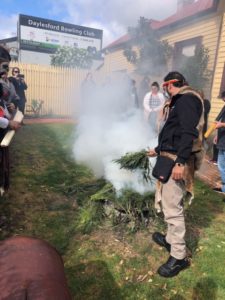
The day started with a Welcome to Country and a smoking ceremony by three traditional custodians of Dja Dja Wurrung country, the land on which we were meeting. It was a powerful and moving ceremony in which we were asked to think about the relationship of Australian First Nations peoples to each other, as well as our own relationship to the land.

Innovative Resource had the privilege of facilitating the first session of the gathering, a ‘Strengths Approach Principles and Tools’ mini workshop. Participants were invited to notice their own strengths and the strengths of others using Strengths Cards for Kids. While parenting can be incredibly rewarding, it can also include times of stress, isolation, uncertainty and frustration. Becoming a parent can also mean that many of the things we did before, like work or hobbies, are placed on hold. When this happens it can lead us to question our sense of identity. Taking some time out to notice what we do well, our strengths and personal qualities, our skills and knowledge, our relationships and culture—all the things we value in ourselves and others—can help bring perspective, enhance confidence and build parenting skills.

The conversation got underway very quickly when participants were asked to choose two cards that represented strengths they had as a child. Then they chose two cards for strengths they have now as adults. In pairs, each person spoke about the cards they chose, while their partner listened carefully to identify even more strengths in the person speaking.

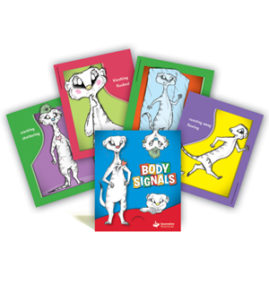
Participants then considered how they can support children through times of worry or anxiety, using the Body Signals cards and Anxiety Solutions for Kids. As HIPPY has a strong emphasis on supporting children in the year before they start school and their first year of school, the tutors spent time thinking about some strategies to support children through this transition to school.

To finish, the tutors shared stories about parenting using the Positive Parenting and Everyday Strengths. They also discussed how HIPPY is an inherently strengths-based program, with its focus on supporting parents to be positive role models in their child’s learning. Judging by the lively conversations, many stories were shared and strengths were noticed.

To find out more about the HIPPY program, visit the HIPPY Australia or HIPPY International websites.


• Accept a gift from a client?

• Drink alcohol or smoke with a client?

•Acknowledge a client if you see them in public?

• Encourage a client to lie in order to access a service or benefit?

• Connect with a client on social media?

• Ask a client to sign a petition?

You may be able to answer some of these questions with a resounding ‘No!’ Others may cause you to waver, and still others may not pose a problem at all.

While every human service profession is governed by the laws of the land and has its own policies and codes of conduct, there are many greys areas that pose ethical dilemmas.  When there are no absolute right or wrong answers, where do you draw the boundaries?

Walking the Boundaries is a unique tool for building reflective practice. Through a single sentence starter, ‘Would you ever …?’ this resource shines a light on the assumptions and latent values that shape our practice. Each of the 80 cards opens up discussion regarding appropriate ethical responses to an everyday dilemma. The diverse responses that emerge reflect the profession, the organisation, the role, the experiences and the personal values of each participant. 


‘The perfect tool for building critical reflection’– Dr Fiona Gardner, La Trobe University, Bendigo, Australia


Walking the Boundaries has been successfully used in team meetings, planning days and organisational culture building. The cards have also been used in one-on-one supervision, mentoring and coaching as a window into critical reflection and practice development. They are a great tool for students of social work and any human service teaching course. Also great for staff inductions.

Simply place the cards face down on a table and allow participants to choose one card at a time … and watch the conversation unfold. Is there consensus? Is there a firm belief? Is there a rule? Can you be unequivocal? Are there exceptions? How much depends on the role you are in?


80 full-colour, laminated cards, 105mm x 120mm
Polypropylene box with 44-page booklet


Over five hundred delegates gathered in Brisbane late last month for the Asia Pacific Rim Confederation of Counsellors Conference. Bringing together a dizzying array of speakers and workshop presenters, the conference aimed to build the capacity of practitioners in mental health services. Topics included complex trauma, eating disorders, couples counselling, prolonged grief, and Indigenous approaches to counselling and psychotherapy, to name but a few.

One of the keynote speakers, Catherine Tang from the National University of Singapore, presented data on behaviour addictions across Asian countries, including gaming and internet.

Fiona McCallum from the University of Queensland spoke about Complex Persistent Bereavement Disorder (CPBD). She began by pointing out that grief is a normal part of the human experience and not an illness. While most of us greatly appreciate support when we are grieving, we don’t need ‘treatment’. However, she said it is estimated that over 40,000 people in Australia are living with levels of bereavement distress that meet the criteria for CPBD.

Melati Sumari from the University of Malaya in Kuala Lumpur discussed the results of a study on culturally-appropriate assessment for Malaysian families. The study aimed at producing a family functioning scale.

Tristan Lesley Snell from Monash University painted a picture of the impact of urban living, pointing out that for the first time in human history, the largest proportion of our population lives in urban environments. He said that studies repeatedly highlight the stressors associated with urban living including physical threats, pollution, noise and traffic. Tristan discussed the findings of a global study on the impacts of urban living on adult mental health and personality. Results indicated that exposure to specific environments in childhood can predict personality traits in adulthood. He also offered some ideas for how counsellors might support people to adapt to the stressors of contemporary urban environments using psychoeducation as well as targetting specific emotions and coping strategies.

Incorporating the latest information about how the brain responds to trauma was a common thread that wove its way through many of the workshops and presentations. And in terms of new frontiers for counselling, Lizzy Bilogrevic from Multicultural Aged Care Services in Geelong, Australia, posed the question: Is the aged care sector the next frontier for counselling? Lizzy said that personal carers make up 80% of the aged care workforce and that stressors on these workers are mounting relentlessly. She spoke of the disparity between staff training and the complex needs of people accessing aged care services. She also raised some of the shadow aspects of elder abuse scrutiny, and called for reflection on how this affects culturally and linguistically diverse consumers and workers. It’s a no-brainer that meeting the complex needs of our aging population requires investment in therapeutic support for staff as well as people accessing services.


Reading body signals is crucial for protective behaviours, trauma-informed practice or simply navigating  everyday life

A resource for hearing and validating before shifting the focus to recovery.


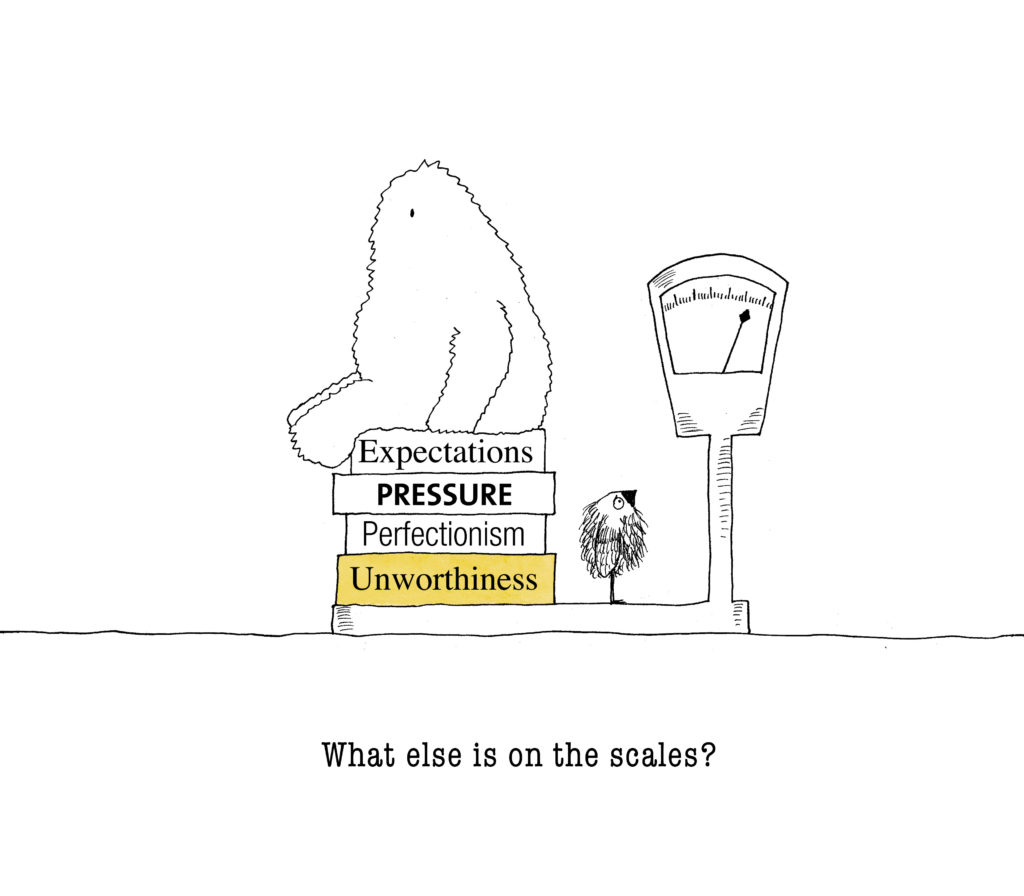
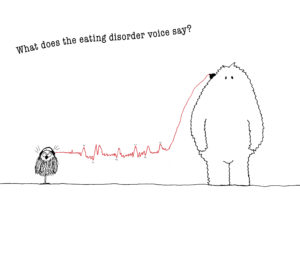
What does it feel like to live with an eating disorder? What does the ‘eating disorder voice’ say and how do we challenge those messages? What supports recovery and what gets in the way? How can we help reduce the isolation and shame surrounding eating disorders?

These are some of the questions that are guiding the current development of a set of cards called Eating Disorders & Other Shadowy Companions.  Due for release early next year, this resource is for people living with an eating disorder and those who walk alongside them—family, friends, counsellors, teachers and health professionals.

The lead author is Danni McDougall, an art therapist and senior mental health practitioner.

‘Many people say that having an eating disorder is like being stuck in a prison of your own mind that feels impossible to get out of. I believe that this experience needs to be heard and validated before the focus can shift to recovery,’ says Danni.
‘An eating disorder is an illness, like a broken leg. No-one feels shame about breaking a leg or how long it takes to heal. In creating these cards I wanted to open up conversations about what it’s like to have an eating disorder, and challenge some of the isolation and shame that people living with eating disorders often feel.’

The artist for these cards, Fiona Mansfield, has brought to life three characters to help express the breadth and depth of living with an eating disorder. You will meet Ed, the Eating Disorder Monster. Ed is not demonised for this character came into being to serve a purpose, but now causes havoc and takes up way too much space. You will also meet Reggie, the Recovery Rhino. Reggie is larger than life too. More than up to the task, Reggie is a steadfast source of nurturing and solace. And at the centre of it all is Bird. Bird is you, me, your brother or sister, mother or father, friend or colleague. Bird is the one living with an eating disorder.

These three quirky characters are accompanied by a question on every card to gently open up hopeful possibilities, if they are wanted.
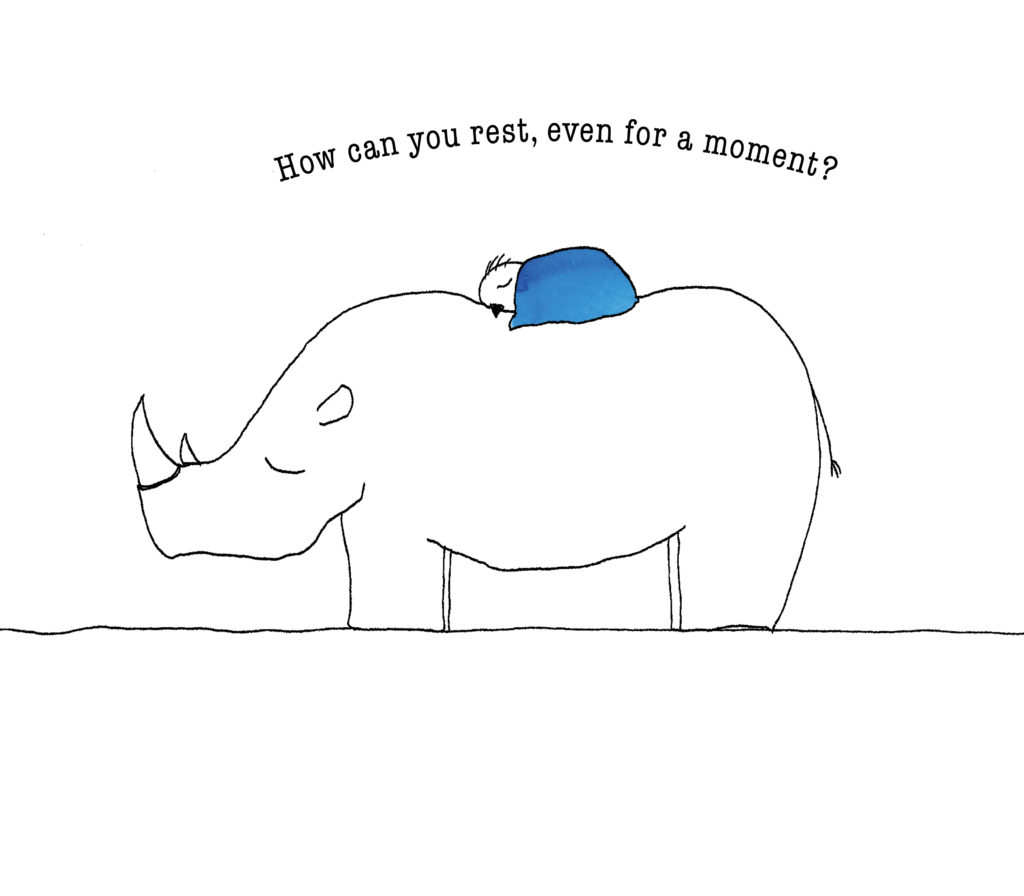
Because these cards depict what happens in our mind and lives when we are under pressure, they can also be used to describe living with other ‘shadowy companions’ like addiction, depression and anxiety.

We will let you know when Eating Disorders & Other Shadowy Companions is nearing release.


When it comes to emotions, body signals or moods, it is easy to assume that we feel one thing at a time. But even a cursory look inside ourselves using our amazing super power of ‘interoception’ (that’s our ability to notice what’s happening inside us), reveals that we are often—maybe always—experiencing several emotions or internal signals at once. And sometimes they seem contradictory.

At times of transition such as changing jobs, travelling overseas, moving house or beginning a new relationship, we may feel excited and scared. When someone dies, especially after a long illness, we may experience a mixture of sadness and relief. During times of deep grief we can shock ourselves and scandalise others by flipping into a moment of black humour.

We can easily feel that we have one foot on the brake and the other on the accelerator when we experience a clash of two values such as planning carefully and acting spontaneously.  And haven’t you ever felt ok and not ok at the same time? Coping and not coping? Finding your life both significant and insignificant? Perceiving time as going by in a flash and at a snail’s pace—all at the same time?

The ‘rub’ that is created by two seemingly opposing perceptions is sometimes called ‘cognitive dissonance’, but it does not always need resolution one way or the other.  This play of opposites can have great resonance for us therapeutically (and spiritually). The ability to hold a paradox, and accommodate two or more differing emotions at the same time, are hallmarks of social and emotional maturity. Somehow, these seemingly opposing forces generate a beneficial heat that can open our perception to new possibilities and fresh ways of thinking. It is certainly the ‘blow your mind’ territory of Zen koans.

When people come to counselling or other human services such as social work, they are often in a kind of ‘liminal’ state—betwixt and between. Sometimes this is excruciatingly difficult. Something is no longer working but the new circumstances or way of being has not yet arrived. There is an internal (and often external) swirl of dissonance. In any therapeutic setting there is nearly always something to let go of and something to hold onto. This can be a good starting point for exploring the opposites at play, and visual resources can be supportive in this.

Facilitators may notice that some cards in The Nature of Strengths form a natural pair because the phrases on them seem to be opposites. For example: ‘Blending In’ and ‘Standing Out’; ‘Holding On’ and ‘Letting Go’; ‘Standing Solid’ and ‘Walking on Air’;  ‘Listening Well’ and ‘Speaking Out’, ‘Taking Care’ and ‘Taking Chances’; ‘Warming up’ and Chilling Out’.

Conversation starters might include:

  • Choose two cards that represent ‘opposite’ strengths to you. Can you share a story about a time when you used each of these strengths?
  • How do these two strengths support each other? Oppose each other? Are they really opposites?
  • How do you know when to use each of these strengths? What happens when you do one of these behaviours while excluding the other?
  • How do you know when you have the balance right?
  • Which of these strengths do you think your family, school, organisation, community or culture favours? Which ones are not valued as much? Are any seen as ‘weaknesses’?
  • Have you ever deliberately decided to change from one strength to the opposite?
  • Thinking of a challenge, decision or an upcoming project, how could you apply both of these strengths? Will one be more useful to you than the other at this time? Or can you find a blend of both?
  • Is one of these strengths easier for you than the other? How could you learn to strengthen the one you need most at this time, even if it’s difficult?
  • Who do you know who does this well? Can you learn from what they do?
  • Will people be surprised to see you using this strength? What will they notice?
  • What is one step you can take today?

By Karen Bedford

Green Sea Turtle

Using her hind flippers, the female buries up to two hundred eggs in the sand. After about two months, the hatchlings emerge and scamper across the sand, taking their chances on reaching the ocean as gulls and crabs prey on them.

How sweet are some people?

Just when I think that the world is heading towards the dumpster and we have politicians who overlook those less fortunate, my faith in humankind is regenerated.

I was interstate at a conference and had arranged to meet up with some long-term friends who I often don’t see for years at a time. During the evening we talked about many things, but one conversation was about the professions and qualifications of many taxi and Uber drivers. Our drivers are often highly qualified doctors in their countries of origin but have to pay high costs and pass difficult exams in order for their qualifications to be recognised in Australia. (I’m not against setting high standards for our medical professionals, but I do wonder about the high cost of accreditation when we have so many communities that have no doctor available.)

I caught a taxi out to my friends’ family home and the driver gave me his number to call when I was ready to be picked up and taken back to my hotel. It was about a thirty minute trip so we had plenty of time to talk. In thinking about the conversation we had over dinner, I asked him what he did when he wasn’t driving. He is a student in business. His mother, whom he is very close to and misses dearly, convinced him to leave Pakistan and study in Australia—to build a ‘better life’ for himself.

There are many who take that leap of faith and come to Australia for a ‘better life’. It reminds me of the Nature of Strengths card set—specifically the green sea turtle who buries her eggs, leaving the hatchlings to take a chance at making it safely to water. Much like my taxi driver’s mother who cast him out into the world, with the very best of intentions.

We talked about opportunities for employment post his studies and I asked him what he would do if money was no object. I was blown away and very endeared by his response.

He said he would work to remove poverty so that everyone had food and shelter, and equal opportunity for success. He was very passionate and very serious about it and this led to a conversation about the kind of leaders we need in the world today.

He has no idea where he will work when his studies are completed or what opportunities might open up for him, but I really hope that he—and

people who share his ambition for a fairer, more equal society—get to achieve their goals—that their ‘taking chances’ pays off.


Georgena Stuckenschmidt


Money? Happiness? Love? To be that special person in someone’s life or to have that special someone? There are lots of things we would like more of but isn’t RESPECT at the top of the list when we consider an intimate partner relationship?

Intimate partner violence is about power and control. It’s about how we touch, talk and treat each other. It can show up in our attitudes to such things as gender, sex, finances, friends, culture, family, freedom, decision-making and roles. That’s why…

There are ten ‘domains’ in Innovative Resources’ No Room for Family Violence cards, representing key indicators of abusive or respectful behaviour within intimate partner relationships. While these domains are not necessarily the only areas where power and control can play out, they have consistently been identified as important arenas of intimate partner violence. The ten domains are:

  • Communication
  • Decisions
  • Equality
  • Finances
  • Freedom
  • Honesty
  • Other people
  • Safety
  • Sexuality
  • Turning points.

There are three cards in each domain: ‘What I want MORE of’, ‘What CONCERNS me’, and ‘What I want NONE of’.

The MORE suit (green) names behaviours and qualities that help build strong and respectful relationships. Each card in this suit features the heading: ‘What I want MORE of’. People can interpret this in a variety of ways. For example, they may want something that has never been present in their relationship, or that used to be present but has disappeared and they would like it again, or it may be something that is going really well already and they want it to continue. A respectful relationship is not simply the absence of abuse; this suit names some key things that would be happening instead.

Introducing the MORE suit (green) to a young person who is considering an intimate partner relationship can be of benefit.

That is because these cards name respectful behaviours and encourage people to talk about what they want in a relationship.

Starting with the MORE suit enables the conversation to focus on what the person’s preferred ‘picture of the future’ looks like and what their expectations of a relationship are. It can also help them to notice when they or their partner are not being respectful, and the strengths and resources they can draw on to help them respond effectively.

This strengths-based, solution-focused approach helps people explore their hopes and vision for how they would like things to be.

A family services practitioner observed:

When trialling the No Room for Family Violence cards, one woman explained she could not find anything in the green cards that she had in her relationship, and this realisation was a catalyst to her ending the relationship.

By helping young people explore the domains of a respectful relationship they are better informed of what they want MORE of, what CONCERNS them, and what they want NONE of in a respectful relationship — but it will empower them to establish the kind or relationship they want.