Join the conversation! SOON (Seriously Optimistic Online News) keeps you connected with everything Innovative Resources – subscribe today!

If your situation is urgent, you can contact these services 24-hours a day, 7 days a week

CLOSE (X)

The Power of Vulnerability and Trust in the Classroom

Lillian Daley, a Grade 6 teacher in Darwin—the capital city of Australia’s Northern Territory—writes about the power of vulnerability and trust in the classroom.

I first came across Innovative Resources when I was a pre-service teacher completing a placement at a school for disengaged youth in Bendigo, Australia. During a session designed to build female empowerment and self-esteem, we used the Deep Speak cards with a group of about 15 girls. Each student selected a card and answered the question. This process continued around the circle a few times, with staff and pre-service teachers joining in and responding.
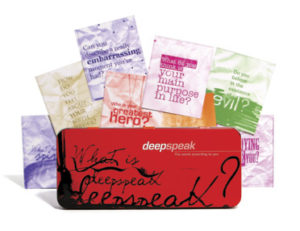
To date, this has been one of the most powerful teaching situations I’ve ever been part of. I felt extremely vulnerable sharing my response to some of the questions, but at the same time, very privileged that the students felt safe enough to share some of their perspectives with me. I also really valued getting to know the other staff on a deeper level. After this session, I felt I had a stronger connection with the girls and the staff involved. It will forever be such a special opportunity for me.

Supporting respectful discussions in upper primary

I’ve just started using Deep Speak with my Grade 6 class this year (mostly 12-year-olds). Prior to starting any activity with the cards, we discuss some ground rules and behavioural expectations such as the right to pass, one voice speaking at a time, what is said in the circle stays in the circle, names only in a positive way, confidentiality and respect. We revisit these each time we use the cards.

We go round the circle with each student turning over a card and considering their response. Students can also return their card and select another one, if they wish. I leave the depth of response up to them. Some answer the question literally in one sentence, whereas others go into a deeper reflection. I think the students really appreciate hearing my honest answers to the questions; this often gives them the confidence and trust to replicate it themselves when it’s their turn.

Noticing strengths warms the heart

I also use Strength Cards®  to help students identify assets within themselves and others. Generally, the students sit in a circle with the cards spread out on the floor, face up. I invite the students to consider a strength they have or would like to have, and share why they chose that card.
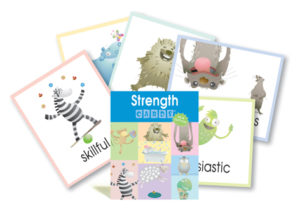
The first few times we use these cards, I take my turn first to model a potential response for the students, but they quickly get the hang of it. Sometimes, if students find it difficult to identify strengths within themselves, I will ask them to select a card for the person beside them. Again, sharing why they selected the card often results in rich conversation. It’s also a confidence boost for the student the card was selected for. Other students often chime in with different strengths they have noticed within that student. It warms my heart when I see them trying hard to hold in their happiness and smiles as the positive comments flow.

Different kinds of conversations

In the school day there is a huge emphasis on academics and related skills, and I think the students simply enjoy taking a break from that, using the cards to develop their social and emotional strengths. They enjoy the honest conversations we have, especially as lots of the topics would not have been brought up otherwise.

They’re different kinds of conversations, with the students feeling safe and secure about asking a whole range of questions.

I often use the Strength Cards® in the first few weeks of the year as an introductory activity. I revisit them every 2—3 weeks, changing the activity each time. Generally, there is lots of excitement when the cards are used for the first time, but regular use gives the students an opportunity to use the vocabulary in an appropriate context.

Building strong relationships with your students

I don’t introduce Deep Speak until the end of Term 2 or the start of Term 3, when I feel I have a fairly solid understanding of each student and their background. This is important as some of the cards include challenging topics that are inappropriate for this age group. I remove some of the cards first to avoid anything that could be triggering for the students.

If a student has a negative response to a question or discussion, I always follow it up with them afterwards, starting with a casual chat and going from there, if need be. Circle Time should always be a positive, safe and inclusive experience, and I work really hard with the students to develop that space.

Basically, having a strong relationship with your students is a huge advantage when using the cards. It will facilitate deeper conversations and assist with strengthening the trust between you.

Lillian has developed a resource called PDme , a website where educators, but especially those working rural and remote, can access timely and relevant Professional Development (PD).

#strengthsatschool

Thinking of ourselves as a car can be a very useful thing to do. Clean and green with zero emissions, of course. Or maybe not. Depends on the fuel you are putting in your tank, the junk in the trunk, the road you take and who is behind the wheel.

Inspired by Choice Theory, Reality Therapy and strengths-based ideas, Cars ‘R’ Us is a conversation-building card set written by Russell Deal and Ivan Honey, and first published by Innovative Resources in 2006. And now in 2019 it is about to go into its umpteenth re-print. You could say it’s a classic model. One reason for this is that the car metaphor is so accessible to everyone—young and old—licensed or on your learner’s plates.

Whether or not you can see evidence of burn outs (highly likely if you are a human service practitioner), Cars ‘R’ Us is a very useful tool for exploring feelings, making choices and setting goals.

Where am I heading?

How will I get there?

Who is in the driver’s seat?

Is it time for the accelerator or the brake?

Here is an inspiring story of how Joan Hoogstad, an instructor with the William Glasser Institute and a certified counsellor at the time Cars ‘R’ Us was first published, used the car metaphor in a primary school to empower children to make good choices and behave safely in the playground.

  • Joan built on the car metaphor by creating a drawing of a roundabout with radiating roads complete with stop signs, speed limits and other desired features.
  • She explained to children that we drive a car around all the time.
  • We choose the cars we drive—our behaviours. (Children can choose their car using the Cars ‘R’ Us cards.)
  • We have a preference for certain cars (behaviours). These become our habits.
  • When we allow others to control us, we are giving them the key to our car. You can ask the child, ‘Who is driving your car?’, ‘Is that what you want?’ and ‘What can you do to drive your own car again?’
  • Joan tells children that feelings are our friends because they tell us that our behaviour is either working well or not working so well.
  • There is nothing wrong with being in any car (or having any feeling). However, the stop sign reminds us that, at times, we need to stop and consider whether driving this particular car is the best way of managing the situation.
  • Similarly, when we reach the stop sign, we need to stop and become aware of the feelings, consider where these feelings may take us, and if necessary, take a U-turn back to the roundabout.
  • When ready, we can select another car that will work better for us.
  • When children say that another child told them to act a certain way (for example, leaving the school grounds to collect a ball) the teacher’s response could be: ‘Do you mean that you need a back seat driver?’, ‘When someone tells you what to do, how can you remain in charge of your own car? Or with very young children, ‘How can you remain the boss of your car?’
  • At playtime, she tells the children, ‘There will be 300 cars in the playground. What might happen?’ The children always say, ‘There could be crashes!’
  • The children in the class talk about what is required to be a skilful and safe driver in the playground, which leads to discussion and practice of social skills (also known as driving lessons!).

The use of the behaviour car model is limited only by our imagination.

[Adapted from the booklet for Cars ‘R’ Us.]

My name is Monique Beglinger and I am a psychologist based in Sydney, Australia. I currently work in two primary schools and one high school across Western Sydney. Prior to this I worked in child protection, out-of-home care, intensive family support, disability support and domestic violence. So overall, I have been in the human service industry for over ten years.

Working with children, adolescents and parents, I utilise many modalities including cognitive behaviour therapy, acceptance and commitment therapy, dialectical behaviour therapy, solution-focused brief therapy as well as art and play therapy, to name just a few. All my work is attachment- and trauma-informed.

I first came across St Luke’s Innovative Resources whilst working in a child protection intensive family support program in 2012. The first resource I ever purchased was a card set called The Bears. From there I bought a barrage of St Luke’s resources—you can never have too many, right?! (I have shared all of these on my Instagram page @the_mindful_psychologist.)

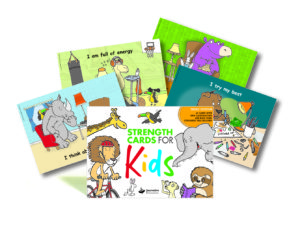
About 2 years ago I started using the Strength Cards ® for Kids 3rd Edition and just love this card deck! I really enjoy using these cards because the focus is positively geared. In therapy, it is easy to focus on what is not going well and on problem-solving solutions. These cards help provide a visual cue for children to recognise their strengths—a task that can be extremely difficult for many to do.

I work with children and teens impacted by a variety of presenting problems such as complex developmental trauma, anxiety, depression, bullying, peer conflict, complex family dynamics, self-harming, suicidal ideation … and the list goes on. We know from research that trauma shapes the way children see the world, often not having trust in adults and holding negative views of themselves. This can lead to children being unable to identify and verbalise any quality in themselves that they see as a strength.

This is when utilising the Strength Cards as a practical and tangible tool to help guide identification of personal strengths is helpful. I had a student who for a long time held a deep negative self-evaluation, however when I introduced these cards they were able to select one single card of a strength they recognised. This was significant progress after months of work!

I consider the work I do a privilege and an honour. Children, teenagers and families share deeply sacred stories with me and I’m lucky enough to witness transformation on a very personal level. Each small step is progress and I enjoy being able to use the engaging and creative resources from St Luke’s in my work.

By Monique Beglinger


#bearcards #strengths

On Wednesday 29 May 2019, St Luke’s Innovative Resources and the Bendigo Reconciliation Committee hosted a forum on organisational white privilege. The forum was facilitated by Andrew Shirres (Practice Development Coach, St Luke’s Innovative Resources) and John Bonnice (Co-Chair, Bendigo Reconciliation Committee).

The forum was conducted as part of the reconciliation activities in Bendigo during Reconciliation Week. Over 30 staff from 12 organisations attended the forum. A wide range of organisations participated including agencies from the health sector, community welfare, early years services, family violence, community legal services and also State Government Departments (Human Services and Education).

The aim of the forum was to enable non-Aboriginal agencies to explore the issue of organisational white privilege and their understanding of its impact on the relationship and work between Aboriginal and non-Aboriginal people and agencies. The session took the form of a facilitated conversation using the Bendigo Reconciliation Committee’s document Identifying and Addressing Organisational White Privilege as the basis for discussion.

The session focussed on the following areas:

  • Reflection on the main tenets of white mainstream culture, the benefits received from this culture, and areas of mainstream culture that impact on Aboriginal and Torres Strait Islander people
  • Reflection on nature and benefits of white privilege with a focus on organisational white privilege
  • Reflection on how white privilege influences professional practice and the impact of organisational white privilege
  • Identifying the barriers and opportunities for change that would enable organisations to become more culturally-safe and competent
  • Future areas of action by mainstream organisations.

Discussions during the forum highlighted the following:

  • Organisational white privilege has not been on the radar of mainstream organisations
  • There is a need for greater reflection by mainstream organisations on the nature of organisational white privilege
  • Organisations are not aware of the cultural bias that they operate from, and the impact this has on the relationship and work with Aboriginal and Torres Strait Islander people
  • Organisations need to look at their values, beliefs and attitudes
  • Organisations need to rethink their approach to reconciliation and partnership work with Aboriginal and Torres Strait Islander people and communities. Indeed, the starting point may need to be reflection on the cultural bias and covert racism that organisations are operating from.

The discussion highlighted a range of actions that the organisations present at the forum could do in the future to address organisational white privilege. These included:

  • The need for reflection on organisational white privilege to occur across the whole of an organisation
  • The need for organisations to rethink their approach to reconciliation action plans with the need for addressing organisational white privilege as a key component of them
  • The need for organisations to highlight and name unconscious bias and covert racism
  • The need for organisations to challenge current thinking and approaches to partnership work with Aboriginal and Torres Strait Islander people and agencies.

In summary, the forum highlighted how much work needs to be done by organisations in addressing organisational white privilege and the current lack of thinking on this issue.

For further information on the resource Identifying and Addressing Organisational White Privilege and how your organisation may start on the journey of reflecting on organisational white privilege please contact John Bonnice.

Sometimes little fish need to speak up about treating people respectfully, especially in sporting and after work environments.

Here is an example of a recent experience shared with me—similar to the ‘drinks after work scenario’ we have seen on television, where a man’s colleagues challenged his behaviour towards his partner on the phone. Such examples are great because they play a part in the mammoth task of holding people to account for behaviour that is no longer acceptable as ‘the norm’.

The scene: End of year cricket bus trip—away for the weekend.

A girlfriend calls her cricketing boyfriend on her way home—just like she does every evening. The phone gets passed around the bus and all the cricketers, in a jolly frame of mind, contribute to the phone conversation. All good so far, until the phone makes its way to the coach (big fish), where the conversation is ended abruptly with the comment, ‘We don’t talk to partners when we are on a bus trip,’ and rudely hangs up.

The girlfriend is feeling very much like the ‘little fish’, and ponders for a while, speaks to a few close friends and then, in point form, responds to this behaviour. The boyfriend and fellow cricketers support her response, but she hears nothing back from the coach.

Two weeks later: It’s the cricket club awards night, and again the girlfriend is feeling very much like the ‘little fish’, and she is nervous about seeing the coach. (She has scripted a number of responses in her head.) On entering the venue, the coach makes a direct line straight to the girlfriend. He apologies for his behaviour and asks for her forgiveness. He approaches her several times throughout the evening to reiterate his apology, in front of his peers, family and friends. The other cricketers watch his behaviour and also show their support for the girlfriend. So the ‘little fish’ is promoted to ‘big fish’, and the ‘big fish’ has stepped up in displaying respectful behaviour.

It is a shame that people have to experience disrespect in the first place, and then the anxiety that comes from standing up to the ‘big fish’ in order to make change happen. But aren’t we so very fortunate to have so many brave ‘little fish’ out there? Let’s hope that as a society we can learn to all swim together—as a school of fish, where there are no ‘big fish’ and no ‘small fish’.

‘Respectful behaviour’ is a term that is talked about more and more, and St Luke’s Innovative Resources has several resources that encourage conversations about feelings, mateship, respect and relationships.

The fish metaphor is expanded further in the set of cards called Funky Fish Feelings. You will notice an observer (called Phar-Lap, the seahorse) on every card, making it easier for a person to externalise and speak about their feelings in less confrontational ways.

Similarly, Respectful Relationships illustrates the various strengths and bumps in relationships—like ‘We celebrate’ and ‘We have our moments’, and is a great way for families and children to talk about their relationships at home, in the school-ground, or in any group activity.

And, in reference to the story above, No Room for Family Violence is a resource that could be used in sporting groups to really stimulate conversations around what is respectful behaviour in a relationship, and can start with ‘Want I want more of’ and lead into conversations about ‘What I want none of’.

Georgena Stuckenschmidt

You could say that social and emotional literacy is the heroic journey from the amygdala to the frontal lobe. A very short distance when measured in terms of the physical brain but a life-long journey in terms of developing impulse control, building respectful relationships, developing our principles and values, and reaching our full potential as human beings — emotionally, socially and spiritually.

While developing social and emotional literacy is life-long learning, the foundations are best laid in early childhood—defined by UNESCO as birth to eight—when remarkable learning is taking place and brain development is at its peak.  Young children are highly influenced by the people and environment around them. The early years is when stereotypes relating to gender, race and class are laid down. Children begin to internalise concepts about their own and others’ potential, role and place in life. They tune into power dynamics and mirror the language, behaviours and attitudes of the significant adults around them.

With the guidance of caring adults, children can begin developing a vocabulary for recognising and speaking about emotions and body signals. And all going well, they can begin developing empathy for others and an internal locus of control, appropriate for their age.

So how might we define social and emotional literacy?

Traditional meaning of ‘literacy’

The word ‘literacy’ used in the traditional sense implies being able to read and write at a certain level of proficiency. It includes being able to recognise, interpret and create letters, words and sentences appropriate to age. It means internalising the give and take of human communication, and the sounds and rhythms of a particular language. It means having a basic grasp of ‘the rules’ of written, verbal and visual language.

What a complex set of skills for a child to develop!

Emotional literacy

But what does ‘emotional literacy’ mean?  Drawing on the definition of ‘literacy’ above, it implies a certain level of skill in ‘reading’ emotions—recognising and interpreting our own feelings and those of others, at a level appropriate for age. It implies learning about the rhythms of emotions—in other words, learning some skills for navigating the ups and downs of emotions at play within one’s self.  It is about learning to manage the powerful pull of what we want and don’t want, and negotiating with others as we bump up against their needs and wants.

Social literacy

Similarly, ‘social literacy’ implies a level of skill in being able to form respectful relationships. It implies learning about the give and take of interacting with others. It includes the delicate, delightful and sometimes very painful dance of sharing with others and allowing them to be ‘real’ to us—beyond stereotypes and labels and beyond simply being a means to fulfill our own needs.

Clearly social and emotional literacy can continue being built throughout our lifetime. Perhaps a hallmark of remaining vibrant and youthful at heart even as we age, is having the courage and humility to stay in the space of continuous learning about feelings and relationships, knowing this kind of literacy is never ‘done and dusted’. But for parents and early years educators in particular, having some tools up their sleeve for building social and emotional literacy with young children can help lay the foundations for resilience and connectedness – qualities and skills that will serve them and others for the rest of their lives.

Karen Bedford

Managing Editor – St Luke’s Innovative Resources


Interested in learning more?

Tools for Building Social & Emotional Literacy in the Early Years


As a social worker, I have been taught I need to practise self-care as this will assist me to continue to help others. Whilst I agree that self-care does have this function, I feel like the self gets lost in this explanation since the primary focus is the benefit of others, with the benefit of the self being a somewhat secondary gain. I think self-care needs to be reframed with the self at the centre, and continuing to help others as the secondary gain. This may sound selfish, however, in order to be truly effective I think self-care needs to be self-focussed. This does not mean it cannot include others, as connection is likely to be an important ingredient in self-care practice. Nor does it mean becoming selfish as it is not necessary or even possible to practise self-care 24/7. During self-care practice I think there is a need to put aside the focus on the other, and for this time, to focus on oneself as human services is hard work, and takes a toll on the body and mind.

Keeping this different explanation of self-care in mind and challenging myself to keep the focus on my own needs, I allowed myself time to use the Self-Care Cards for Home & Work with this focus rather than my original thought of using them to help others. In time, I will do that, however, as I navigate some challenges in life and listen to myself, I know I need time with these cards before I can share them with others.

Mostly, I simply selected cards randomly, and what this gave me was a combination of feeling seen, understood and connected.

Creativity sustains me and when I randomly selected this card it reminded me to prioritise it. This can be challenging after a stressful day and this card helped me remember that creativity does not have to take a long time to be effective. Making my own daily cards or doing some stick figure drawings can be enough.
Looking at the hands drawing in this card also helped me feel relaxed as I was able to imagine how it felt in my body when I was creative. It also helped me feel connected because I was not alone in my need for creativity.


The card I chose whilst writing this piece, ‘Food’, is a loaded, complicated topic for me, and this card gave me a laugh. One of the things I enjoy about using these cards is the fact that it is up to me what I do with the card I select. For example, I have chosen to laugh at my selection, experience the humour and lightness in my body, enjoy the moment … and leave it there. I could also ask myself the questions on the back of the card, namely, ‘What role does food play in your life?’ and ‘Would you like to change your eating habits?’ to take this topic further, if that would be useful to me.

Another thing using these cards gave me was permission to be human, permission to be impacted and to honour the strength required in my work. In human services work, I think there is a risk that workers can be judged, criticised and seen as ‘not coping’ if they experience vicarious trauma or burnout. I wonder if the judgement comes from wanting to distance ourselves from colleagues who are suffering to avoid the reality that we too can suffer? There is still much stigma in society when it comes to mental health, including the mental health and vicarious trauma of human service workers. What these cards do for me is hold up a different perspective, like a mirror, and communicate that it is all right to be human and I am deserving of self-care.

This is my creative response to how these cards supported me in being kind to myself; giving myself space to focus on my needs and self-care practice, and putting the needs of others aside for a time, even though that may feel challenging and ‘selfish’.

And as I said, in time I will use these cards with others in my work, such as colleagues and families, to open up discussions about their self-care needs. When I do that I will remember what I needed; permission to focus on myself, with the needs of the self at the centre. I will give this same permission to people I discuss self-care with, giving them space to think of what they need whilst putting the needs of others aside during their self-care practice.

By Danni McDougall, senior practitioner and art therapist.

Davys and Beddoe, authors of Best Practice in Professional Supervision: A Guide for the Helping Professions (2010: Jessica Kingsley Publishers, London), suggest that strengths-based approaches to supervision are different to an hierarchical and managerial model of supervision where the supervisor is perceived as the ‘expert’, who imparts their wisdom and knowledge to the practitioner or supervisee.  Strengths-based supervision is:

essentially a ‘way of being’ with supervisees where attention is given to power ‘with’ rather than power ‘over’, and the environment is such that both supervisor and supervisee contribute their expertise to the relationship’ (p.38).

This approach does not reject or deny the supervisor’s professional knowledge, but instead, acknowledges and prioritises the expertise of the supervisee or practitioner. Advocates of the strengths approach like Davys and Beddoe believe that highlighting the expertise of supervisees ‘facilitates supervisees to find solutions within themselves based on their existing strengths and prior positive experiences’ (p. 46).

Wayne McCashen, author of The Strengths Approach, offers the following definition of strengths-based supervision:

Strengths-based supervision can be defined as a process of shared responsibility for supporting the work of employees in ways that are respectful, inclusive, collaborative, empowering, socially-just and build potential. It is a process in which two or more people work with one another to assist learning, provide support and manage all that is necessary for good practice. It involves parallel practice in order to integrate the principles, processes and skills of the strengths approach (2017: p.216)

McCashen’s definition highlights some of the key underlying principles of strengths-based supervision.

Key principles of a strengths approach to supervision

The strengths approach to supervision has a focus on three key principles:

  • shared responsibility
  • shared learning
  • shared leadership

In this supervisory model, all people involved in the supervisory relationship take responsibility for organising, structuring and determining the purpose of supervision. They also share responsibility for the outcomes that result from their decisions.

Strengths-based supervision is a model where all parties learn and grow. It is a process that recognises that both the supervisor and practitioner bring a range of skills and knowledge to the table, and they also have many things to learn. The process of reflecting on practice and exploring different ways to approach challenges builds the capacity and insight of both the supervisor and practitioner.

As the strengths approach encourages practitioners to find their own solutions to challenges, rather than just doing what they are advised by their supervisor, they are simultaneously developing skills they can share with others.

By Sue King-Smith from Stepping into Supervision: A Strengths Approach online course.


To explore how these three principles manifest in practice, and to ‘Step into Supervision’ enroll in our online strengths-based supervision course.

And

Take a look at our supervision card set, designed for supervisors and supervisees to practice supervision in a strengths-based, solution-focussed way. Great for individual or group supervision, and team meetings.

Those who choose to work in human services are often well-equipped, not only to do their jobs, but to do their jobs well. Those in leadership roles endeavour to provide them with frameworks, procedures, infrastructure, leadership, professional development, teams and resources intended to support them in their support of others.

As well, a human service worker usually has the internal resources that make them the best person for the job at hand, whether it be through personal experience of the issues they help others with, their world view or deep-seated values and beliefs about people’s rights, strengths and capacities.

While implementation of human services programs will always remain contentious (such as staffing and funding levels, changing social policy), the overall aim is to ensure that the right people have the right resources to do the right job.

They need these resources too (whether they be externally provided or internally sourced) for the job at hand can be stressful, confronting and emotionally charged. Human services workers can find themselves working with people who are at turning points in their lives—young people leaving care, children moving into foster care or people experiencing a mental illness or family violence, losing a job or ending a relationship.

How is it then—even in those cases where staffing levels are ok, where training needs are observed and provided, where buildings and office spaces are purpose built, where everyone has the latest IT and equipment, where one-on-one supervision is offered—high attrition rates, stress, burnout and vicarious trauma still exist?

When taking a break isn’t enough

‘Physician heal thyself’ has long been a mantra for anyone working in the ‘people industries’. We know that as much attention must be paid to looking after ourselves as is paid to supporting others. We also know the value of overt ‘parallel practice’ and that we must apply the same principles of practice (respecting rights to self-determination, using and demonstrating empathy) as much to our organisations as to the people our organisations support. If we ask someone to take care of themselves, we should do that too.

Consequently, and thankfully, worker self-care is not a new concept in human services. Workers are often asked how they are ‘going’, encouraged to take a break or leave the office for a while. It is no longer so strange when someone says they took a ‘mental health day off’. Self-care even manages to sneak onto supervision agendas, down there … at the bottom … if there is time.

In my role as a practice development coach and trainer in strengths-based practice, and particularly when it comes to a strengths approach to supervision, I meet with teams of workers from organisations across the country. It is fair to say that even where organisations have strong team cultures and strong supervision practices, self-care is usually given short shrift. I’ll often ask if anyone has a formal self-care plan or has attended any self-care training. Usually the answer is, ‘No’.

Plenty of informal self-care plans exist and when I ask what is included in them, the answers usually relate to taking a break, using annual leave, attending gyms, having a bath after getting home, going for a walk, having a glass (or two) of wine or catching up with friends.

We can think also of the need for rest, sleep, using the right medications, getting out into nature, relaxation, eating and drinking what helps, as part of a self-care plan.

While all of these are very important, and can be valid self-care strategies, I would argue that they alone will do little to lower the incidences of stress, burnout, compassion fatigue or vicarious trauma that are so prevalent in the human services industry. This is because each of these strategies sits ‘outside’ of the work we do.

Looking ‘inside’ work

Real, effective, self-care plans need to look ‘inside’ the work we do. They need to include strategies that relate to the work being done and the people who are doing it, such as a commitment to reflective practice. Just as vicarious trauma can be a ‘transformative’ experience, where we are ‘changed’, usually for the worst, by our experience of the problems faced by the people we support (Saakvitne & Pearlman,1996), we need to see how an experience of work can be also be transformative in a way that benefits us and helps us cope. We can explore what work might do for us, how it gives us meaning, how it is supported by, strengthens and affirms our values and beliefs, what we share with others and how it fulfils our sense of community.

In this way, when formulating a self-care plan, as well as thinking about non-work related activities, we need to also ask ourselves questions that focus more on how practice itself can be the basis of what serves us to be able to cope with what we see, hear and feel every day.

We can ask ourselves questions such as:

  • Who or what gives me energy? Who energises me?
  • What purpose does my work serve for me?
  • How does my work enrich my life or that of others?
  • How do I feel when I reflect upon my practice?
  • What benefit is there in having conversations on practice with others?
  • Have I got enough space for reflecting on practice in my working day?
  • What work habits support me?
  • Do I have enough time to celebrate successes within my work?
  • Where do I find meaning within my work?
  • Who supports me?
  • How does my workplace culture contribute to my well-being?
  • What am I curious about? What more do I need to learn?

The more we associate self-care purely with non-work related activities the more we will see work as uniquely a contributor to stress, burnout and even vicarious trauma. Finding self-care strategies within our work enables us to focus less on creating conscious or unconscious boundaries between work and us, and more on creating meaningful connections between our practice and our well-being.

Andrew Shirres – Practice Development Coach

References:

Pearlman and McKay (2008). Understanding and addressing vicarious trauma. The Best Start Resource Center: When Compassion Hurts https://resources.beststart.org/product/j13e-when-compassion-hurts-manual/

https://resources.beststart.org/wp-content/uploads/2019/01/J13-E.pdf

Saakvitne, K. W., & Pearlman, L. A. and the Staff of the Traumatic Stress Institute (1996). Transforming the pain: A workbook on vicarious traumatization. London. New York: W. W. Norton.


As a child, did you ever pick up a stone, rub your wet thumb over its surface to reveal the colours, feel the satisfying heft and shape of it in your palm, and then carry it around in your pocket? Before long, you may have forgotten about it, lost it or discarded it. Or you may have put it on a window sill where the light could catch its pattern or colours, or you may have placed it on the floor where it could hold a door open or closed with its weighty yet humble presence.

Perhaps you wanted to keep a particular small stone because you could see an expression, a creature, a character hidden in its contours. That stone may even have become a reminder of a particular person, time, place or dream—a talisman, a touchstone.

Stones play such an iconic role in human life. They are used in art, games, gardens, buildings. They are carved, shaped and stacked. They are imbued with stories, meaning, healing powers and identity. Perhaps this is why stones and stone metaphors can be so useful in educational and therapeutic settings.

The following ideas are based on a range of classroom activities developed by an early primary teacher using stones and the stone metaphor. Her intention was to create a program of activities that would celebrate diversity and build empathy and inclusion.

To begin with the class read The Wrong Stone, a much-loved picture book by Russell Deal featuring an odd-shaped stone who thought he would not be chosen for a place in the wall because … he was the ‘wrong’ stone.

 But then, miracle of miracles … the stonemason picked him up! ‘I’ve been saving you for the perfect spot,’ he said. ‘It’s your job to keep the whole wall together.’ The wrong stone had become the very right stone.

The book ends with a heroic double-page spread revealing the whole wall made up of different stones, of various shapes and colours (some look oddly like people or objects you know).

  • During and after reading the picture book the teacher focussed the discussion on the various feelings that the wrong stone experienced. Why did he feel worried? What did he think about the other stones? What did he think about himself? When do you feel this way? How does it feel in your body? What helps most when you feel this way? What was he feeling at the end of the story? Have you ever felt this way? What was it like?
  • Then the discussion can naturally shift to noticing what others may be feeling. Have you ever noticed someone feeling left out, perhaps feeling like they are a ‘wrong stone’? How do you know they are feeling that way? What could you do to help include them or help them feel better?
  • The teacher then drew a very simple wall with a variety of interconnecting stones. (This could be drawn by hand or on the computer.) She made copies of this template and cut out the shapes to create paper jigsaws.
  • In small groups, the children assembled and illustrated their jigsaw wall, depicting different people and things that are all part of their school.
  • This activity is a way of discussing inclusion and diversity. You could do it using other illustrations on the stone wall, such as different plants that make up an eco-system, different ingredients in a meal, different strengths or skills that people contribute in their classroom or school.
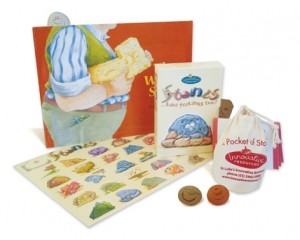
  • This activity could be further developed using A Pocket of Stones—a set of 12 ceramic heads in a calico pouch. Each stone shows a face depicting an emotion—sad, happy, scared, and so on.
  • Or you could use Stones … have feelings too! a set of 52 cards with fun stone characters expressing a wide range of emotions. There are possible words for the emotions on the back of the cards for building vocabularies for talking about feelings.
  • The class could reflect on and discuss emotions using some of the cards or the 12 ceramic stone heads. What is each stone feeling? How do you know? Have you ever felt this way? What does your body feel like when you are feeling this emotion?
  • The class could then go outside and each find a few stones to bring back inside and paint with various emotions.
  • Or they could find a single stone to represent themselves and write their name on it, or they could paint a symbol of themselves on their stone (such as a skateboard, horse, football or something else they like).
  • All the stones could then be arranged on a table as a collage of a stone wall where every stone has its place.
  • Each day the stones could be moved around so each stone has a turn in different places in the wall—making sure no stone is ever left out and each stone has a turn as the ‘key stone’ keeping the whole wall together—just like the very right stone!

(The Wrong Stone, A Pocket of Stones, and Stones … have feelings too! cards and stickers are available as part of the Stones bundle)


Picture this: You are in a room with your extended family. It might be a celebratory lunch, a special birthday, Christmas dinner, or some other festive occasion. And yet, it’s not quite as exhilarating, and definitely not like it ‘used’ to be. The children are all young adults now, forging out careers and living independent lives with their chosen partners. Of course, it’s always nice to catch up, but the excitement of young children and the connectedness you once had have morphed into something new and different.

So, what can you do? You can feel sadness and mourn the closeness that once was—always knowing that the foundations and closeness you built over many years are ready to be tapped into when needed. Or you can start a journey of discovery and explore what your ‘picture of the future’ might be. Sometimes, letting go of the past can make way for the joy and excitement of what’s to come.

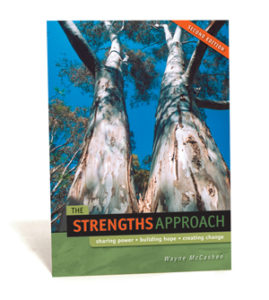
When working with people in human services, Wayne McCashen, author of The Strengths Approach (expanded second edition 2017) discusses developing a ‘Picture of the Future’.

‘Developing a picture of the future helps people get in touch with and describe their aspirations. It consists of two inter-related processes:

  1. Exploring future possibilities and ways of being (exploring aspirations, hopes and dreams)
  1. Developing concrete description of what people will be doing/what will be happening when the problem no longer exists (setting goals).

The picture of the future is people’s vision of what they want things to be like. It’s a description of what will be happening when the issues are resolved, including how they’ll be feeling and what they’ll be doing. This provides a meaningful context for change efforts. The picture of the future (people’s values and aspirations) becomes a point of reference or theme for setting goals. Goal setting is the process of describing (and recording), in specific and concrete terms, the desired outcomes that arise from the picture of the future.

Questions for developing a picture of the future

 Questions that assume positive change are characteristic of questions that help develop a picture of the future. Some questions for developing a picture of the future might include:

  • What do you want to be different?
  • What do you want to be happening instead?
  • How will that make a difference?
  • What are your hopes?
  • What do you want for yourself and your life?
  • What do you really value in life?
  • How would you be feeling if these issues were not in your life?
  • What would you be doing that would help you to feel this way?
  • What would others be doing?
  • If you could change one thing what would it be?
  • If there were a miracle and things were different what would you be doing?’ (pp 126, 127)

Going back to the ‘picture this’ scenario we started with, maybe asking yourself even a few of the questions above can help in moving through this, or any other, phase of your life. Strengths-based practitioners know that focussing on the picture of the future is a valuable approach when working with others, but it’s helpful to remember that a strengths approach to our own life’s stages and foibles can work for us as well.

The Strengths Approach book (second edition) and Picture This photographic cards, together, can provide a practice framework and a practical tool to help all of us discover our ‘picture of the future’.

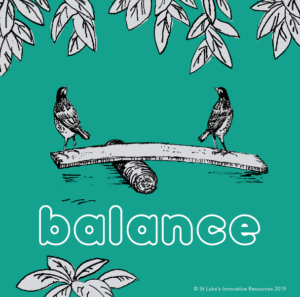
In our work, regardless of the industry, we often find ourselves being pulled one way and another … both at the same time. How do we look after ourselves so that we don’t ‘snap’ in half?

Maybe it’s about balance.

Whilst looking through the Self-Care Cards for Home and Work, a new resource soon to be released by St Luke’s Innovative Resources, I couldn’t help but think of both my daughters who are beginning very different careers, and the challenges they have learned to conquer in relation to Giving, Receiving and Balance at work.

One daughter is very clever with digital marketing, and in her first twelve months she has become the ‘go to’ person in the marketing agency for all questions around digital marketing campaigns for numerous business clients. She became so overwhelmed by sorting issues that had come up for everyone else that she was staying late to finish her own work. Then her frustration and fatigue boiled over and she became grumpy towards her colleagues at work.

After considering concepts of giving and receiving, she developed strategies to help the team move forward in a more productive and positive way. As an example, she now meets with everyone first thing each morning, making sure each person is clear on what they are to do, and where the day’s priorities lie. In this way, she is giving them guidance at the start of each day.

In return, she lets them know in advance, when her ‘non-contact’ time is. In other words, she allocates a period of time each day were she is not to be interrupted, and can get her own work done. In this way, she is receiving from her colleagues some clear time to get through her duties for the day.

What my daughter has achieved in the workplace is a balance between her needs and those of her colleagues.

My other daughter works in a very busy pharmacy, and in her role of dispensing medication, she gives and receives information all day. Sometimes the information she has to give is not what customers want to hear, and so she often receives insults and verbal abuse that can be hard to take. Of course, this is balanced with the times when she gives and receives useful and complimentary comments, reinforcing why she has chosen this particular career path.

Over the last twelve months I have seen my daughter grow in her ability to not carry the insults and negativity shown by some customers. She has learnt to look for the balance in her work, and to reflect on how she has been able to help people, within the legal and compliance framework that she is bound to operate within.

In a social work setting we often hear about vicarious trauma, where the difficulties faced by clients becomes a burden on the worker’s shoulders. Time away from work or professional help may be required to maintain self-care and separate ‘self’ from the circumstances of others.

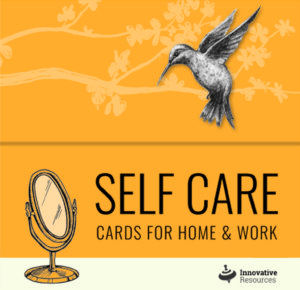
Self-Care Cards for Work and Home has been developed for workplaces and individuals to start conversations about self-care, including questions on managing elements like balance. Social workers and other human services professionals have been forefront in the mind of the Innovative Resources editorial team throughout the whole design and development process.

We hope that this resource, beautifully-illustrated with original art, will help you, your team and your organisation to appreciate the importance of self-care, and take action … both at work and at home.

Georgena Stuckenschmidt


What is your self-care strategy, at work or at home?
Please share it with us and our readers.