Join the conversation! SOON (Seriously Optimistic Online News) keeps you connected with everything Innovative Resources – subscribe today!

If your situation is urgent, you can contact these services 24-hours a day, 7 days a week

CLOSE (X)

Choosing Strengths

The profound and very simple belief at the core of strengths-based practice is that everyone has strengths. What are our strengths and where do they come from? These two questions have fascinated philosophers, psychologists and everyday thinkers for centuries.

At first glance many of us tend to think of strengths as personality traits that we inherit or learn as we journey through life. These certainly are great strengths, but that is not the sum total of our strengths. Our qualities, capacities, relationships, actions, values, stories, experiences, skills and material resources can all be strengths as well. The ‘strengths approach’ holds that all of these strengths are our greatest assets to call on for making the most of the ups and downs of everyday life.

Fundamental to the use of strengths as catalysts for change is the concept of freedom: freedom to choose. In fact, we can also think of our strengths as the choices we make. While things are constantly happening in our lives (much of which may be beyond our control), we are still able to make choices about what we think and how we behave.

Choosing Strengths is a set of 32 cards from Innovative Resources in the rich tradition of strengths-based conversation-building tools. The Choosing Strengths cards are powerful reminders that our use of strengths is in our own hands. We can choose to adopt for ourselves any number of strengths from a huge array of possibilities.

Notwithstanding the significance of conditioning, our environment and our genetic makeup, we remain a species for whom choice gives meaning. Choosing Strengths clearly puts the responsibility of ‘making meaning’ back onto each of us. While events will always happen, it is our choice as to how we make sense of these events. We are not victims of circumstances even though it is easy to attribute events as the causes of our thinking, feeling and behaviour.

Viktor Frankl writes in his book Man’s Search for Meaning:

‘Everything can be taken from a man [sic] but one thing: the last of his human freedoms – to choose one’s attitude in any given set of circumstances – to choose one’s own way.’

Many readers will know that Viktor Frankl was imprisoned by the Nazis and lost his wife and all other family members in the German concentration camps. But for Frankl it was the very denial of so many choices in his internment that led to his discovery of his ultimate and immutable choice: who he actually WAS.

‘When we are no longer able to change a situation, we are challenged to change ourselves,’ he writes.

It was Frankl, Rollo May, and others, who developed ‘Existential Therapy’ which has influenced all humanistic psychology including the work of William Glasser who went on to expound his own theories of human behaviour in Reality Therapy and Choice Theory.

Thinking about strengths as being available for choice can be very liberating. One does not have to feel trapped in any limited repertoire of strengths, there are many to choose from. Neither does one have to feel oppressed by fatalism. Choosing strengths is a long way from feeling like one is merely a parcel of knee-jerk reactions.



Some situations can be particularly strong triggers for anxious thoughts and feelings in children such as on the way to kinder or school and when the parent leaves (separation anxiety) or when a routine is interrupted (such as a change of teacher), or in social situations such as birthday parties, or when a child is away from home such as on excursions and school camps.

Children express their anxious feelings in different ways, for example, some children may become quiet and withdrawn, and others may become loud, angry or agitated. As a parent you can become very skilled at noticing the signs that your child is beginning to feel worried, and you may find it very helpful to have some mindful, relaxing, distracting or soothing activities already in place in the daily routine.

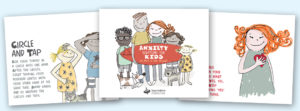
Using Anxiety Solutions for Kids cards, encourage your child to select a card each day or week, preferably around the same time of the day. (It may be overwhelming to put out all the cards so you may want to select four or five for the child to choose from.) Doing it regularly helps develop a habit and an expectation—a calm, fun time where you do something together which changes the focus and teaches the skills of self-soothing. It could be a time when the child is most likely to feel anxious or unsettled in the day, such as just before bed. Complete the activity on the card together.

After the activity, you can discuss with your child how you could do it in a different way. For example:

  • The Colour of Calm: What about the sound of calm? The smell of calm? The feel of calm? Can you find a crayon or paint colour that best matches your calm colour?
  • The Feel of Fabric: How else can you explore the fabric with your senses? Smell it? Feel it with your feet? What is your favourite piece of clothing or fabric to touch or wear (for example, a favourite pair of socks, a pillowcase, a soft toy, an old shirt, a mohair blanket)?
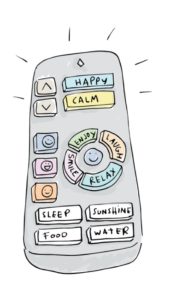
  • Remote Control: Draw or make out of cardboard your own remote control to ‘dial down’ worry and ‘dial up’ calm? What buttons would be on your remote control for your body and brain?

Always ask your child for their ideas first and give them a go!

Other activities for children include:

  • Choose your three favourite cards. What do you like about them?
  • Can you make up your own names for these cards and draw your own pictures?
  • Choose cards for things you have done before. When did you do these things? Who with? Did you like doing them? Do you still do them? If you have stopped, are there any activities you would like to start doing again?
  • Choose cards showing things you have never done before. Can you be a scientist and conduct an experiment to try them out? See how you feel while doing each of these the activities or just after! (Parents can support them in trying something new by doing the activity with them, if the child wants that.)

Parents can also place a relevant card in a child’s lunchbox, or on their pillow, or on a noticeboard as a gentle reminder. Try the ‘Better Than Before’ card. This activity is great for children who may find it hard to name something they are good at, but they may be much more able to name things they are; ‘better at than before.’ This helps them see that they are learning and growing all the time. Also, ‘Being Me’ is a very good card for those children who may be feeling anxious about being different. This activity encourages children to celebrate their own uniqueness and be inclusive of others’ differences as well.

Even though Anxiety Solutions for Kids cards have been designed with kids in mind, many of the strategies for managing anxiety are essentially the same for adults, so you may want to do these activities alongside your children, or pick some to do later in your own time!


Children thrive when their strengths are valued. Often, the weight of a ‘problem’ can lift considerably when we think of it as a strength yet to be developed. For these reasons many family counsellors, welfare coordinators and support workers encourage parents and carers to reflect on the importance of noticing children’s strengths. Questions to explore include:

  • What are the child’s strengths?
  • What difference might it make if I name them?
  • Am I in the habit of celebrating the strengths of the children around me?
  • How do the child’s strengths make a positive difference to us all?
  • Do I celebrate my own strengths?

 Strengths: Past, Present and Future

Try using Strengths Cards for Kids. Begin by spreading the cards out. Invite people to pick cards using questions such as:

  • When you were a child, what strengths do you think you had?
  • Who noticed these strengths in you? Did you have strengths that others didn’t see?
  • What strengths did your parents/teachers/siblings think you had?
  • Are these strengths important to you now?
  • Which strengths have you built on over time? How did that happen?
  • Think of someone you admire. What strengths do you see in them?
  • Which strengths do you want to role model for your own children?
  • Think of someone else in your family or team. What strengths do you see in them?

Random Selection for Adults

There are endless creative ways to create random choice. For example, you can spread the cards out face down and people can simply choose cards at random; someone can shuffle the deck of cards and deal one or more cards to each person; or the cards can be placed in a bag or basket to create a ‘lucky dip’; or a card can be placed on each person’s seat before they enter the room. Questions like the following can then be asked:

  • What do these strengths mean to you?
  • What other words could describe these strengths?
  • How do these cards relate to your life at present?
  • How significant do you think these strengths are?
  • Do they relate to each other in any way?
  • Can you think of situations where you have used these strengths recently?
  • Do you know someone who is particularly good at these strengths?

Strengths Sitting Behind Difficulties

When the going gets tough with a child’s behaviour, it can be easy to lose touch with the strengths of that child. Especially during challenging times, parents (and teachers) may end up seeing only the problem.

They may forget the person that the child is and the strengths that they have. Questions such as the following can be useful:

  • What was your child like when they were younger? Pick 2 cards for strengths you saw in them then. Can you share some examples of how they showed this strength?
  • Think about good times you have had as a family in the past. Pick a strength for every family member and talk about what you see in them.
  • Think of a child in your life whose behaviour you find difficult (if you are a teacher the child may be in your class). Pick a card for a strength that may sit behind that behaviour. Does this change how you see the behaviour, or will react to it?
  • How might you acknowledge this strength openly with them and help them to express that strength in other ways?

When the Boat Tips Over

Sometimes there is a point at which things get out of balance and a strength tips over into a difficulty. For example, tidiness may be a wonderful strength, but it can also tip over into obsessiveness or rigid control. Questions such as the following can be useful for reflecting on change, discussing challenging behaviour and developing interpersonal skills:

  • Do any of your strengths ever get you into trouble?
  • Have you ever felt that you have lost touch with a strength you used to have?
  • Do you use some strengths more than others?
  • Has anyone ever criticised a strength of yours? Were their comments useful?
  • Are there other strengths that could help you keep a strength from going overboard?
  • How might you bring balance when you think one of your strengths is dominating too much?
  • Do you sometimes feel you have lost strengths you used to have? Have they really gone?
  • How might you bring them out again?

Who Can Find the Toucan? You Can!

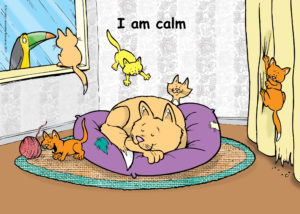
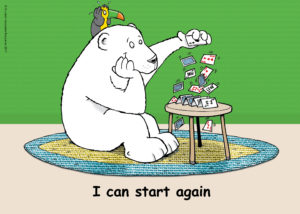
Can you find the toucan in every card? The toucan observes the action from the sidelines or from the air or even from the other side of the window. The toucan’s expressions and behaviour are responsive to what is happening in each picture. The toucan is an ‘observer character’—a witness—and he or she has an important job. The toucan watches what is going on and represents an extra voice or alternative viewpoint that can be brought into the conversation. It is a voice that has a more detached perspective than the characters participating directly in the scene. You can ask:

  • What is the toucan thinking?
  • What is the toucan noticing?
  • What would the toucan say is happening in the situation?
  • What would the toucan want you to notice?
  • What would the toucan say you should do?
  • If you were the toucan, what would you say to all the other animals in the scene?

From the booklet accompanying ‘Strengths Cards for Kids


The first week in July is NAIDOC Week here in Australia—a time dedicated to celebrating Aboriginal and Torres Strait Islander history, culture and achievements. This year (2017) the celebrations are entitled Our Languages Matter and they are focussed on the unique and essential role that Indigenous languages play in cultural identity, linking people through story and song to their land, water, history, spirituality and rites.

Some 250 distinct Indigenous language groups covered the continent at first (significant) European contact in the late eighteenth century. Most of these languages would have had several dialects, so that the total number of named varieties would have run to many hundreds.

Today only around 120 of those languages are still spoken and many are at risk of being lost as Elders pass on.

National NAIDOC Committee Co-Chair Anne Martin said, ’Aboriginal and Torres Strait languages are not just a means of communication, they express knowledge about everything: law, geography, history, family and human relationships, philosophy, religion, anatomy, childcare, health, caring for country, astronomy, biology and food. Each language is associated with an area of land and has a deep spiritual significance and it is through their own languages, that Indigenous nations maintain their connection with their ancestors, land and law.’

Committee Co-Chair Benjamin Mitchell hopes that the theme will shine a spotlight on the programs and community groups working to preserve, revitalise or record Indigenous languages, and encourage all Australians to notice the use of Indigenous languages in their community.

‘Nationally, many place names for our suburbs, rivers, mountains and parks are Indigenous language words. Noticing and paying attention to these words will generate greater appreciation and respect for the significance of language among all Australians. The preservation and revitalisation of the Aboriginal and Torres Strait Islander languages – the original languages of this nation – is the preservation of priceless treasure, not just for Indigenous peoples, but for everyone.’

Wherever you live in the world, NAIDOC Week in Australia is a powerful invitation to notice, celebrate and preserve the rich heritage of Indigenous languages of the country you inhabit.


Innovative Resources has had the privilege of collaborating with SNAICC in the production of Talking Up Our Strengths, a resource that celebrates the strengths and resilience of Aboriginal and Torres Strait Islander cultures.

How easily we can forget that each person’s world is unique and even in the closest of relationships there will be differences in perspective, taste, reactions and desires. This is especially so within the world of home.

Parents, partners and children can forget that other members of the family live in their individual and unique worlds of likes, dislikes, emotions, beliefs, feelings, inclinations, relationships and experiences. It is easy to assume that the way we see the world is the way others see it, and we can be surprised when we discover they don’t!

The word ‘world’ can be used to describe a distinct part or aspect of someone’s experience of life.

Most of us are a part of, and move between, different worlds in order to meet our various needs. A single world is unlikely to be the entirety of someone’s life, but a significant and differing aspect of their life. Examples include the worlds of home, work, school, extended family, friends, sports and other recreational activities.

While it may seem obvious that each of us is a ‘world unto ourselves’ and we each ‘live in our own world’, worlds may (and often do) overlap.

For example, the world of school overlaps with the world of home with regard to homework, morning preparations for school and school friends visiting at home. Individual worlds exist within worlds and are influenced by the worlds they touch. The worlds of home, work and school exist within the worlds of the neighbourhood, larger community, country, continent and planet on which we live.

A world is individually experienced through multiple interacting dimensions including:

  • physical—what we can see, smell, hear, taste and touch
  • cultural—the way things are done, rules, regulations, policies, procedures, and stories and habits passed down through generations
  • emotional—how we recognise, name, experience and express feelings
  • social—how we interact, and are affected by, our relationships with individuals, families, groups, and communities
  • cognitive—our beliefs and thoughts, how we think about, and make sense of, our experience
  • spiritual—how we determine values, higher purpose and meaning.

Just as each of us lives and moves between different worlds, so we also see and interpret things differently.

There is no description of the meaning of each Two Worlds card and why there are no words on the cards themselves. Each card has the potential to mean something different to each person. The images on the cards will elicit different associations, meanings, stories and feelings according to such factors as the history, imagination, personality, hopes, dreams, fears and present circumstances of the observer. One person may have different reactions to the same card on different occasions. Equally, two people may have similar interpretations of an image. That is the power and beauty of images—they are open to unique and sometimes surprising interpretations that can give rise to significant conversations and helpful insights.

For these reasons, whether working with a group or an individual, it is important to invite each person to speak about what they see in the card (or cards) before them.

Because there are no words on the cards, Two Worlds can be used by anyone regardless of their capacity to read English … or any language for that matter!

Two Worlds can therefore be used with people who have limited capacity with language. Equally, Two Worlds can assist users who are confident in language and literacy but want to express something beyond words.

Some people will look at the cards and see many uniquely Australian scenes, while others will see images that are symbolic of experiences that anyone anywhere can relate to. This is because transitions, changes and separation are a common part of the human experience. While the creators of Two Worlds have chosen cards to reflect the experiences of people living in Australia—regardless of cultural and language backgrounds—we hope that the cards will have relevance for people living in a wide variety of countries and cultural environments.

Two Worlds is co-published by Anglicare Diocese of Sydney and St Luke’s Innovative Resources


One of the consistent complaints by youth is that adults do not listen to them—they don’t mean passive hearing, but active listening and understanding. Youth discern very quickly whether people are genuine. If they are listened to and responded to with respect they develop a sense of dignity, of being valued as a person, and develop a sense of self-worth.


 Youth are the experts in their own lives and we need to listen to them with respect.

Young people often ignore or overlook their successes; astute listeners listen for these, however small. They listen to the way language is used and the values underlying statements, using these observations to create openings for reflection. By adapting a stance of active curiosity adults can encourage conversations with young people that allow them to reflect and articulate. These kinds of conversations assist young people to build the chapters of their life story; making links with significant people and events, and navigating the feelings and emotions connected with these.

The way adults, indeed any person—young or old—interacts and communicates with young people can have a life-long impact on their experiences and development as they progress through to adulthood. The adult who is able to connect with a young person has a tremendous opportunity to influence the course of that young life. Adults have a role in enabling them to experience success. Sometimes, this can involve challenging—with empathy and caring—their observations and interpretations of the world, and their own behaviour. We can assist them to learn to self-advocate through conversation.

Changes in the way of an emerging and growing adolescent thinks are almost invisible, yet they are just as great as bodily changes. Guidance is needed, though it may not always be welcomed. An adolescent needs to test out their new thinking skills and learn how to make sense of a very complex world—a world of drugs, sex, conflict, job-search, unemployment, love, and a myriad of pressures and uncertainties of all kinds—all while trying to establish independence. Underpinning this journey are the values and ideas passed on by their parents, carers and peers, and the search for their own ideas and values. To do this successfully, they need to author their own life story and be given opportunities to reflect on and articulate the events, thoughts and feelings that punctuate their lives. This kind of reflection and articulation gives meaning to their experiences.

Through active curiosity one can gain valuable information about what is important in young people’s lives. In his book From Surviving to Thriving—promoting mental health in young people (ACER Press 1998), Australian author Andrew Fuller notes:

 It’s surprising the amount of information that can be extracted out of a song lyric or favourite films. The art seems to be to use their own diversion strategies as an entrée to their world. Also, it allows them to educate you about something, which often places them in a different position from being misunderstood or not listened to.

Two of the most important things you can do to enhance your relationship with someone is to improve your communication and to create opportunities to connect.

To really connect with a young person you need to share some good times with them; find some common interests, talk, share stories and do things together regularly—whether it is one-on-one or in a group. Deep Speak cards can provide the opportunities to do just that. They have been found to be a valuable tool for parents, youth workers and other carers of young people. But more importantly, they are a great resource for young people themselves—giving them opportunities to tell their stories and share their thoughts, feelings and beliefs.

Jo Haythorpe (Foreword from the booklet accompanying Deep Speak card set)


‘The value of Reflexions is found in its ability to build … conversations in new and existing directions.’(Reflexions booklet, p8)

Innovative Resources’ cards can act as ‘conversational prompts’. That is, when used in conversations with other people, they can suggest pathways of communication that can effect change, not only in how we think about ourselves, but also in our relationships. We hope that anyone might obtain meaning and enjoyment from simply picking up the cards and using them to ponder their own feelings and thoughts regarding the choices they make and how they have shaped their personal identity.

Equally, we would hope that teachers, youth workers, social workers, psychologists and others will discover opportunities to build our card sets into their therapeutic conversations.

As strengths-based resources, our card sets have grown out of a philosophy of service delivery that includes a commitment to building:

  • client-directed practices
  • community development
  • social justice

Strengths-based practice shares much in common with narrative and solution-focused approaches and with various models of intensive family services. These are the sources of many of the values and ideas that inspire the tools published by Innovative Resources. The materials that have grown out of these frameworks have been used by practitioners from different fields and organisations and with different theoretical frameworks.

While the cards can be used by individuals in private, their ability to promote change is magnified when they are built into therapeutic or change-focused conversations. These conversations might be between friends or colleagues, a supervisor and staff or workers and their clients. These clients might be individuals, family groups or even organisations and community groups.

Therapeutic conversations can never be scripted. They are intriguing and exciting due to the unlimited pathways these conversations can take. The use of strengths-based materials in therapeutic conversations allows for an intricate dance between the strategic use of questions and metaphors.

Reflexions fills a particular niche by providing a useful tool to enable young people to explore feelings and thoughts by themselves or in conversations with other people.

The graphic style used is a techno design using digitally-enhanced photographic montages to create a contemporary feel. The graphics add meaning and richness to the concepts that identify a range of feelings and thoughts.

These are some of the thousands of possible questions that Reflexions can prompt:

  • How do these feelings and thoughts work for me as an individual?
  • Do I enact them well?
  • Do I do them in a safe and constructive manner?
  • Am I in control of all these feelings and thoughts?

Reflexions was designed as a tool for young people who, in the process of growth towards independence, are creating their own identities. Becoming an independent individual can be a difficult journey in our society. Dealing with the pressures of families, schools, peers, authorities and even the media is a difficult undertaking at a time when hormones are raging and there is a constant urge to experiment with all aspects of what life has to offer.

For young people, Reflexions can work as a mirror that helps them to look at themselves from different angles and to see how others, such as parents, friends and teachers, see them. Reflexions can challenge the ‘images’ or ‘stories’, young people have developed about themselves. It can also be a reminder of how we actively create our own identities. We are not just the passive recipients of identities imposed on us by others. We can constantly make choices about how we want our life to be.

(Extracted from the Booklet accompanying Reflexions card set)

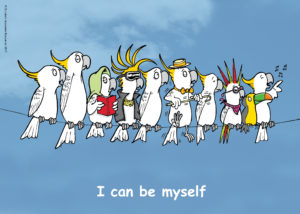
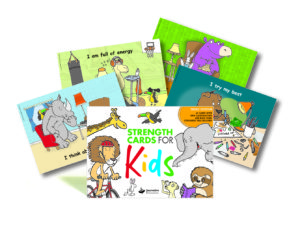
Now in its third edition, Strength Cards for Kids features a mixed bunch of raucous, funny, serious, quiet, loud, big, small and rather outrageous animal characters. They get up to all kinds of antics, most of which you will never see when you are visiting animals in a zoo, park or sanctuary. That’s because—as any child knows—animals only do these things when humans aren’t looking.

  • An elephant and a tortoise playing soccer
  • A sloth in a hammock reading her favourite book
  • A rabbit bandaging the leg of a yak
  • A conga line of critters in the living room
  • A rhino pondering his next chess move
  • A meerkat on surf life-saving duty.

These are the kinds of activities you will see in Strength Cards for Kids. You’ll even see a little monkey crying and that’s because sometimes things can get tough. Thank goodness for the caring hug of the baby elephant. Everyone needs a friend like that.

 Why are the animals doing all these things in Strength Cards for Kids? Well, apart from having a huge amount of fun, they are demonstrating their strengths! And everyone has strengths, including us humans.

Strengths are Surprising

Like the strengths these animal characters are showing, sometimes our strengths are very surprising! Sometimes a strength is hidden deep inside and no one knows it’s there. Even if a strength is not hidden at all and someone is demonstrating it every day in countless ways—still others may not notice. Sometimes we have a kind of ‘strengths blindness’. Take ‘challenging behaviors’ for instance—they have strengths hidden within them too—but sometimes adults have to dig very deep to be able see them.

Like most people you may have a dose of ‘strengths blindness’ because even if we are very good at noticing the strengths of others, it’s common to be blind to many of our own strengths. Especially in times of difficulty, we might think our strengths have disappeared—and when things have been tough for a long time, we might even think we never had any strengths to begin with.

And that’s just … not … true.

Strengths are Within Everyone

Everyone has strengths—all the time! Strength Cards for Kids is based on the belief that it is very important to notice and celebrate strengths. One good reason for this is that strengths are the foundation of our resilience. They are our greatest assets to call on in times of difficulty. Each time we put a strength into practice, even in a seemingly small way, we are building more of that strength; we are adding to our capacity.

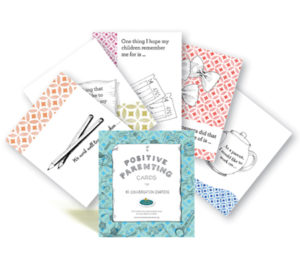
In March I had great pleasure in attending the inaugural Wellbeing Australia conference in Cairns. What made it special was the inspiration and passion shown by so many teachers and wellbeing officers towards the children—and extending further to the parents and the broader school community. In packing for the conference, I gathered up many of the resources that schools most often find useful, only to discover that there was particular interest in our Positive Parenting cards. Not surprisingly, there is a lot of wellbeing work that is undertaken by schools through the supporting and running of parenting groups.

What I find so inspiring, is how schools are taking on a role as community developers, bringing communities and neighbours together, and building capacity. This, coupled with a focus on wellbeing, strengths and circle-work, is helping to build a more inclusive, respectful society.

I was also reminded again this week, of how important wellbeing officers are in schools. A friend of mine, who is currently studying social work as a post-graduate, is on placement as a wellbeing officer for a regional secondary school. The sometimes complex issues within families and the spilling over of anger and other emotions in children are benefited by the provision of these services. One young boy around the age of 12 or 13 approached my friend asking for help in managing his anger. He said that he wanted to be in control and not in trouble. On that particular day, his father had promised to visit him early in the morning for his birthday. This meant he had to miss his bus to school and was devastated when his father didn’t show up. After some tears, a few video games, and a comforting word, he was on his way, but no doubt was feeling the effects of the morning and wanted to catch up with my friend again the following week. (I am sending through a set of Cars ’R’ Us cards to my friend to assist this young boy around behavioural choices.)

Denise Juneau, US politician and education advocate is quoted as saying:

‘Teachers do the noble work of educating our children. And we can’t thank them enough for the hard work they put in every day to ensure a bright future for all of us.’

While this quote is accurate, what is missing is widespread community acknowledgement of the humanity of teachers and the nurturing role that they also play—not only for our children, but for the extended school community. Let us hope that wellbeing continues to be an important consideration within schools, and that our teachers are supported in encouraging strengths, circle work and other forms of social and emotional learning.

Georgena Stuckenschmidt

Other related blogs:

Aboriginal Girls Circle

Strengths in Circles

As a Parent I wonder…

For most people, feelings of worry or anxiety happen every now and then and are part of a healthy emotional range. Such feelings can serve us well by warning us of potential danger and helping us ‘gear up’ for performance. However, sometimes these feelings remain long after the ‘threat’ or stressful situation has subsided and escalate into an unwanted problem, becoming what is known as ‘anxiety’.

According to the National Survey of Mental Health and Wellbeing conducted by the Australian Bureau of Statistics (Summary of Results, 2007, 4326.0, Canberra) anxiety is the most common mental health condition in Australia. The results showed that on average, one in four people will experience anxiety at some stage in their life and in a twelve-month period, over two million Australians will experience anxiety.

Children, as well as adults, experience anxiety—whether it is a response to particularly challenging circumstances or a generalised, free-floating habit of worry for no apparent reason. When it becomes an intense, prolonged experience, anxiety can be excruciating and even debilitating.

As author of our soon to be released Anxiety Solutions for Kids card set, we asked Selina Byrne M.A.P.S., ‘What is anxiety anyway?’

 ‘Anxiety is an unpleasant feeling combined with certain worried thoughts. Usually the feeling comes first, maybe a sick feeling, or dizziness or tightness in the chest. And it only becomes ‘anxiety’ when we think it’s a problem. If we think it’s just a feeling, or just a thought, it may not be a problem at all. Any feeling in human experience is a mix of both physiology (something in the body) plus focus (where we put our attention). If we feel something we don’t like, then zero in on it in a worried way, bam. We have anxiety.’

Selina Byrne, M.A.P.S., once had a client, a young boy, who had unpleasant feelings that his parents and she thought would be anxiety-related. But for him, he was used to the feelings, didn’t think much about them, and just went on with his life. So they agreed there was no need to change anything as long as he wasn’t bothered by the feelings! Many people start thinking about those feelings, though, and get worried. They talk inside their heads about the ‘awful’ feelings and how to ‘get rid’ of them. Strangely, the more we focus on anxiety and how to remove it, the more we build fear of the feelings, which can make them more frequent or intense.

Anxious feelings are a normal part of the human experience, depending on individual tolerance, frequency and intensity of the feelings and thoughts. Some people (kids included) are more prone to anxiety due to both genetics and/or personality and need a little help re-routing the brain. Luckily, the brain is very fast at learning, and can learn to go in another direction when it has the urge to veer towards fear! ‘

Teaching all children to manage worry, find ways to distract and soothe themselves, challenge their thinking and self-talk is very important. These are essential ‘resilience’ skills.

As a publisher of therapeutic tools for children and adults, Innovative Resources hopes that Anxiety Solutions for Kids cards will help lay a foundation of wellbeing for children. We are delighted to have co-created this tool with author, Selina Byrne M.A.P.S. and artist, Katie Jardine. We hope that children (and parents) will enjoy experimenting with the activities and discovering that there are things they can do when old Worrywart drops by and outstays the welcome.


‘Everyone benefits in cultures where their strengths are appreciated and noticed. Children, in particular, blossom when they are held in positive regard by the people around them.’

 We are surrounded by many different cultures—not only the obvious cultural differences between countries and peoples—but also the different mini-cultures found in families, schools, communities, clubs and workplaces. Each of these cultures may emphasise different strengths—for example, ‘standing out’ may be admired in one setting, and in another, ‘blending in’ may be highly prized.

Learning to recognise the strengths that are emphasised in our own cultures and those of others is part of developing ‘strengths literacy’. And sometimes a person’s strengths may run counter to a culture they are part of. That can be very tough; it is easy to feel like an outsider. But recognising strengths that are invisible to a dominant culture is a very important part of developing healthy self-esteem … and an equitable society!

 When talking with children about strengths, it’s good to find simple and fun ways to express what a ‘strength’ is! For example, you might talk about a strength as

  • a good thing
  • a special thing
  • a thing that makes your heart feel good
  • something that makes you feel safe and friendly and strong
  • something you are really good at
  • something that someone else is really good at
  • something you are learning and getting better and better at
  • something that helped you learn to do something you couldn’t do before—but now you can!

Children thrive when their strengths are valued. Often, the weight of a ‘problem’ can lift considerably when we think of it as a strength yet to be developed. For these reasons many family counsellors, welfare coordinators and support workers encourage parents and carers to reflect on the importance of noticing children’s strengths. Questions to explore include:

  • What are the child’s strengths?
  • What difference might it make if I name them?
  • Am I in the habit of celebrating the strengths of the children around me?
  • How do the child’s strengths make a positive difference to us all?
  • Do I celebrate my own strengths?

Looking for strengths and fostering ‘strengths cultures’ in our friendships, families, communities and classrooms means actively creating environments and opportunities where strengths are noticed and encouraged. A very important part of this is building the vocabulary needed to speak about strengths—building a ‘strengths literacy’, so to speak.

That’s where Strength Cards for Kids comes in! It will bring delight to children and adults alike, and help build cultures of strengths and strengths literacy wherever they go. Before you know it, the children around you will all be speaking the language of strengths!


Ever been to a funeral of someone you liked and thought you knew well, only to discover through the eulogy that there was so much more about the person than you knew?

How many times have you walked by the reception desk, said hello to the office administrators and even gone so far as to ask if they had a good weekend, but not really asked how they spent their time?

Or how many times have you gone on the Saturday morning group ride with other cyclists and never thought to talk about something other than the sport of cycling, the weather, or the new bike they might be thinking about buying?

We can very often fall into the trap of seeing a person in the role they are undertaking, without ever considering that they may have other skills, strengths, interests or roles that we don’t know about.

Do we fall into the trap of seeing a client or student within the context of how they have presented to us or can we look a little deeper and discover that they have more strengths and skills they can bring to the table?

Andrew Shirres, Innovative Resources’ practice development coach, facilitated a workshop with an administration team recently. He asked the question, ‘How can you look at someone in your team, not as a co-worker, team mate or colleague, but in another way?’ The second part of this activity involved participants thinking about how they themselves could be viewed in another way by their work peers.

Innovative Resources has been testing a set of cards to help with ‘widening the lens’ on how we look at each other—especially how we can view clients as people with skills, interests and strengths, and more specifically, as contributors in our communities.

Some of the roles or contributions a person might carry include: story-holder, inspiration, hard worker, family-builder, solution-finder, holder-of-wisdom, artist … the list goes on. The investigation and reflection is aimed not so much at identifying what people are good at, but more at discovering, sharing and reflecting on a fuller and more accurate appreciation of ourselves and others.

The administrative team enjoyed learning about the diversity and richness of members in their team and have adopted a mantra, ‘More than just …’ as the starting point for extending awareness to other colleagues across the agency to look beyond stereotypes.

Georgena Stuckenschmidt

Note: Andrew is available to work with organisations around practice reflection and broadening perspectives on how to deliver services in a strengths-based way. For more information contact us or visit our training page.