Join the conversation! SOON (Seriously Optimistic Online News) keeps you connected with everything Innovative Resources – subscribe today!

If your situation is urgent, you can contact these services 24-hours a day, 7 days a week

CLOSE (X)

The Role of the Observer

‘Two things make a story: the net and the air that falls through the net.’

      (Pablo Neruda)      

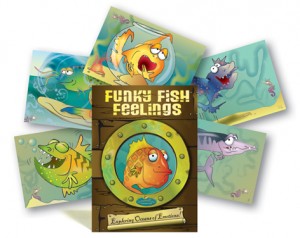
Keen observers of the Funky Fish Feelings cards will have noticed that a seahorse manages to make an appearance on every card. (Well, all except one card where it is left for you to imagine him somewhere in the whirlpool!)

Introducing Farr Lapp, the seahorse, so named because he:

  • is a New Zealand seahorse
  • likes to be associated with the larger variety of horses
  • likes to swim lapps [sic].

Farr Lapp doesn’t appear on each card because he has a rampant ego. Rather, Farr Lapp has a very important role; he is ‘The Observer’. Having an observer can be very useful. An observer can scan action and events; an observer is in the picture in one sense but also has an arm’s-length (fin’s-length!) relationship with the subject. An observer can observe, reflect on, ponder and evaluate the scene before them.

Observers are not neutral, what they observe has an impact on them. Farr Lapp often looks quizzical and bemused as he studies the fish in question. At other times Farr Lapp can be seen to mirror the emotions of other fish or to react to the feelings of the fish depicted in other ways.

Having an observer as a witness creates different ways of building conversations, and can turn a two-person dialogue into a ‘trialogue’.

One can thus ask such questions as:

  • What do you think the seahorse is seeing?
  • Do you think the seahorse could have a different perspective from yours?
  • If the seahorse knows the fish well, do you think he might have a different opinion of the fish from those meeting the fish for the first time?
  • Can you imagine Farr Lapp using different words to describe the emotions of the fish? If so, what words might he use?

Using an observer is a longstanding tradition in social work and counselling. Sometimes it can be very useful to ask questions that an observer might ask, and to consider what an observer’s answers might be. Sometimes the observer can be a special person who might have a particular relationship to the subject, such as a parent, grandparent, special friend or even a favourite teacher. We each have a special person in our life; a person who sees us differently to the way acquaintances or strangers might see us. Hopefully, our special person values us and perhaps sees that our positives outweigh our negatives.Funky Fish Feelings
Observers or complete strangers can be special people because:

  • they can notice change
  • they can give praise
  • they can ask difficult questions.

Of course, Farr Lapp observes himself, as we all do from time-to-time, especially as we develop the capacity to reflect on our feelings, attitudes and behaviour. This is why he gets his very own card! Don’t be surprised if Farr Lapp looks into the mirror of self-reflection and is, by and large, at peace with what is reflected back. If we feel so inclined, we can ponder what it is that may have led Farr Lapp to this treasure of wellbeing within himself?

In exploring strengths-based practice, we navigate the term ‘labelling’, and how using labels can be a form of power-over, can affect people’s identities and behaviour, and confine what is possible for them.

Some labels are certainly devisive but when are they useful and helpful? When can labels enable a pathway through?

A friend of mine has spent five and a half years agonising over his daughter’s behaviour; wondering whether it was autism or another condition, or worse—that his daughter’s behaviour was ‘normal’ and that they were just awful parents. He said that it was a relief to finally have both a diagnosis and also a holistic plan in place.

He went on to say:

It’s official, (though not a surprise to those who know her), but she has finally been formally diagnosed by a specialist as having moderate to severe Attention Deficit Hyperactivity Disorder (ADHD). This means there are thought to be two chemicals (dopamine and norepinephrine) that she makes too much of, and this causes the messages between her neurons to be transmitted too quickly. This particularly impacts the parts of her brain responsible for executive control, but in time may also lead to nervous tics and other co-morbid conditions such as dyslexia, OCD, ODD. But we’re crossing our fingers that they won’t. We still have a way to go to determine if she has the more strongly Inattentive Type (so more ADD) or Hyperactive Type (HD) or, as we expect, if she has both.

‘For us the formal diagnosis is good news. While we acknowledge that her condition will require ongoing treatment, monitoring and refinement on her part and ours (for some, ADHD is a life-long condition), we are overjoyed that we have finally exited our bewildered phase and are about to embark on the enlightened phase of our journey with our beautiful, smart, joyful daughter.’

When labels are used we need to ensure:

  • They are respectful, bring hope and are validating
  • They recognise uniqueness and, at the same time, expose our commonalities and similarities
  • They expose people’s expertise and reflect people’s strengths and capacities rather than reinforce weaknesses
  • We avoid framing people as the problem by recognising the wider structural context of people’s lives
  • We open up other possibilities and solutions, create greater understanding and accept that we may be wrong.

(McCashen W 2005, The Strengths Approach, ‘Taking Care with Labelling’, Chapter 2, p. 25)

 i-can-be-me

It seems that we need to acknowledge the appropriate use of labelling. Actually, naming the condition, but respectfully separating it from the person, is important. My friend’s beautiful, smart, joyful daughter is just that. But now, her known condition can be treated with love and care so that she has the opportunity to grow and learn.

Georgena Stuckenschmidt

‘When autumn darkness falls, what we will remember are the small acts of kindness: a cake, a hug, an invitation to talk, and every single rose. These are all expressions of a nation coming together and caring about its people’.

Jens Stoltenberg

The following statistics from Carers Australia tell a powerful story:

  • There are approximately 2.7 million unpaid carers in Australia. They are the foundation of our aged, disability and community care systems. (ABS 2012 Survey of Disability, Ageing and Carers)
  • An estimated 1.9 billion hours of unpaid care was provided by Australian carers in 2015. The annual cost of replacing this care with formal services is about $60.3 billion. (Deloitte Access Economics 2015)
  • 60% of carers are not employed, 37% have a disability of some kind themselves and 15% care for more than one person with a disability, illness or condition. (ABS 2012 Survey of Disability, Ageing and Carers)

A significant portion of those being cared for has a mental illness. The Department of Health and Aging in Australia estimates that mental health problems will affect more than 20 per cent of the adult population in their lifetime. While every single one of us needs someone who cares—especially when we are unwell—not all of us will become ill enough to need a carer. Even so, there are countless people across the country who struggle daily with the demands of caring for someone with a mental illness.

Carers Australia says there is a need for multiple service responses to meet the diverse needs of carers including peer support, counselling, respite, education and assistance to navigate ‘the system’.angel_2012_120x140_f93

While the statistics tell a powerful story, no one can really know what it is like to be a carer unless they have lived it. Taking the time to hear the stories of carers allows us to walk in their shoes at least a little, and helps us gather the collective momentum needed to bring about change.

This month we take our hat off to all carers, and hope that the love, tolerance and kindness you give to others are radiated back to you this Christmas.

Christmas means many things to many people. To some it is filled with magical memories of sparkling lights, tinsel and brightly coloured presents under the tree. Others anticipate the delights of a table laden with meats, salads, puddings and in the Southern Hemisphere at least—a medley of tropical fruits.

For many it is filled with the joys of giving and receiving—and if we are very lucky, these gifting rituals may even help us draw close to the true spirit of Christmas where we are reminded of the abundant blessings in our lives.

However, for many, Christmas can be a time of tension and loneliness. It can be a time when we are reminded of the painful fractures that may have occurred within families. This can be especially so for families who have separated. Even with the very best will in the world from everyone involved, there are so many things to navigate about Christmas: Where will the children go? How will the parents share them over the festive season? How will they navigate the two separate worlds of their parents? What if relationship have broken down to the extent that they can no longer see beloved grandparents?

At Christmas time, instead of mistletoe and holly, separated families can feel that their path is strewn with obstacles—swamps of despair, no-through roads of disappointment and mountains of dashed dreams.

Two Worlds: when relationships end and parents separate, is a set of cards published by St Innovative Resources and the Anglicare Diocese of Sydney. The 48 Two Worlds
cards use stunning, original, water-colour illustrations by Carolyn Marrone to help provide a voice for everyone touched by separation.

Designed by experienced separation counsellors and child and family workers, Two Worlds is a unique resource for building healing conversations with children or adults experiencing separation … or any significant transitions and life changes.

Use these cards to ask questions like:

  • Can you choose three cards that describe the kind of Christmas you would like to have?
  • Can you choose three cards that describe the kind of Christmas you would wish for your children or other loved ones?
  • Thinking of the lead-up to Christmas and Christmas Day itself—can you choose cards that speak about the challenges you think may face?
  • Can you choose cards that speak about strengths you will want to draw on to meet these challenges?
  • Can you choose cards that express what you think is the most precious thing about Christmas?
  • Can you choose cards that are the key things you would like to discuss with your ex regarding arrangements for your children at Christmas?

When a couple separates, one world becomes two. When that couple has children, they too face the challenges of navigating their way through the two new worlds of their parents. These challenges can be daunting, even overwhelming—especially at significant celebrations like Christmas. Take care this Christmas, in navigating your Two Worlds.Two_Worlds cropped


Records have long played an important role in human service work.  Traditionally they contain assessments, plans, reports, letters, decisions and summaries, held in files by an organisation, and maintained by a worker about a client. Most importantly, traditional record keeping tends to focus on ‘the problem’ that needs ‘solving’. Increasingly, workers and organisations are challenging this view.

What if workers and clients co-create the record?

The practice of maximising the client’s input in the act of recording the support an organisation provides is underpinned by the principles and beliefs of strengths-based practice.

A strengths-based approach is a best-practice framework that serves to foster the conditions in which empowerment and change can occur meaningfully and sustainably in the lives of those who access human services.

Strengths-based principles are as follows:

  • All people have strengths and capacities.
  • People can change. Given the right conditions and resources people’s capacity to learn and grow can be harnessed and mobilised.
  • People change and grow through their strengths and capacities.
  • People are the experts on their own situation.
  • The problem is the problem; the person is not the problem.
  • Problems can blind people from noticing and appreciating their strengths and capacity to find their own solutions.
  • People have good intentions.
  • People are doing the best they can.
  • The power for change is within us.

(McCashen W 2005, The Strengths Approach, p.9, St Luke’s Innovative Resources, Bendigo,  2005)

Client-centred, collaborative practice sees clients as the primary stakeholders. Accordingly, for a service to be effective, stakeholder involvement in the direction and recording of the services provided is critical.

Client-centred, co-constructed recording is firmly aligned with key social work principles that place importance on the values of respect, human rights, autonomy, self-determination and transparency.

Strengths-based recording facilitates genuine empowerment. Co-construction of service folders, collaboratively with clients and workers, can be a therapeutic activity, unlike a worker writing up ‘case notes’ in the seclusion of an office space.

St Luke’s, now part of Anglicare Victoria, decided in 2013 to strengthen its position on the practice of client-centred, co-constructed, collaborative recording. In short, following extensive consultation with agency practice leaders, a set of recording principles and standards were developed aimed at benefiting clients and workers alike. The principles and standards landed on are:.

 PRINCIPLES OF STRENGTHS-BASED, CLIENT-CENTERED RECORDING

Client records are:

  • co-constructed by clients and workers
  • key tools for promoting safety, healing, growth and change
  • clear, relevant and understandable
  • focused on strengths, skills, hopes, values, resources, goals and agreed actions
  • able to be accessed at a convenient time and in an agreed format
  • regularly reviewed to ensure accuracy and relevance.

STANDARDS FOR STRENGTHS-BASED, CLIENT-CENTRED RECORDING

Accountability

  • All content of a record is to be regularly scrutinised for accuracy.
  • Notes and letters are to be written in the first person (ie ‘I’) and to a named client.
  • Each record must contain evidence that the client has been informed of the complaints and appeals processes.

Language appropriate

  • The record will use plain English.
  • Jargon, acronyms and technical language will be avoided.

Therapeutic

  • The people we work with are encouraged to co-construct the record. Workers are expected to maximise client input in designing and contributing to the record.
  • The record will reflect the client’s plan and the work towards achieving their goals.
  • Letter writing is an essential component of recording.

Socially inclusive

  • Clients will have their plans towards health, employment, educational and community connectedness outcomes identified.

Privacy and confidentiality

  • Each record must contain evidence that the client understands the legal, ethical and process standards that St Luke’s adheres to in its recording.

Accessible

  • Current clients can access their record on any work day providing the worker or a supervisor is present.
  • Recorded contacts will be up-to-date and able to be printed within a reasonable time frame upon request.

Client-centred, co-constructed records are in the best interests of the people we work with. Regular review by both client and worker ensures accuracy and clarity, maintaining a level of transparency that ensures all records withstand a high level of scrutiny. A person’s record will be a collaborative effort, constructed ‘with’, and not merely ‘about’, the most important stakeholder. It will contain information that is considered the property of the client, fostering a sense of care and responsibility, held by an organisation, for the keeping of information.

Co-constructed records are immediate and timely in that they can take place during a contact visit, removing the risk of inaccuracy that can occur when completed after the contact occurs.

Records that use both worker and client’s names, are language appropriate, avoid jargon, focus on what is working—as well as what is not—and  that clearly represent the client’s perspective of the service they receive, will be records that promote not only safety, accuracy and accountability, but uphold the dignity and rights of the people, not ‘cases’, they work with.

Andrew Shirres


At Innovative Resources we are so fortunate to hear about the amazing work that people do throughout the world, and to have the opportunity to share these rich stories with our readers. Paula Davis (from Connecting Matters) and her husband recently visited Sri Lanka and India. There they delivered training to counsellors and conducted workshops for married couples to assist them to move towards closeness in their relationships.

‘There is a mixture of arranged and love marriages, but longings for connection, closeness and love are universal.’

Paula said that at first, groups in Sri Lanka and India look stunned when she asked them to choose cards. Participants are used to attending workshops that tend to be didactic and rely heavily on the transfer of information. However, Paula and her husband work experientially.  This is a pleasant surprise for most participants.

Paula recalls a session that occdsc_0447urred several years ago when they were conducting a 3-day workshop with a group of severely war-traumatised Tamil couples in northern Sri Lanka. She asked them to choose a Picture This  card that represented what the word ‘trauma’ meant to them.

‘My husband and I shared first, as even though our experience differed enormously from theirs, we believe that traumatic experiences are relative. One by one the participants stood up holding their chosen card and shared their stories. It was heart-breaking. Every so often we needed to stop and practise grounding and emotional containment exercises, because the stories were so horrific. I kept asking them if it was too much but they ached to give voice to their stories. They ached for someone to bear witness to the horrors they had suffered. Without the cards, I doubt whether the sharing would have been as deep and profound.’

The card sets Paula uses include Strength Cards, Signposts and Picture This.

She said, ‘One of the first sessions we normally do is to help couples identify and celebrate their differences, especially their differing needs. The Strength Cards were fabulous for asking couples in each country to identify the strengths they brought to meet their spouse’s needs. Also, in both Sri Lanka and India, I used the cards in women’s counsellor training groups. Participants were asked to choose a card to represent the strength they perceived they brought to the counselling encounter and one that they don’t have but would like to develop. Discussion was rich and meaningful.

‘The Signposts cards were useful in many sessions. Participants were asked to choose a card that represented what closeness meant for them and to share it with their spouse. The cards were especially useful at the end of a workshop to represent what participants were taking away.

Picture This cards were also used multiple times in each country. Each spouse was asked to choose a card that represented a couple whose communication they admired and then to discuss it with their spouse. They were also asked to choose a card that represented a time when they felt listened to and another to represent a time when they did not feel listened to, and to share and write down the qualities of good listening and bad listening within a small group. Each group then shared the findings that they had written up on a whiteboard.

‘One memorable ”aha!” moment occurred when the husband in a couple shared how he realised that he hurt his wife by the brutal way he communicated to her. She sobbed as she sat beside him and welcomed his desire to change.’

July this year was Paula and her husband’s sixth trip and they now work mainly with married couples, many of whom have arranged marriages. Paula said that they try to work with community leaders as much as possible, such as church pastors, as they believe these people are the influencers and change agents in their communities. They also seek to recruit promising couples in both countries to attend a 3- or 4-day training to continue the work in their own countriedsc_0482s.


Thank you Paula, for sharing your story with us!


Peer supervision—why do it?

Human service workers get together in peer supervision sessions to discuss practice, to reflect, and to wonder about ethical considerations. Lucky souls, aren’t we? And, it feels entirely congruent to approach peer supervision sessions from a strengths-based perspective. The idea of talking together about practice issues, valuing both difference and commonality, recognising what is working, and identifying the strengths that will help reach that collective ‘preferred future’ is valuable. We do this hoping that the people we work with—the clients of our services—will benefit.

Several elements of great peer supervision

  • Great peer supervision can be strengths-based practice reflection at its best.  It draws upon the principles of shared leadership, co-design and shared responsibility, recognising that profound learning can take place when it comes from a collaborative standpoint.
  • Great peer supervision separates ‘problems’ from the people who experience them and reflects on the universality of these experiences, thereby normalising them.  Understanding this shared experience opens doors to shared information, shared strategies and, sometimes, a collective ‘sigh of relief’, reducing stress and building capacity. The effect of this lasts longer than a glass of wine or taking that bath after arriving home.
  • Great peer supervision enables the examination of attitudes, values and beliefs, as well as the assumptions that workers consciously or unconsciously apply, whenever they meet with a client or community group.   This kind of examination healthily interrogates these assumptions, bringing them out into the open. If assumptions are named and, if necessary, challenged, practice will be seen as an interaction between worker and client, informed by the values and beliefs of each. Ultimately, by examining practice through this lens, workers can take more responsibility for the effect of their own practice ‘self’ and consequently, more responsibility for how ‘engagement’ occurs.
  • Great peer supervision builds and maintains teams and sometimes redefines them.  If we take the viewpoint that anyone can be a peer, the weight of a hierarchy can be diminished. One worker’s experience will be held alongside that of a team leader or manager—no more nor less valuable.

 Peer supervision sessions don’t always run smoothly

Sometimes eagerness to explore practice issues can have unexpected consequences and the very terminology used can quickly become a hurdle. Whilst the word ‘issue’, in its communal sense, is relatively benign, when equated with an individual, this can feel more like a synonym for ‘problem’. We may intend for it to be universal but the experience of it can be somewhat different. Instead, it may be more useful to consider, and give weight to, the ‘burning questions’ that need to be asked.

In this way, and by being mindful of the power of the language used, we can propose the telling of practice ‘stories’ rather than the naming of practice ‘issues’. Whilst any story may contain problems or issues, it will also contain challenges, successes, learnings, exceptions and strengths.

Practice issues reframed as practice stories

Listening to a story is different from hearing about an issue. ‘Listeners’ listen and are less inclined to offer advice before it is necessary or requested. ‘Listeners’ are keen to hear more, know more, or discover what happened next. When the story is over, ‘listeners’ can reflect on what they have heard and perhaps share a similar story. Just as in any story-book, another chapter, perhaps yet unwritten, can be pondered. Peers could wonder what an illustration to the story might look like. For example, ‘If this story is about practice, what does that look like in action?’ In a peer supervision session the next chapter could be a story about what ‘could be’ rather than ‘what is’. The group could then wonder what is getting in the way of that story being told and written … and, by invitation of the storyteller, be part of its authorship.

By Andrew Shirres

Building a relationship of trust is the foundation for all respectful and constructive helping processes. This is facilitated by genuine interest in, and validation of, people’s experiences, strengths, capacities and aspirations. It is also facilitated by transparent practices and assisting the person to take ownershipNature of Strengths card fronts changes22 of their own change process. 

Good listening is an essential skill in working with people.

The strengths-approach invites us not only to listen well, but to listen for three essential things:

  • People’s lived experience, the meaning they give it and the context in which the experience takes place
  • People’s aspirations, preferences and goals
  • People’s strengths and capacities and the stories behind them.

Strengths-based listening assists people to reframe their realities and experiences, establishing a springboard for ways forward.

Stages of the strengths approach

A simple but consistently useful framework has emerged from solution-focused ideas and other principles discussed in The Strengths Approach. It consists of six key stages for reflection, planning and action:

  • Listening to people’s stories, exploring the context and the meaning they give their experience, and identifying the core issues (including cultural and structural constraints)
  • Developing a picture of the future and setting goals through an exploration of people’s aspirations
  • Identifying and highlighting strengths and exceptions to problems
  • Identifying additional resources that complement people’s strengths and goals
  • Mobilising strengths and resources through a plan of action
  • Reviewing and evaluating progress and change.

There are dangers in being too prescriptive or simplistic in using this strengths-based framework of stages. Sometimes people are not able to get in touch with their aspirations or describe a picture of the future because they don’t feel hopeful enough. They can feel so overwhelmed by the problems they face that it is difficult to imagine that things can be different. This is typically the case in instances of abuse, depression, or trauma. Taking people down the path of ‘future picture exploration’ in this situation can be disrespectful, unhelpful and counterproductive. In this case giving priority to validating experiences and exploring strengths and exceptions is more likely to help bring enough hope to describe a picture of the future. In these circumstances the process looks like this:

  • Listening to people’s stories, exploring the context and the meaning they give their experience, and identifying the core issues (including cultural and structural constraints)
  • Identifying and highlighting strengths and exceptions to problems
  • Developing a picture of the future and setting goals through an exploration of people’s aspirations
  • Identifying additional resources that complement people’s strengths and goals
  • Mobilising strengths and resources through a plan of action
  • Reviewing and evaluating progress and change.

Sometimes people do not need to explore and analyse their past. They may already be sufficiently in touch with positive experiences or take little to get in touch with strengths and exceptions. In this case priority is given to exploring people’s aspirations. Consideration of strengths and exceptions occurs within the context of these aspirations. The process in these circumstances is like the one outlined at the beginning of this article.

Of course, there are always situations where people are ready to explore exceptions and develop a picture of the future.

It is important to emphasise that the framework provides a versatile map for conversation, reflection and planning. It should be used according to people’s readiness. It is meant as a guide to be used flexibly in responding to people’s sharing. Too much structure can lead to the worker driving the process. At the same time, too little structure can become unhelpful.

(Extract from The Strengths Approach, by Wayne McCashen. Chapter 4, pp 47-51, St Luke’s Innovative Resources, 2005)

Other related blogs:

What is “the Strengths Approach”?

Strengths-based Supervision

#strengths


‘Unpacking the Baggage’ questions are perhaps the most common questions we ask each other.

‘How are you?’ is a universal greeting.

We use it and other related questions all the time to check on how others are journeying.

Often ‘How are you’? is merely a token question, another way of making an introduction and we are surprised, sometimes shocked and even dismayed when our superficial question provokes anything but a superficial response.

But there are many other times when checking on someone’s state is important and for many workers in human services ‘unpacking the baggage’ to elicit honest and truthful answers is critical.The_Bears 300pix

In our work we can ask ‘unpacking the baggage’  questions in countless ways. For the teacher of a child whose parents have separated and who has just had a weekend with the non-custodial parent, it might be important to ask about the weekend early on the Monday morning.

If you are seeing a client for the first time you might ask: ‘What has changed since you rang up to make the appointment?’

If we want to go beneath the superficial we need to provide an appropriate respectful context to allow the ‘baggage’ to be ‘put on the table’. If someone is in pain it is important that we offer a way for this to be expressed and if change has occurred we need to ensure that we notice any significant elements of the change.

‘Comfort in expressing your emotions will allow you to share the best of yourself with others, but not being able to control your emotions will reveal your worst.’

– Bryant H. McGill

Because emotions and feelings are often difficult to put into words, the simple representation of these by The Bears makes them a great tool for unpacking the baggage in ways that words alone may not:

  • Is there a Bear that expresses how you are feeling now?
  • Is it the same Bear that was you yesterday or when we last met?
  • I have kept a record of the Bears that you said were you each time we met. Which is you today? Can you see any patterns emerging?
  • Can you tell me about the Bear you have chosen today? What words accompany this Bear? How would you describe what your Bear is feeling?

The Bears have proved to be a great ‘unpacking the baggage’ resource for group leaders and facilitators. At the start of  many group events it can be useful, even vital, to check how people are travelling. Spreading the cards out and asking group members to choose one or more that reflect their feelings can proBears_fronts6vide a gentle way to ascertain the recent experiences that may impact on the group.

To encourage storytelling and interaction in any group, whether it be a therapeutic group, a staff meeting or even a family meal time, you can introduce The Bears into the ‘BWF’ ritual – that is, each member is asked to tell a story about the Best, Worst and Funniest thing that has happened that day with the choice of a Bear to match each story.

From The Bears, new edition booklet, 2010 published by St Luke’s Innovative Resources


‘To own one’s own shadow is to reach a holy place – an inner centre – not attainable in any other way.’

Robert Johnson, Owning Your Own Shadow, Harper San Francisco, 1971, pg 17


Carl Jung was an exceedingly influential member of the early psychoanalytic movement. His ideas about the Unconscious have shaped how we think about ourselves. The ‘Shadow’ is also one of his ideas and he discusses it in a particular way.

For Jung, the Conscious Self is how we prefer to present ourselves to the world and how we like the world to see us. We know about, and are readily aware of, those parts of us that are conscious. The conscious part of ourselves could be called our ‘Persona’ or mask. It describes our sense of identity and the way we relate to the world.

Part of our Unconscious

The Shadow, however, is part of our Unconscious. It is made up of the aspects of ourselves that we don’t acknowledge or don’t want to accept – the parts of ourselves we struggle to keep hidden from our awareness. The Shadow can be negative feelings about ourselves, behaviour we don’t like or unhappy experiences we don’t want to remember.

The families we grow up in and the wider society we inhabit value certain kinds of behaviour, certain beliefs, certain ways of being and certain personality types. As children we learn what is and what is not acceptable and we create a Conscious Self that conforms to these expectations and works for us. Unacceptable behaviour, thoughts and feelings can be pushed down into the Shadow.

It’s important to remember that the Shadow has what isn’t acceptable to us. And it isn’t all negative; some people find it harder to accept positive aspects of themselves than negative ones.

Why can it be useful to explore the Shadow?shadows-cards7

Firstly, acknowledging the Shadow can help us start to integrate it and become more whole in ourselves. If we want to develop and grow we need to recognise, accommodate and celebrate both the positive and negative parts of ourselves.

Secondly, the Shadow can both generate and absorb a lot of energy. Keeping the unacceptable out of consciousness requires a lot of effort. Imagine a boiling pot. It takes energy to keep the lid on. If we can free ourselves from the energy required to maintain vigilance and suppression of our Shadow, we can use this energy in other ways.

If we don’t acknowledge the Shadow it will make its presence felt anyway. It will antagonise, manipulate and trip us up. We may think, say and act out feelings that we wish we hadn’t. We can act out the character and feel out of control.

Robert Johnson talks about personality being like a see-saw. If we put all our effort into maintaining the Conscious Self, the Shadow will erupt to balance things out. One of Johnson’s examples is how he coped with hard-to-please guests who came for a weekend and stayed longer than he hoped. He managed to stay hospitable throughout his ordeal. When his guests left he then went to a nursery to buy a plant to reward himself, only to find that he picked an argument with the manager.

Shadow behaviour

Sometimes the presence of ‘Shadow behaviour’ works as a warning sign that we are emotionally over stretched; tired, stressed, burnt out. Our normal coping mechanisms may be depleted, our resilience is down and what happens? The Shadow begins to gain the ascendancy.

Lastly, accepting the Shadow side of ourselves can prevent getting our feelings tangled up and confused with those of others. When we blame other people for feelings that come from us we experience the Shadow working via projection. That is, what we don’t want to recognise in ourselves we attribute to someone else. This works at an individual level but stereotyping, scapegoating, and creating categories of ‘us and them’ can be seen in community and international relationships as well.

Using Shadows to explore the shadow

Shadows is a tool that can help people identify and name elements of the Shadow that aren’t conscious or are just becoming conscious.

  • Can you choose a card that has a message for you?
  • Is there a card that ‘speaks’ to you in some way?

Asking such questions as someone scans the array of cards (or studies them one by one) invites the person to get in touch with thoughts or feelings that he or she may not have been conscious of previously.

It is important that the person makes their own choices, does their own sorting and articulates their own meaning. It may be useful to sit in silence for a while, giving valuable time for the person to reflect on the significance of the picture before he or she speaks. Be aware of when the person is ready to start.
Some questions that might open up conversation are:

  • Can you tell me a little about the picture you selected?
  • What does it mean for you?
  • Is there anything happening in your life that makes this picture particularly relevant?
  • Is there anything in the picture that scares you or makes you uneasy?

The pictures may also suggest relationships where shadow issues have arisen and these might be explored by asking such questions as:

  • Tell me a story about you and this picture.
  • Are there other people who are in the story who should be in the picture?
  • How are they like you? How are they different?

Because exploring the Shadow can touch on buried thoughts and feelings that are very sensitive and painful, such conversations should be entered into carefully. The person themselves should always be able to determine what they want to discuss and when is the most appropriate time. Being respectful means one is always cautious about making assumptions and inferences, being provocative and drawing conclusions.

All the above suggestions are made with the understanding that such questions would only ever be used within relationships of trust between the people involved in the conversation.

From the booklet that accompanies the Shadows and Deeper Shadows card set.

Most of us depend on our friends and loved ones for lots of things. Happiness is just one thing that goes hand-in-hand with healthy relationships. But while relationships are arguably the most important part of our lives, it’s easy to take them for granted. We rely on those who mean a lot to us, we enjoy their company, we learn from them—they help make us who we are. But have you ever stopped to think about how relationships are made? How do we choose the important people in our lives? How do we get to know people well? What makes relationships resilient—able to cope with the ups and downs of life?

We also know how we feel when something goes wrong. When relationships fall apart we can feel anger, sadness, loneliness and a mixture of many other feelings. But can we reverse a relationship that is going badly? How can we keep relationships happy, healthy and respectful?

Respectful Relationships is a very simple tool that helps us explore and have conversations about the elements of healthy relationships. Being able to identify the dimensions of a relationship is perhaps the first step in knowing how to make good choices in the connections we make.

And thinking more about what makes a good relationship can help us avoid the sadness of things gone wrong such as bullying, loneliness, despondency and manipulation.

When we are visited by strangers

 Sometimes knowing how to connect with someone new can be very difficult. It might be a new person who joins a class or sports team. It might be going to a party where there are people you have never met before. Or it could even be that cousins you don’t know well are coming to stay or that mum and dad are foster parents and will sometimes care for children who are complete strangers in your home.

How we make connect with others can be a tricky business at the best of times. But when new relationships are thrust upon us and perhaps threaten other long-standing relationships or routines, negotiating a successful pathway into a new relationship can be difficult indeed.

Rather than just accepting that new, ‘imposed’ relationships will work out somehow, Respectful Relationships provides a way of taking preemptive action. The introduction of Respectful Relationships into a classroom or family conversation before the new arrival appears can provide a positive context that may well increase the likelihood of mutual acceptance.

In foster care, for example, sometimes it is the children of the caregivers who feel put out when new children arrive and they are expected to share their home, their toys and their parents. Respectful Relationships provides the opportunity to build a positive expectation of what new relationships may mean and to talk about ways of connecting even if the foster children disrupt some family routines.

Respectful Relationships is a tool that can be used by:

  • Parents—to build conversations with their children about safe relationships (and how kids and their parents can stay friends!)
  • Teachers—to develop healthy cooperative learning environments and conversations about values that can prevent bullying and self-harm
  • youth workers—on camps and adventure activities to build trusting relationships and celebrate the friendships that have emerged
  • family workers—to strengthen sibling relationships and prepare caregivers’ children for the pressures of foster care
  • sports coaches—to develop teamwork
  • social workers/school welfare staff—in problem-solving and decision-making activities
  • pastoral care workers—as a means of dealing with loss and grief

Some of the questions you can ask to help build conversations around the meaning and significance of relationships might be:

  • What are the most important things you think friends should do together?
  • Do you do different things with different friends? How does this feel? Is it okay?
  • How do you go about making new connections with people?
  • Can you have good relationships with people who are very different from you? How does this work?
  • Have you ever lost a friend? What happened? Is there anything that you would now do differently?
  • Why do you think some relationships last a long time and others just seem to fade away?
  • How is it that some people seem to maintain relationships for a long time even when they don’t see each other much?
  • If there was a series of relationship awards to be handed out, which of the 35 Respectful Relationships cards would you like to win the award for? In other words, what do you think you do well with the people in your life?


According to the Kids’ Skills method, issues confronting a child are best resolved by having the child learn a specific skill. This idea is based on the observation that when a child is faced with a problem, it is often due to the fact that there is some skill lacking, and that when the skill is acquired the problem goes away.

At first this may seem like splitting hairs. But the switch to talking about skills instead of problems is a way of re-framing the behaviour. Once we begin talking about skills instead of problems we find that it becomes far easier – for children as well as adults – to discuss matters in a constructive way.

Let’s imagine that you are the mother of a wild boy. His teacher comes to you and says, ‘Your son behaves aggressively towards the other children in the class.’ How do you react to her words? Do you thank the teacher for bringing the issue to your attention and begin to discuss it with her calmly? I doubt it, because that would make you an exceptional parent.

If you are a normal parent, you feel that you have been blamed and you react accordingly by doing what people do when they feel attacked. You defend yourself by deflecting the blame onto someone else. You might say, for example, ‘He never does that at home’ or ‘That’s because he is being bullied by his classmates’ or even ‘I am never aggressive so he must have got this behaviour from his father!’

On the other hand, how would you react if the teacher brought the same issue up in a different way? She wouldn’t say a word about yourproblem to skill son’s problematic behaviour but would approach the issue by talking to you about the skill she thinks your son needs to learn. Here’s what she might say:

I’ve spoken with my colleagues about Karl, and we’ve been thinking about the most important thing for him to learn so that he can be successful at school. We’ve come to the conclusion that it would be important for him to develop better self-control and to stay cool even when others are not kind to him. How do you feel about this idea? 

Disarming, isn’t it? How would you react now? You might even consider saying something like, ‘I have thought about the same thing’ or ‘He definitely needs to develop better self-control, and to tell you the truth, I would have a use for that ability myself.’

Talking about skills to be learned rather than problems to be overcome is a more constructive and cooperative way of approaching the issues that children face.

Kids_Skills_W

(Extract from Kids’ Skills book, Chapter 1 ‘Converting Problems into Skills’  2013 Author: Ben Furman,  Publisher: St Luke’s Innovative Resources.

(‘Kids’ Skills’ is a 15 step method by which children overcome difficulties in a positive and constructive way by learning new skills.)