Join the conversation! SOON (Seriously Optimistic Online News) keeps you connected with everything Innovative Resources – subscribe today!

If your situation is urgent, you can contact these services 24-hours a day, 7 days a week

CLOSE (X)

Coming Soon: A New Edition of Note to self – Reflecting on life’s choices

Innovative Resources is thrilled to announce the upcoming release of a new edition of Note to self, a beautifully reimagined card set that has been helping people navigate life’s challenges for more than 15 years.

Created by author and founder of Seeker & Sage, Gena McLean, this updated edition brings fresh energy to a timeless resource—with all-new artwork, revised questions and statements, and a thoughtfully crafted digital booklet to guide your journey.

Note to self is a set of 24, full colour illustrated cards featuring more than 70 powerful, hopeful, and sometimes challenging questions. These questions are designed to be catalysts for change—to help unlock our inner strengths, shift perspectives, and make meaningful choices. Whether you’re facing a difficult moment, seeking clarity, or simply wanting to deepen your self-awareness, these cards offer powerful ‘notes to self’ to support your journey.

The new edition is steeped in the principles of choice theory and strengths-based practice, making it an ideal companion for counsellors, social workers, life coaches, and mental health practitioners. But its reach goes far beyond professional settings. Note to self is equally powerful for journalling, personal reflection, or simply as a daily reminder that we always have choices—even when life feels overwhelming.
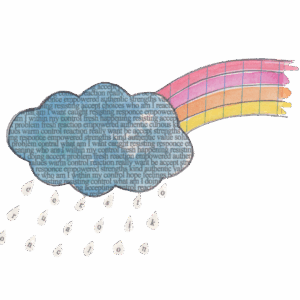
Each card is paired with three thought-provoking questions, encouraging deeper exploration; prompts that invite us to pause, reflect and reconnect with what truly matters.

Note to self is about using encouraging and supportive self-talk,’ Gena explains. ‘It provides the opportunity for us to be kind, compassionate and forgiving toward ourselves and others and promotes responsibility through acceptance and respect. It helps us resume control when we feel like we have none. And it offers hope.’

The first card in the set—I have choices—is the foundation of the entire deck. It’s a gentle but powerful reminder that even when we can’t change what’s happening around us, we can always choose how we respond.

Another important note to self—I am a work in progress—offers a compassionate nudge to embrace the journey, imperfections and all. These cards aren’t just affirmations—they’re invitations to explore, to question, and to grow.

Like all Innovative Resources card sets, this new edition of Note to self also includes a digital version of the cards and booklet, plus access to an online toolbox full of extras—making it easier than ever to integrate into your personal or professional practice. Whether you’re working one-on-one with clients, facilitating group sessions, or simply journalling at home, Note to self is designed to meet you where you are.
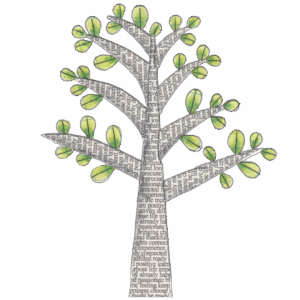
The artwork in this edition is by long-time Innovative Resources collaborator, Katie Jardine, whose illustrations have brought warmth, whimsy and emotional depth to beloved sets like Strength Cards and Anxiety Solutions for Kids. Katie’s intuitive, playful style has helped thousands of people around the world connect with their strengths and emotions, and her contribution to Note to self adds a fresh layer of creativity and heart.

Katie’s journey with Innovative Resources began almost 20 years ago with a serendipitous encounter at a central Victorian printing press. She brings a whole new look and illustrative style to Note to self, built around collage, watercolour, line drawings and an ingenious use of text as image.

Now a primary school teacher, Katie brings a deep understanding of emotional literacy and creative expression to her work, both in the classroom and in her art.

‘I love to be creative and make something out of nothing,’ Katie says. ‘It isn’t always drawings, but sometimes creating with clay, sticks, string or wire. I enjoy the process—not knowing what might appear.’

As Gena reflects on the journey of creating Note to self, she feels a sense of both nostalgia and pride.

‘It’s over 15 years since the first edition hit the shelves,’ she says. ‘But the wisdom and learning that exists within the cards still rings true.’

‘The phrase “note to self” was originally about those everyday mental reminders—”note to self … check the pockets next time!” or “note to self … leave ten minutes earlier!”’ Gena recalls.

‘If we can remind ourselves about the little things, I wondered, then what about the big things—the things that really matter?’

From that insight came a distillation of a 50,000-word book manuscript into 24 essential reminders—each one a lifeline for those navigating change, challenge, or simply the desire to grow. These cards are not just tools, but companions for the journey, helping us rewrite the scripts we’ve been living, one ‘note to self’ at a time.

Whether you’re a seasoned practitioner or someone seeking a little more clarity and kindness in your day-to-day life, the new edition of Note to self is a gentle yet powerful tool for transformation. It’s a reminder that we are all works in progress, and that every moment offers us the chance to reconnect with our values, our strengths, and our sense of purpose.

Note to self  will be launching in late 2025. To stay updated on its progress, simply sign up here.

resources mentioned

Explore each item to see how it can help you get better results.

Our much-awaited Teacher Wellbeing Cards have hit the shelves!

And not before time. A recent 2023 national survey of 4000 teachers by the Black Dog Institute in Australia found that poor ‘teacher mental health and burnout could halve the workforce’.

Even UNESCO is recognising that we need to have a strong focus on wellbeing if we want to attract and retain teachers, saying:

‘Addressing teacher shortages requires a holistic approach. Beyond recruitment, factors such as teacher motivation, wellbeing, retention, training, working conditions, and social status need attention.’

A fundamental part of being an effective educator is taking care of yourself, but we often neglect to talk about what best practice looks like in relation to self-care. Or if it is discussed, it is in general or broad terms rather than specific, concrete strategies. This is currently resulting in many teachers experiencing burnout before they seek support.

Drawing on extensive research by education lecturer and teacher, Dr Kristina Turner, and psychologist, Professor Monica Thielking, Teacher Wellbeing Cards are grounded in evidence about what works for teachers in terms of increasing wellbeing, and reducing stress, overwhelm, burnout and compassion fatigue.

These evocative cards, with stunning illustrations by artist, Kain White, are perfect for opening-up honest, reflective conversations about building personal and collective cultures of support, meaning, and hope in educational settings.

But don’t just take our word for it. Here’s what educators are saying:

‘When I unwrapped these wellbeing cards for teachers, I literally gasped at how good they looked. And then a second gasp, because they’re actually so good. They’re clearly grounded in the evidence base of wellbeing science. I shouldn’t have been surprised, given the amazing authors, Kristina Turner and Monica Thielking, but it’s a good reminder that something grounded in research can also be beautiful and genuinely useful.

Now to get these beauties to all the teachers.’

Kelly Ann-Allen, Associate Professor (Research) & ARC DECRA Fellow

‘In my thirty years as an educator, I’ve never before seen a resource so attuned to the specific day-to-day challenges and life stresses faced by teachers. Well-thought out conversation starters addressing the experiential realities of the teaching life, are augmented by evocative, soulful images designed to help teachers transcend workplace routines in order to reconnect with the deeper well-springs of their profession.’

Dr. Ian Irvine, Tafe teacher and university lecturer for over 30 years

‘The Teacher Wellbeing Cards are a simple yet powerful tool for supporting staff wellbeing. Easy to use and thoughtfully designed, they’re perfect for sparking meaningful conversations, whether one-on-one or in small groups. The open-ended questions allow individuals to reflect in a way that feels comfortable, while also encouraging strength spotting and a shift away from negativity bias. Best of all, they’re grounded in solid research, making them a trustworthy and effective resource for any school team focused on wellbeing.’

Michael Morrissey, Assistant Principal – Wellbeing and Inclusion, Bendigo Senior Secondary College

The Teacher Wellbeing Cards include 32 beautifully illustrated cards with a theme on the front and three sentence starters on the back. Every set also comes with a digital booklet full of ideas for using the cards in different settings, a digital set of the cards, a card hack video, and lots of additional content with suggestions for using the cards.

Use Teacher Wellbeing Cards to have conversations about:

  • re-discovering meaning and joy in your work
  • the importance of celebrating successes
  • establishing meaningful work-life boundaries
  • seeking support and building connection
  • embedding simple self-care practices into your day.

Designed to be used even when you’re short on time—in that 5-minute break between classes, as a reminder on your desk or fridge, or as a quick prompt in a debrief with colleagues—they are also perfect for staff meetings, professional development, team building and creating a culture of support, respect, kindness and trust.

For all educators—from primary and secondary teachers, to early years educators, trainers and university lecturers—and the people who support them, including wellbeing staff, counsellors and psychologists.

Buy now!

Ask Pip Westwood what she loves most about being a play therapy practitioner and her passion for the role is palpable.

‘It’s the honour of being entrusted with children’s stories,’ she says. ‘Being able to witness, first-hand, a child’s growth and development as they overcome something in their past that seemed so bleak.

‘Each child comes with different strengths and needs, and when you meet them, their heart is on their sleeve.’

Pip works in private practice with two other play therapists under the banner of Wildflower Play Therapy in Adelaide. Since graduating with a Bachelor of Psychology in 2011 and going on to complete a Masters in Child Play Therapy, she has seen the industry slowly grow and gain traction in Australia as a respected and successful form of therapy for working with children.

Play therapy is an evidence-based approach for working with children backed by decades of practice and research, particularly the work of American psychologist, Virginia Axline, in the mid-20th century. Axline developed child-centred play therapy and a set of principles that guide therapists in creating safe, supportive, and non-directive environments where children can explore their feelings, make choices, and develop self-awareness through play.

‘Because of pioneers like Virginia Axline, Garry Landreth and Athena Drewes, everyday I journey into the intimate stories that children choose to share with me through the power of play,’ Pip says. ‘Because play is their number one form of communication, my role as a therapist is to discover, analyse, and unpack their experiences.

‘It’s about giving children the opportunity to be heard in their language. If I’m asked to describe it, it’s like each child comes into the playroom with an itch they need to scratch—a need that’s met within the playroom. They gravitate towards the resources they feel called to.’

Every play therapy room has a diverse range of toys and resources aimed to provide kids with the words to tell their story. Pip often sees children gravitate towards a ‘self-figure’—something they feel connected to and might use to experience their journey.

Like the young boy (who was selective mute) who immediately connected with a dragon puppet in Pip’s play therapy room.

‘This young boy tied up the dragon’s mouth with a piece of rope,’ she remembers. ‘He then chose two little dinosaurs with move-able jaws and made them snap and pinch at the dragon.

‘It was one of those play therapy moments where I could feel the emotional weight of what I was seeing—knew it was significant—but I didn’t have the context to interpret the metaphor being expressed to me.

‘In a review meeting with his mum, she told me there were two children at her son’s school who were pinching and bullying him during class to try and induce him to make sounds. With the help of the dragon, he was playing out the experience of having his mouth almost tied—not being able to speak out.

‘That was such a powerful experience for him. Being able to come in and tell that story, not with words, because he didn’t really speak to me at all, but through play he could communicate the experience he’d had.’

Play therapy is still in early stages of development in Australia—it is much more established overseas, particularly in countries like the United States and the United Kingdom. While awareness and interest in the therapeutic benefits of play are growing, Australia still faces challenges, such as limited formal training programs, inconsistent professional recognition, and a lack of widespread integration into mainstream mental health services.

‘In Australia we’re still establishing regulation,’ Pip explains. ‘Regulation around what a child is going through, how to keep them safe, and how to keep us safe as professionals. Theoretical grounding and the right kind of qualifications—all these things are still playing out.

Pip says that while word of mouth is one of the main ways parents come to hear about play therapy, professional referrals continue to increase.
‘We have children referred to us by Child Protection, paediatricians, GPs, and other allied health professionals,’ she says. ‘Schools will often recommend that kids come to see us. There are a growing number of pathways to our door.’

Pip is also a big fan of Innovative Resources’ cards when it comes to helping kids talk about their experiences and feelings, using sets like The Bears and Cars’R’Us in creative and spontaneous ways.

‘I’ll often use The Bears to play a type of charades,’ she says. ‘I’ll choose a card at random, then have the child act out what’s on the card and guess the emotion. It can be a really great way to build emotional intelligence, but also social acumen—understanding how others are feeling and being able to read those really subtle facial expressions.’

Pip also remembers a powerful interaction with a young boy using Cars’R’Us.

‘I was working with a child who had some pretty complex issues in his home life, particularly in relation to parental addiction. I simply asked him to, “choose a card that tells me how you’re feeling”.

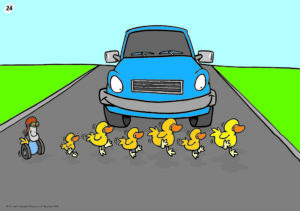
‘He chose the card that depicts a car stopped at a crossing with a line of ducklings crossing the road. In my head I’m starting to get a bit curious, but also mindful of my own interpretations of the card.

‘”So, why did you chose that one.” I asked. He said, “well, this is me and my brothers and sisters (pointing to the ducklings), and this (the car) is my mum ready to mow us down”.

‘If I had jumped in with my own interpretation I would have completely missed it. For him, that card resonated in a completely different way and helped him express what he was feeling in the moment.’

When Pip isn’t in the play therapy room you’ll find her at Deakin University, investing in the next generation of Masters of Child Play Therapy graduates—teaching, supervising placements, and guiding them to become passionate advocates for the language of play as a way for children to share their stories.

She’s passionate about promoting play therapy as a valid and vital intervention in mental health support for children.

‘We shouldn’t always be turning to verbal forms of interventions for children, when we can communicate with them in their natural language. Play.’

by John Holton

In the sterile, high-stakes environment of a neonatal intensive care unit, where every second counts and emotions often run high, Dr Huang Peiqi—a paediatrician specialising in neonatology at KK Women’s and Children’s Hospital in Singapore—has found an unexpected source of healing: clay.

Dr Huang’s journey into the world of art therapy began not with a brush or a canvas, but with a grant from the SingHealth Duke-NUS Medical Humanities Institute (SDMHI). Inspired by the department’s annual theme, ‘Stronger Together’, she envisioned a pottery workshop that was both practical and symbolic, creating a space for growth and transformation.

‘Clay transforms through fire into something more resilient and beautiful,’ she explains. ‘I wanted the act of sculpting clay to symbolise my department being shaped by challenges and emerging stronger together.’

What started as a simple idea evolved into a powerful initiative when Dr Huang partnered with Phylaine, a senior art therapist and SDMHI faculty member. Together, they merged the therapeutic potential of art with the reflective practices of medical humanities, creating a three-part workshop that brought together doctors, nurses, and allied health professionals from the neonatal unit.

The workshop began with a reflective session using the Innovative Resources card set, Two Worlds. Participants were invited to contemplate the metaphor of ‘a vessel’—what do we hold and who holds us—and select cards that resonated with their personal and professional journeys.

‘The visual prompts made it easier for participants to be vulnerable and articulate their complex emotions,’ Dr. Huang says. ‘Even the simplest images held profound meaning.’

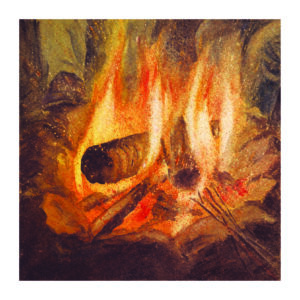
One image of burning logs sparked two vastly different interpretations. For one participant, it symbolised passion and dedication; for another, it represented burnout and the need for self-care. Another card, showing an animal trapped in the rain, prompted reflections on the emotional isolation patients and families may feel, and the privilege of being able to offer comfort and safety.

Dr Huang herself was drawn to a picture of a clock—a poignant symbol in neonatal care.

‘We call out the time when a baby is born, and we call out the time a baby dies,’ she shares. ‘Time never stops, and it made me realise how important it is to cherish the time we have.’

Following the card reflections, participants sculpted clay vessels that represented themselves, culminating in an intimate sharing session. The experience was deeply moving, she notes.

‘Participants shared that discovering an additional facet of their colleagues’ lives helped them understand each other better and deepened a sense of connection,’ Dr Huang says. ‘Knowing others shared similar experiences helped them feel part of the same team.’

The workshop’s success lies not only in its emotional resonance but also in its alignment with the principles of medical humanities—a field that integrates arts and humanities into medical education and practice.

‘Medical humanities explore both the human experience of illness and our understanding of professional identity,’ Dr. Huang explains. ‘It helps trainees explore their emotions and form a sense of who they are as healthcare workers.’

KK Women’s and Children’s Hospital has long embraced reflective practice. From mandatory reflective writing during medical training to initiatives like MhOSAIC (Medical Humanities Offer Self-discovery through Arts for Improved Care), the hospital fosters a culture of introspection. During the COVID-19 pandemic, a film discussion program helped frontline doctors process the emotional toll of the crisis, sparking powerful conversations about resilience and purpose.

According to Dr Huang, the Two Worlds cards proved to be a particularly effective tool for facilitating these conversations.

‘They provided a safe entry point for difficult topics,’ Dr Huang says. ‘We didn’t have to ask uncomfortable questions—participants could use the cards to approach what affected them most.’

One card featuring a birthday cake prompted reflections on the uncertainty faced by parents in the neonatal unit—wondering if their child would live to see their first birthday. These organic, heartfelt discussions helped participants reconnect with their ‘why’—the reason they chose healthcare in the first place.

‘The work we do can be heavy,’ Dr Huang acknowledges. ‘We can’t do it in isolation. These conversations help us realise we’re not alone in our challenges. They renew our sense of purpose and remind us to care for our own wellbeing.’

The feedback from the workshop has been overwhelmingly positive, and Dr Huang is exploring ways to expand the program within the hospital and across the SingHealth cluster.

‘At the end of the day, we are all human,’ she says. ‘We have deep needs—the desire to do our best for our patients, the desire for purpose, and the desire for connection. It’s important we don’t lose sight of that.’

In a field defined by precision and urgency, Dr Huang’s initiative offers a gentle reminder: healing isn’t just for patients. Sometimes, it begins with a lump of clay, a picture card, and a conversation.

by John Holton

Just the other day, I was talking to a social worker who was trying to access support for a person experiencing a serious mental health crisis. She’d tried different programs within her service (which was not focussed on mental health) and all the local mental health services, including crisis services, only to be turned away and told they were overstretched and unable to help.

Sitting with the person, with whom she had built trust and rapport, she felt powerless and compromised. She was concerned that if the person left, they may harm themselves, but she was unable provide the support she knew they needed.

Even though this was not her fault, she felt responsible. She also felt a sense of betrayal, that she was betraying the client’s trust, and the system was betraying them both.

I could also see that she was carrying the stress and concern with her, even when she wasn’t at work.

When I asked her if this was a common experience for social workers, she said it happened pretty regularly.

While we often talk about things like burnout, compassion fatigue, mental health, and vicarious trauma, we often don’t talk about how being forced to act in ways that don’t align with our values can significantly impact on our health, wellbeing and sense of identity.

what is moral injury?

The term ‘moral injury’ was first coined by psychiatrist, Jonathan Shay, while working with Vietnam veterans in the 1980s. He noticed that while many veterans experienced trauma, despair, or PTSD, their symptoms appeared to be worse if they felt they had been complicit in actions or events that went against their values. The shame or guilt they felt exacerbated their symptoms and made it more difficult for them to recover.
As The Ethics Centre describes:

‘Shay saw that these veterans were not just traumatised by what had happened to them, they were ‘wounded’ by what they had done to others. He called this new condition “moral injury,” describing it as a “soul wound inflicted by doing something that violates one’s own ethics, ideals, or attachments”.’

Moral injury involves specific experiences—often involving moral transgressions, either perpetrated or witnessed—and can lead to lasting psychological harm. It is a betrayal of a person’s moral code, either by themselves or others.

While this term is still most commonly used in military contexts, it is increasingly being talked about in other fields like social work, counselling, education and health.

Writing in The Conversation about moral injury in the education system, Glenys Oberg says:

‘…studies on moral injury in schools have shown how rigid disciplinary policies, high-stakes testing regimes and chronic underfunding often force teachers to act in ways that contradict their professional judgement. This can lead to frustration, guilt and professional disillusionment.

‘Recent studies have reframed moral injury as a systemic issue rather than an individual psychological condition. This is because institutional constraints—such as inflexible accountability measures and bureaucratic inefficiencies—prevent teachers from fulfilling their ethical responsibilities.’

In a study coming out of the School of Social Work, University of Texas, about the impact of moral injury on medical social workers, they found that, ‘… encounters of potentially moral injurious events (PMIEs) may result in longstanding psychological trauma that impact healthcare workers’ mental health and wellbeing.’

how is moral injury different from burnout?

Moral injury may be mistaken for stress, burnout, or compassion fatigue, and although there can be some crossover, experts agree that moral injury is distinct. People can experience stress, burnout, or compassion fatigue without compromising their values, identity or beliefs.

Moral injury is also different from other forms of distress because it impacts on a person’s sense of identity. Professionals in fields like social work, psychology, health, and education often derive their sense of purpose and self-worth from their ability to help others. When they face ethical conflicts, it threatens not just their professional integrity, but their personal identity as well. This clash can lead to a crisis of self, as individuals begin to question their core values, competence, and worth.

This compromising of identity or moral coherence can feel like an existential trauma.

Given that moral injury is about a violation of a person’s deeply held values and beliefs, people may eventually feel like they are inherently bad people with a profoundly corrupted sense of identity.

The symptoms of moral injury often include things like guilt, shame, anxiety, depression, disconnection, erosion of sense of self and personal identity, and alienation from job, family, or community. As these symptoms can be similar to those of burnout, it is important to explore the causes of the symptoms in nuanced and curious ways, to identify if moral injury is a contributing factor.

what does moral injury look like in practical terms?

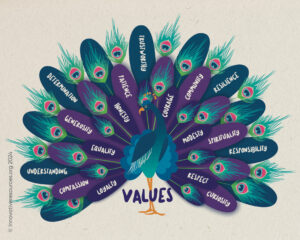
Whenever we are working with individuals or groups of people, we are often working from a set of values or principles. If we are working from a strengths-based perspective, for example, we might believe:

  • Everybody deserves to be treated with respect and dignity.
  • Everyone has strengths, skills and wisdom.
  • The problem is the problem; the person is not the problem.
  • Every person has a right to have their basic needs met.
  • People are doing the best they can with the resources and knowledge they have.
  • Every person should have access to quality food, housing, education and healthcare.
  • Every person has the right to feel safe.

If we hold these values, we may feel compromised if we are made to act in ways that don’t align with what we believe.

This might take the form of things like:

  • Not being able to provide housing for a family experiencing homelessness when you know they are desperate and have no other options.
  • Having to deny people medical care as you have limited resources, or only being able to give care to patients who can pay.
  • Offering a service to one person experiencing suicidal thoughts over another as there aren’t enough beds.
  • Having to complete forms or ask for personal information when you know the person is needing you to be present.
  • Having to spend time completing paperwork rather than being with students, clients or patients.
  • Witnessing systems or institutional structures that perpetuate or increase trauma, shame, or harm.
  • Not following up with a student you know is experiencing difficulties at home because you simply don’t have time.
  • Supporting someone who has committed acts that have harmed others.
  • Witnessing practices that marginalise or exclude certain people within your organisation but not feeling like you can do anything about it.
  • Having to report a family you’ve been working with for a long time to child protection, knowing they may have their children removed (knowing also, that this may cause additional trauma).
  • Having to teach a one-size-fits-all curriculum, knowing that this will not work for many of your students.
  • Witnessing violence or abuse, but not being able to intervene as it’s beyond your job role.
  • Making students who are neurodivergent take tests designed for neurotypical students, knowing the results will be unfair and inaccurate, and some students will be alienated from education as a consequence.

Events leading to moral injury may be one-off circumstances, or they may be an accumulation of small events that happen over time.

how to address moral injury

To combat moral injury, it’s essential to understand that healing does not just involve emotional support, but also the reconstruction of moral identity.

Here are a few ideas for how you can explore moral injury in a meaningful way:

  • Naming – create safe spaces where you can openly discuss moral conflicts without people fearing judgment or reprisals. This may be in supervision, peer supervision, in teams, counselling, or even with friends or family. Reflection allows individuals to integrate their feelings of guilt or shame into a larger understanding of their role and responsibility. It is also important to acknowledge what is within your control to change and what isn’t.
  • Acknowledgement – be aware that sometimes our teams or organisations may have become desensitised to moral injury.  This may manifest in the normalising or justification of behaviours or practices that are ethically questionable. Sometimes this has become a culture in a team over time or sometimes it results from people trying to deal with the reality that they are under-resourced. Challenging your team or colleagues to think differently, or ask deeper questions, may feel confronting or uncomfortable but it can also be empowering. You might find other team members have been sitting with the same concerns.
  • Reconnect with your values – moral injury can feel all-encompassing, like your whole being has been compromised. But this is rarely the case. Chances are, there are very specific circumstances where you’re feeling morally compromised. By identifying your values and exploring the specific instances you felt compromised, you can then consider if there are any solutions or changes you can make that allow you to continue working in a way that you feel is ethical. If the sense of moral injury has become debilitating, you may require professional support like counselling or external supervision.
  • Parallel practice – many organisations now have a set of guiding values designed to direct the work of the organisation at all levels. Building in regular opportunities for staff to reflect upon where their work aligns with organisational, and personal, values can help to identify places where policies, processes and practices don’t align and therefore increases the likelihood of moral injury. These can then be addressed at a systemic level. Moral injury can also be reduced if people believe their concerns are being taken seriously and change is likely, so it’s important to build in an action-reflection process to ensure people know their concerns are being acted upon.
  • Professional development – as moral injury is a relatively new concept in human services work, it may be valuable to organise some professional development or reflective practice sessions to understand what moral injury looks like for you and your workplace. The benefit of doing this collectively is that you can also start to explore potential solutions as a team or group. Make sure you spend time exploring how you can stay aligned to your values, even when things are tough. It is also important to talk about strategies for navigating challenging ethical terrain.
  • Understanding the broader context – moral injury isn’t just an individual issue; it reflects broader societal problems. It can be viewed as a symptom of an imperfect system—one where systemic inequalities, inadequate resources, and bureaucratic constraints force people to act in ways that are contrary to their beliefs. Addressing moral injury also means looking critically at the structural issues that create these ethical dilemmas in the first place.

Have you experienced moral injury? We’d love to hear your insights or reflections.

by Dr Sue King-Smith


Relevant card sets

Teacher Wellbeing Cards

Self-Care

Walking the Boundaries

Shelly Skinner is the Founder and CEO of Lionheart Camp for Kids. As a Social Worker whose own mother died when she was a young adult, Shelly is committed to building a community where grief is seen as a healthy and normal response to death and life challenges.  A world where everyone is taught the skills to identify grief and grieve in a safe and healthy way.

We recently spoke to Shelly and asked her advice about the best way to talk to kids about grief and loss.


‘Checking in’ is something that kids really appreciate. As adults we get a bit stuck in our grief, we jump in a grief boat and we paddle around, and we really like putting the grief blanket on and sitting right in there, but kids don’t do that.

A child might be told that their parent has died and they will cry and be really sad, and then ask if they can go play with their friends, or ask what’s for dinner. And the adult will think, ‘didn’t they understand what I said?’. But kids are so good at grief that they will attend to it in a moment, and then they’ll have some respite from it, and then they’ll attend to it again, and have some more respite. They’ll probably want to talk about it just before they’re meant to go to sleep at night and you don’t have the energy. But they’ll always go back to it when they need to.


The best thing we can do for kids is to be as honest as we can. Particularly these days with social media making things like suicide and murder so visible.

So many kids have lost a parent by suicide and haven’t been told the truth. But kids hear everything—every whispered conversation from behind closed doors. They might only hear snippets of details and try to fill in the gaps, and that can be really problematic. If a child doesn’t hear it from you, someone is going to tell them a version in the schoolyard. Often the ‘mean kid’ version.

Kids need to be able to trust the adults in their lives, so being as clear and direct as you can, even with hard information, helps kids know that a/ nothing is off limits to talk about and b/ they can trust you enough to ask tricky things.


We have an activity on our Lionheart camp called ‘the anonymous question box’. Everyone who comes to our camps has at least one question they haven’t asked for fear of upsetting someone, or feeling that it’s inappropriate. So, we invite everyone to write their question down, put it in the box, and on the second day of camp, a doctor comes along and we sit down in a big group (with a social worker present) and answer all the questions.

When it comes to answering kids questions, the short answer is, it’s all about being age appropriate and brief with your answers. Simple, clear answers and always introduce the idea of a follow-up question.

So, a child might ask, why do some people who get sick die and some people don’t die? We could go on for ages about details, but an answer could be: ‘Do you know what, every living thing will die, and we don’t know when we’re going to die, but everyone does the very best they can to make people better’.

And then we might say: ‘If you have a follow-up question, you can ask me any time’.


People often ask us at our Lionheart camps: If kids say things like, where do you go after you die? Or what happens to your body? What answer do you give? After all, everyone’s going to have a different belief.

We say: Every family thinks or believes something different. For example, we could all be Jewish people in this room, all have the same faith, but even then we would all do things in our family slightly differently.

So, your job is to talk to your family and find out what it is that’s important to you, and what you believe. Then really lean into that. Do all the rituals—all the things that make sense and are right for your family.

Having all the family on board is so important, so kids don’t hear one thing from a parent and something different from an aunt or a grandparent.


Grief plays a bigger part in people’s lives than we know. We carry grief into every day.
If we are experiencing significant grief then our threshold for just dealing with our day is going to be so much lower. Kids can’t say, I’m feeling really bereft today, or I really miss my mum. Or my dog died a week ago, and I know it’s only my dog, but I just feel really sad.

It’s going to come out in bad behaviour, talking back, withdrawal, or whatever it is for that child.

What we know about grief is that it magnifies who we are. If we are someone who is reasonably quiet then we’ll be far more withdrawn. If we’re someone who uses humour then we’ll be extra funny to the point of annoying. We’re going to see the behaviour, but not know what’s behind it. Behaviour is communication. And what we know about each child is really important.


For more information about Lionheart and its programs visit: Home – Lionheart Camp For Kids

We all need reminders sometimes that, even when things feel overwhelming or out-of-control, we always have choices.

We can choose how we interpret a situation, what we choose to focus on, the things we choose to tell ourselves, and how we choose to respond.

But in the intensity of the moment, it’s easy to forget this simple yet important fact.

Created by author, teacher and seeker, Gena McLean, and drawing strongly on the tenets of Choice Theory, Note to Self provides a set of simple, hopeful reminders to take a moment and reflect on the things we have control over, and the things we don’t.

With statements on the front and three simple questions on the back, these cards are perfect for helping us to take a deep breath, step back and remember that every situation presentsicecream opportunities for us to change and grow.
As the cards invite us to explore our lives from a more hopeful, proactive perspective, they are also creative and gentle reminders that we all have strengths, resources and skills we can draw on.

The 24 cards are divided into 6 suits—Choice, Perspective, Success, Meaning, Insight and Growth— which means you can focus on a particular suit, work through them systematically or just mix them up and choose randomly.

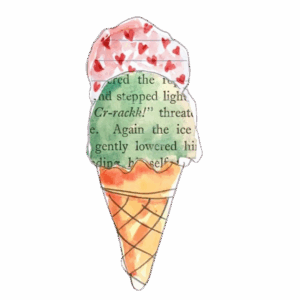
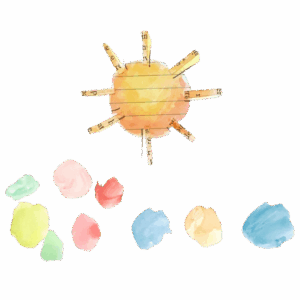
In this new edition, we have invited the wonderful artist of our Anxiety Solutions for Kids and iconic Strength© Cards, Katie Jardine, to create some fun, quirky images to help bring the cards to life. The Note to Self cards were originally designed to be stuck up on your mirror or fridge, above your work space, or wherever you need a reminder. Now with these beautiful, reflective and gentle artworks, they provide an even more engaging prompt to support you to reflect on the things that matter.

Perfect for individual self-reflection, counselling, social work, as a journalling tool, or a gift for an important person in your life who needs a lift.

Note to Self will be available later in 2025.

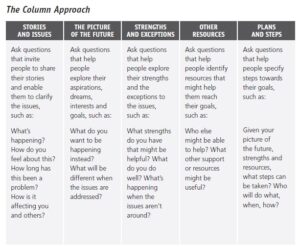
Today, I thought I’d talk about a tool that has been around for a while but is still a favourite – the five-column tool.

The five-column approach was pioneered by Di O’Neil and Wayne MCcashen at St Luke’s Anglicare back in 1990 and is one of the cornerstones of strengths-based practice. It began as a paperwork tool used to record, in summary point form, conversations and reflections between workers and those accessing services, but it’s evolved to become an amazingly effective tool for supervision, reflective practice and for creating organisational change.

I’ve been using the five-column approach a lot lately in our Strengths Approach to Practice workshops and recently had an amazing experience while delivering training to an Aboriginal Co-Operative.

Normally, I’d ask participants to break into small groups, try out the five-column tool, then report back to the group. But in this case, the group decided they wanted to do the exercise together as a collective.

There were 25 people in the room, but I thought, okay then, let’s give this a go.

The topic for conversation was ‘where are all the men?’ Their focus was how Aboriginal men be encouraged and supported to participate in programs.

The conversation flowed for more than 30 minutes and we filled the entire white board. There were so many questions asked, pictures of the future imagined, strengths and resources identified, and plans made for the way ahead.

The conversation steered towards things like, What have we done in the past that’s worked? and What might change if we do things differently?

There were tears too, with participants saying things like, ‘we’ve never seen it all up there in writing before’ and ‘we’ve been holding onto these things for such a long time’.

Participants felt a sense of power and relief that their observations and concerns—their voices—were there for all to see. There was a consensus that ‘higher up’ need to see this.

What I love about the five-column tool is that it’s a living document—one you can keep going back to. You can cross things out and add things to it. It keeps all those conversations alive and everyone accountable.

Real and positive change followed those training day conversations—many new, culturally significant ways of involving men in programs were implemented as a result.


‘…whether we lose a person, or whether we lose a place, or whether we lose some ’thing’ that’s important to us, it’s normal for us to need an extended period of emotion or reaction to that.’

Shelly Skinner isn’t afraid to talk about grief and loss. Indeed, she’s made it her life’s work to help others, particularly young people, have those important conversations about death, dying and loss.

Shelly is the CEO of Lionheart, an organisation she began a decade ago with colleagues at Princess Margaret Hospital and Perth Children’s Hospital.

As a palliative care social worker, it became obvious to Shelly that children who experienced the death of a parent or sibling, where the death was not caused by cancer, received little to no support to help manage their grief.

‘If your family member died from cancer, you had Camp Quality and Canteen and all those excellent services that Lionheart now works closely with,’ Shelly says. ‘But if your family member died of anything else, there was nothing. You could pay for psychology, or pay for play therapy, but there was no kind of normalising, connecting, community support.’

Shelly ‘raged’ for a while and then decided she had to do something about it. Her own mum had died unexpectedly when Shelly was just 26, so it was an easy leap for her to understand what the young people she counselled must be going through.

‘I remember thinking, “I’m an adult, and I know what my mum believed in, and I know what her values were and what she wanted for me in my life, but if I was 6, or 7, or 10, I wouldn’t know any of that”.’

‘My sister and I talked about it a lot,’ Shelly says. ‘If Mum had died when we were little, life would have been so different. Dad would have had no support. It made me think of all the families in that situation.

As Shelly describes, she decided to ‘put up or shut up’. With her colleague Belinda Hughes she created a program called Blue Skies—a two-day camp for kids aged 8 to 12 following the death of a parent.

‘The children really blossomed,’ Shelly says. ‘The problem was, that while we were providing the kids with new skills and language around grief—new connections—they were going home to siblings, parents and extended family who hadn’t shared that experience.

‘We realised the program was never going to make sustainable change, unless we broadened the circle.’

When Blue Skies couldn’t find an organisation to continue the program, Shelly and Belinda decided to bite the bullet. After all, how hard could it be to start a charity? (turns out, pretty darn hard). And so, Lionheart was born.

‘Yes, it’s been hard and there have been challenges, but it’s also been the most wonderful journey and experience,’ Shelly says. ‘We now have support programs in our community for ALL children regardless of how a person died, regardless of who died, where they lived, or whether families can afford support.’

Lionheart’s programs are designed to educate children, teens, and adults about grief and loss, to ensure the whole family unit is strengthened and empowered on their grief journey. They provide a safe, fun environment for children and teens to explore and understand their grief and recognise that while grief is one part of their life, it doesn’t need to define them.

Lionheart’s programs also offer opportunities for parents and grandparents to learn about childhood grief and how to manage their own while supporting their children.

‘Our camps are for whole families,’ Shelly says. ‘The family members do some activities separately and some together. This all happens six months after the death of someone in a family’s life—we think the first six months is just too overwhelming and all-consuming.

‘We also run “returning family camps” that families can come to each year for as long as they need or want to.’

Lionheart is also piloting a new program called Raw to Roar, after feedback from families about the lack of support immediately after the death of their loved one.

‘If someone has an illness, at the time of diagnosis, families are surrounded by health professionals and social workers and OTs and nurses … the system is also getting really good at end-of-life care,’ Shelly says.

‘But then families are telling us things like, “our child died yesterday and we had to leave them at the hospital and have woken up this morning without them, standing in our loungeroom, no role, no purpose, not knowing what to do”.’

Raw to Roar will see grief coaches walking alongside families from the time of diagnosis (if it’s a terminal illness) through end of life, into bereavement, and for two years after that. The grief coaches work with extended family as well, and into schools and workplaces.

‘The idea is to provide skills and scaffolding for those in the family’s circle of support,’ Shelly explains. ‘If we can upskill the whole community, imagine how beautiful that would be for a grieving child or family.’

One of the most important aspects of the Lionheart new families camp is the opportunity for young people to tell stories about the person they’ve lost. For many it’s the first opportunity they’ve had to talk about the person and, as Shelly says, they delight in it.

‘Often the people close to them feel awkward and don’t talk about the person who’s died for fear of upsetting the child, but we start every camp with an activity that invites the young person to bring a photo and share their story with other participants in a small group.

‘To begin with, they’re a bit hesitant, and not sure what their story means to them yet. But they practice it over the two days—think about “how” they tell their story. When they return a year later we start the same way, and you can see how their story has evolved. Often, they find the connection between themselves and the person who died. My dad really loved reading and I love reading. We have the same colour hair.

‘They start to connect with their person, what it meant to have them in their life, and how that connection will grow into the future.  The more they tell their story the more they have a sense of belonging to that story.

‘It’s a beautiful thing.’

Shelly Skinner provided us with so much wisdom when it comes to talking with children and young people who are experiencing grief that we’ve saved much of it for another blog. Keep an eye on our social media or website blog page for more.

We’ll also include some great ideas from Shelly for using Innovative Resources card sets in a grief and loss settings which you’ll find in our product toolboxes.

Find out more about Lionheart programs at: Programs – Lionheart Camp For Kids


by John Holton

When artist and designer, Fiona Mansfield, thinks about the awakening of her creative self, she’s taken back to a time in her childhood when she was stuck at home with the measles.

‘I was in quarantine with a big A3 pad of paper and coloured pencils,’ she remembers fondly. ‘I filled pages and pages with goofy characters with googly eyes and the time flew by.’

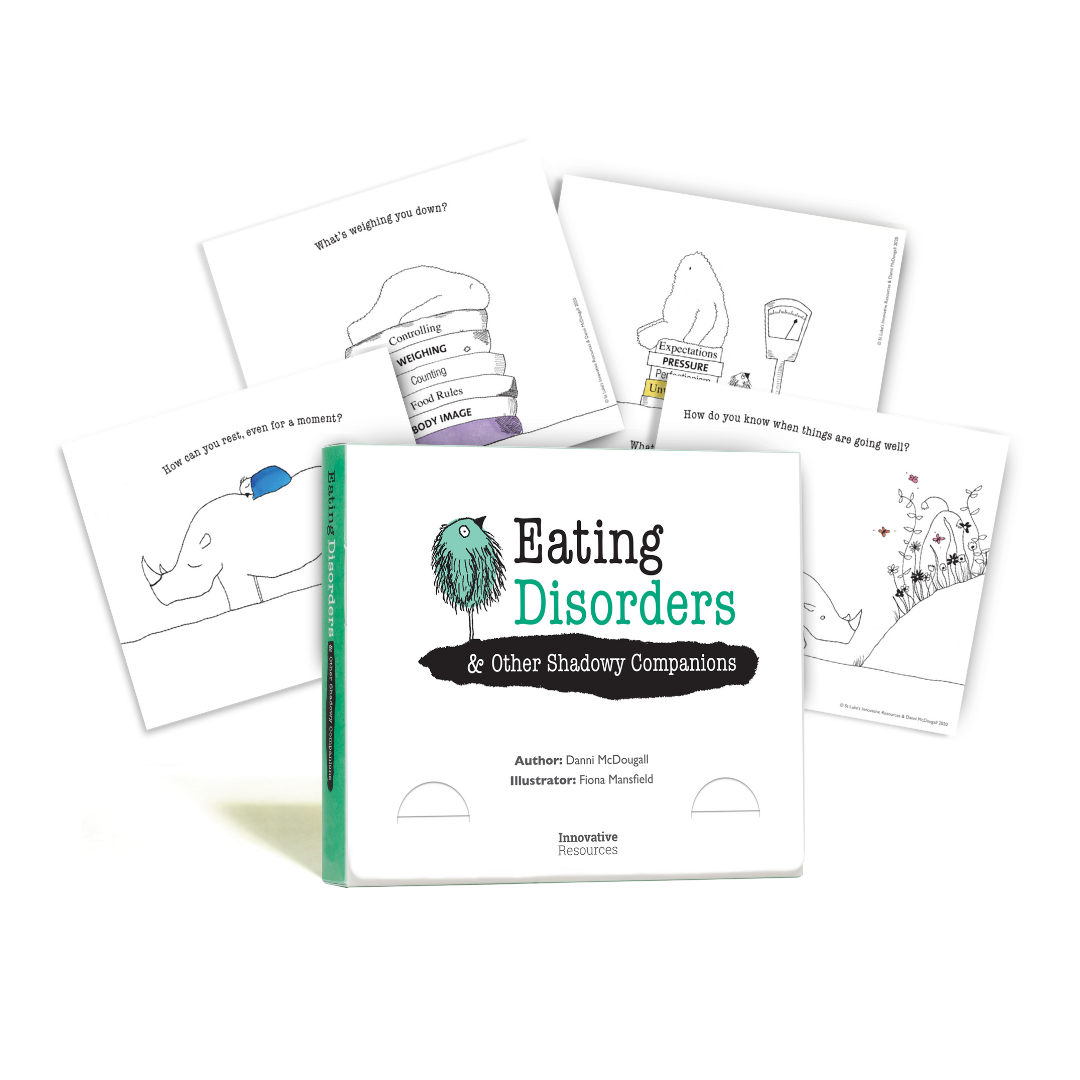
Anyone familiar with the soulful and quirky characters at the heart of Innovative Resources’ card set Eating Disorders & Other Shadowy Companions won’t be surprised by this genesis, but the artist herself never dreamed of a life for her characters beyond that A3 drawing pad.

‘I never saw myself as having the skills to be an illustrator, or that my drawings would have any practical application or outside appeal,’ Fiona says. ‘It’s just something that’s always been part of my life to varying degrees.

‘When art gets squeezed out by the daily busyness of life, I feel myself shrivelling up like a neglected pot plant. It’s then I know I have to revisit my creative self and have a conversation with her.’

It was that understanding of art—as a form of connection and communication—that led Fiona to explore how art could help others deal with the challenges of life.

‘I always carried around a sketchbook and doodled what I was feeling, and usually I felt lighter and less anxious afterwards,’ she says. ‘I was fascinated by how that worked in the mind and body and decided to do post graduate studies in Art Therapy.’

After graduating, Fiona joined Arts Billabong, an organisation that worked with teenagers therapeutically in an art studio. She has since worked with young people in a range of settings, including schools and mental health organisations.

It was as an Art Therapy student that Fiona first crossed paths with Innovative Resources’ cards.

‘I first used The Bears and Strength Cards in Art Therapy classes, and then later in my sessions with young people and groups,’ she recalls. ‘Over the years I’ve used them as a student, a therapist, a client and a creative. It’s incredible how the cards grow and adapt depending on what you need from them at the time.’

Fiona’s first publishing venture with Innovative Resources was in 2010 when she wrote and illustrated Violet’s Voice, a picture book that grew from an experience happening close to home.

When her cousin’s daughter was having challenges adapting to a new educational environment, she found the resources provided by the school to be pretty ‘dry’ and unrelatable. Fiona saw the opportunity to create something more personal.

‘I made up a story about her and illustrated each sentence to make it more like a picture book that “she” was the star of,’ Fiona says. ‘She found it really helpful, so I sent a copy to Innovative Resources. It was a great surprise when they offered me a publishing contract.’

Violet’s Voice is a simple, yet powerful narrative about the many voices each of us has, how we use them in different situations, and how our different voices can affect the way we feel about ourselves and the way we communicate with others.

Jump ahead 10 years and Innovative Resources was once again knocking on Fiona’s door, this time seeking her unique illustrative style for a new card set called Eating Disorders & Other Shadowy Companions, created by social worker and art therapist, Danni McDougall.

Danni had lived experience of an eating disorder and also a strong vision for the cards. The combination of Danni’s desire to help others and Fiona’s quirky soulful illustrations (along with their shared experience of art therapy) created the characters at the heart of Eating Disorders: Bird, Ed (the eating disorder monster) and Reggie (the recovery rhino).
‘Bird surfaced one day during my Art Therapy course,’ Fiona recalls. ‘I’d cut random words from magazines, then made some marks on the page in response. I just keep adding marks until some kind of drawing happened.

‘In one of these drawings a scruffy bird appeared, and then he kept appearing and interacting in different ways with the words I’d pick. The results were often nonsense, but sometimes meaningful.’

Reggie the rhino appeared in a similar way in Fiona’s early drawings … a calming and stable presence. Ed arrived much later as a response to Danni’s initial sketches for the project.

‘She drew a monster with spiky hair and I thought it was an effective way to illustrate this uneasy companion,’ Fiona says. ‘He isn’t outwardly scary, but his blankness can often feel malevolent.’

One of the biggest challenges for Fiona at the time was, as she puts it, the limitations of her illustrative style and her experience with the subject matter.

‘There were many concepts and ideas I tried that were difficult to make work in a one-dimensional line drawing,’ she explains. ‘I worried that they wouldn’t be relatable or useful for someone experiencing an eating disorder. There was a lot of trial and error involved on my part and I was glad to have Danni and Karen [Karen Bedford was Managing Editor at the time of publications] for feedback and guidance.’

With many of the illustrations based on the spontaneous drawings from her Art Therapy course, Fiona found bringing them back to life both ‘a bit weird’ but quite wonderful.

Asking Fiona about her favourite cards from the set, it’s easy to see why Eating Disorders has the capacity to transform lives.

‘At the moment I really relate to the “what helps ease the pain” card,’ she reflects. ‘It reminds me of the watchful love my dog offers me constantly and unconditionally.

‘I also love the “what can you do to take care of yourself today” card. For me it reinforces the idea that creating something from the heart is an act of love to yourself or someone else.’

Fiona still draws and paints regularly and sees art as a therapeutic tool for herself as much as her clients. She’s currently building a body of work she affectionately calls her ‘Blah paintings’.

‘It’s just me putting paint on a surface in whatever way it happens to get there, bringing with it whatever thoughts and emotions surface,’ she says. ‘They may not pretty or even understandable, but I’ve gained a renewed appreciation for the magic of making art and how healing and cathartic it can be.

‘A blob of paint is never just a blob of paint … it sometimes knows more about us than we could ever imagine.’

by John Holton

Wherever you turn these days, there seems to be reports of teachers leaving the education system in droves. And things seem to have become significantly worse over the past few years.

A 2023 national survey of 4000 teachers by the Black Dog Institute in Australia found that ‘teacher mental health and burnout could halve the workforce’. The study found that ‘almost half of Australian teachers (46.8%) are considering leaving the profession within the next 12 months. This is an increase from 14% of teachers intending to leave the profession in 2021’.

The data also showed:

  • 60% of teacher absences in the previous month were due to a mental health or emotional problem.
  • 52% of teachers reported moderate to extremely severe symptoms of depression compared to 12.1% in the general population. For teachers with anxiety symptoms the figures were 46.2% compared to 9% and for stress, these figures came in at 59.7% compared to 11.4%.

A meta study of teacher wellbeing research also found that teacher wellbeing (or lack thereof) is associated:

‘… negatively with teacher stress and burnout, and positively with satisfaction and positive emotions, resilience and flourishing, and motivation and commitment.’

Senior lecturer in education and teacher, Dr. Kristina Turner, and psychologist, Professor Monica Thielking, have spent several years researching the wellbeing of educators. Drawing on positive psychology frameworks, they have worked with hundreds of teachers to identify the things that are leading to stress, burnout, and overwhelm (all things contributing to the current ‘teacher exodus’), and the things that help teachers feel more hopeful, connected, supported and happy at work.


‘Teachers play a vital role in educating and shaping the lives of young people,’ Turner and Thielking say.

‘Many enter the profession with a deep commitment to making a positive impact on students’ lives. Teaching is both rewarding and challenging, and ensuring teachers’ wellbeing is essential for them to perform their roles effectively.’

Their research has found that there are many factors that contribute to poor teacher wellbeing including increasing workloads, administrative pressures, poor resourcing, emotional demands of teaching and a lack of work-life balance.

They also note that the impacts of low teacher wellbeing go beyond the impacts on the teacher themselves, saying, ‘Poor teacher wellbeing has implications for workforce sustainability, teaching quality and student outcomes.’

Their research also draws on international data, which finds that this issue isn’t just an Australian problem.

‘Recent research indicates that teachers worldwide are experiencing heightened levels of stress, anxiety, burnout and depression. This global issue prompted the United Nations Secretary General to recently convene a High-Level Panel on the Teaching Profession in response to the global teacher shortage and as a key follow-up to the UN Transforming Education Summit of 2022.

‘Similarly, one of the recent recommendations arising from the European Commission’s expert group on enhancing supportive learning environments for vulnerable learners and for promoting wellbeing and mental health at school was to empower educators to innovate in teaching while maintaining their own wellbeing.’


what can we do to address these challenges?

A recent Monash University study of over 1000 educators found that teachers identify the following as key to their wellbeing: ‘ feeling safe, supported, valued and trusted, as well as achieving a work/life balance.’

This aligns with Turner and Thielkings findings. They say:

‘Addressing this crisis requires a shift in focus towards strategies that ensure teachers have high job satisfaction, experience their work as meaningful and effective, and promote wellbeing.

Their research found that strength-based positive psychology approaches to supporting teacher wellbeing have been shown to be effective.


benefits of supporting teacher wellbeing using positive psychology

Turner and Thielking’s research (Turner & Thielking, 2019a; Turner Thielking & Meyer, 2021; Turner, Thielking & Prochazka, 2022) has shown that when teachers consciously apply positive psychology strategies in their daily teaching practice, they:

  • Feel less stressed, more relaxed, more positive and calmer in the classroom.
  • Feel more engaged with teaching, which they believe improved the quality of their lessons.
  • Spend more one-on-one time individually with their students and as a result developed a better relationship and understanding of their students, as well as an improvement in students’ work and confidence.
  • Adopt a more positive outlook toward their students and give students more strengths-based feedback about their work.
  • Become more focused on making their lessons deeper, more meaningful, more engaging and more enjoyable for students.
  • Empower their students by giving them a greater voice in the classroom and including more student-led activities.
  • Create classroom environments that are calmer, with an increase in engagement, learning, and completion of work.

If we are to stem the flow of talented, creative, skilled and experienced teachers out of education, we need to start creating educational environments that are supportive, enriching, respectful, and hopeful, where workloads are reasonable and educators feel valued.

Kristina Turner and Monica Thielking are the authors of our newest resource, Teacher Wellbeing Cards. With stunning, illustrations by artist, Kain White, these cards are perfect for having honest conversations about how educators can set boundaries, find a better work-life balance, rediscover meaning and energy in their work, and feel more hopeful and empowered.

Preorder now for delivery in July 2025.

Nick Avery is the CEO of South West Autism Network (SWAN) in Bussleton, Western Australia, a not-for-profit organisation that grew out of a very real need for families in regional areas to have access to support, information, community networks and advocacy.

SWAN’s vision is both simple and life-changing; to create communities where every autistic person is able to live the life they choose.

It’s both Nick’s passion and her lived experience. Her two children, now in their 20s, both live with autism and Nick herself was diagnosed at the age of 43.

‘Both my kids were diagnosed as toddlers in 2000 and 2002,’ she says, ‘but living in regional WA, there was no access to early intervention therapy outside of Perth.

‘Every week I would drive four hours each way so they could access therapy services. I wanted to change that experience for autistic people and families in regional areas.’

What began as small peer support group has grown into an organisation that supports hundreds of clients every week, providing specialised programs, resources and advocacy, while linking families and individuals to services. Everyone at SWAN either has a disability, is a family member of a person with disability, or both.

‘When you’re feeling overwhelmed and exhausted, and are desperate to find support, being able to talk to someone who’s been there and can help you navigate these complex systems not only creates hope, but also access to practical, meaningful support,’ Nick says.

Being diagnosed later in life—mostly due to the cost involved in going through the process—Nick understands better than most just how hard the National Disability Insurance Scheme (NDIS) can be to navigate.

She describes herself as being ‘very detail-oriented’ which can be a great strength in some situations, and real struggle when dealing with bureaucratic systems.

‘I struggle with a lot of sensory issues, particularly in social or work situations where I’m confronted with a question or statement that I don’t have a memorised script for dealing with,’ she explains. ‘Job interviews are a particular area that I’ve struggled with throughout my adult life. I’ve never successfully achieved employment through a job interview.’

Her lived experience means that when Nick is listening to her clients explain what’s going on for them or their family, they quickly realise she ‘gets it’.

‘When supporting our clients, it’s really important they feel heard; that their concerns and difficulties are acknowledged,’ Nick says. ‘We can then provide information, resources, strategies and support to empower them to make decisions about what to do next. They can get the support that actually meets their needs.’

Nick has been a long-time fan of Innovative Resources’ card sets and finds them really useful in her day-to-day work with SWAN clients.

Image from The Bears

The Bears cards are fantastic for learning to recognise and understand emotions,’ she says, ‘something that doesn’t come naturally to many autistic people. It needs to be explicitly taught to many of us. The Bears can help to identify and connect the nuances of similar and related emotions.’

Body Signals is another of Nick’s favourites for exploring interoception—commonly defined as ‘the ability to be aware of internal sensations in the body’. Things like recognising when you’re feeling hungry, full, thirsty, or need to use the bathroom—but also recognising the signals from the body that indicate anxiety, overwhelm, anger, excitement, tiredness or illness.

‘For autistic people, connecting body signals with emotions is so important for improving emotional regulation, reducing sensory overwhelm and improving self-care,’ Nick says.

‘I’ve used Body Signals a lot with an autistic youth who struggles with severe anxiety that triggers frustration, anger and meltdowns. They’ve been able to use the cards to identify what they’re feeling in their body and connect those symptoms with the emotions.

‘It’s a huge achievement for this particular young person, and we’re hoping, with practice, they’ll be able to recognise the signs of their anxiety building before the point of overwhelm.’

Image from Strength Cards

Strength Cards® have also been a great tool for working with young people, especially in building self-esteem. SWAN mentors often do an activity with kids and youth where they create an A3 poster with a photo of themself in the middle, and Strength Cards® stickers around the image to represent their unique strengths.

‘Autistic kids hear so many negative things about themselves, and very little about their strengths,’ Nick says. ‘Watching them proudly show their parents the poster of their strengths at pick-up time is one of my favourite things. We encourage them to put the poster up in their bedroom as a reminder of how awesome they are.’

While things are slowly improving for neurodivergent people, including those with autism, Nick says we still have such a long way to go to make communities truly inclusive.

The autistic community call it the double empathy problem. Neurotypical people socialise and interact really well with neurotypical people, and autistic people socialise and interact really well with autistic people. It’s when neurotypical people and autistic people try to interact and socialise that things typically go pear-shaped.

‘It’s a bit like visiting another country which has very different customs and colloquialisms,’ Nick says. ‘Misunderstandings are guaranteed. The problem for autistic people is that our way of thinking and interacting is assumed to be wrong and the neurotypical way of thinking and interacting is assumed to be right.’

Nick uses the example of shared environments as a way to highlight the impasse.

Image from Body Signals

‘While many people with autism don’t get enough signal from their interoceptive senses, most of us get too much signal from some of our other senses,’ she explains. ‘Too much noise, too much light, strong smells … these can all cause pain, distress and overwhelm. Many of us can hear fluorescent lights buzzing and find bright lights excruciating.

‘Crowds are overwhelming for most of us, and trying to focus in on what one person is saying in a sea of other voices and sounds can be impossible. Neurotypicals who don’t experience these issues are often dismissive.’

Nick would like to see a world where more people adopt an open-minded, curious approach when interacting with autistic people, and environments specifically designed to be sensory-friendly.

‘Time and again I’ve watched accommodations made for autistic people in classrooms and other environments, and neurotypical people have benefited from the changes.  When environments and systems are made neurodivergent-friendly, everyone wins.

‘People are increasingly acknowledging that there are strengths as well as difficulties in being autistic, rather than seeing it as merely a grab-bag of deficits. But there’s still a long way to go to achieve equity.’

By John Holton