Join the conversation! SOON (Seriously Optimistic Online News) keeps you connected with everything Innovative Resources – subscribe today!

If your situation is urgent, you can contact these services 24-hours a day, 7 days a week

CLOSE (X)

The power of koalas

Around the world, koalas are universally loved. They are furry balls of sleepy cuteness (if you ignore their sharp claws and the eerie grunting sounds they make at night—holy Manuka, that is one scary noise)!

But they are also more than that. They are tenacious, strong and incredibly resilient. They are also perfectly designed to deal with the often harsh and changeable Australian landscape, needing little water and food to survive.

And they are completely unique. They are not a bear (despite publicity to the contrary) but a marsupial, carrying their young in a backward-facing belly pouch (how does that work). They have four opposable thumbs, ‘particularly hard bottoms’ and survive on a diet of toxic leaves. They also have fingerprints, just like us. In fact, under a microscope, koala fingerprints and our fingerprints are almost indistinguishable! There isn’t another animal like a koala anywhere else in the world.

In other words, just like humans, they are complex and multifaceted. They may look like one thing on the surface but hidden just beneath that surface are many diverse and fascinating qualities. This is one of the things that make them so relatable and engaging.

It is also the reason Innovative Resources has chosen to use them as characters in many of our card sets and tactile tools. Like many animal characters, koala characters are great because they can be any gender, ethnicity or age, so everyone can relate to them. Koalas are also enigmatic which makes them a great canvas for exploring different emotions, feelings and body signals.

Koalas feature in The Koalas, Mates Traits cards and activity book and on the Koala Company Therapy ball. They also make a cameo appearance in Strengths Cards for Kids and Picture This. Now they are also the stars of our latest digital card set, the Koala Company cards.

The Koalas and Koala Company cards—what are the differences?

Two of our much-loved card sets, The Koalas (available hard copy only) and the Koala Company (these were previously available in hard copy format, now available digitally only) were designed with different uses in mind.
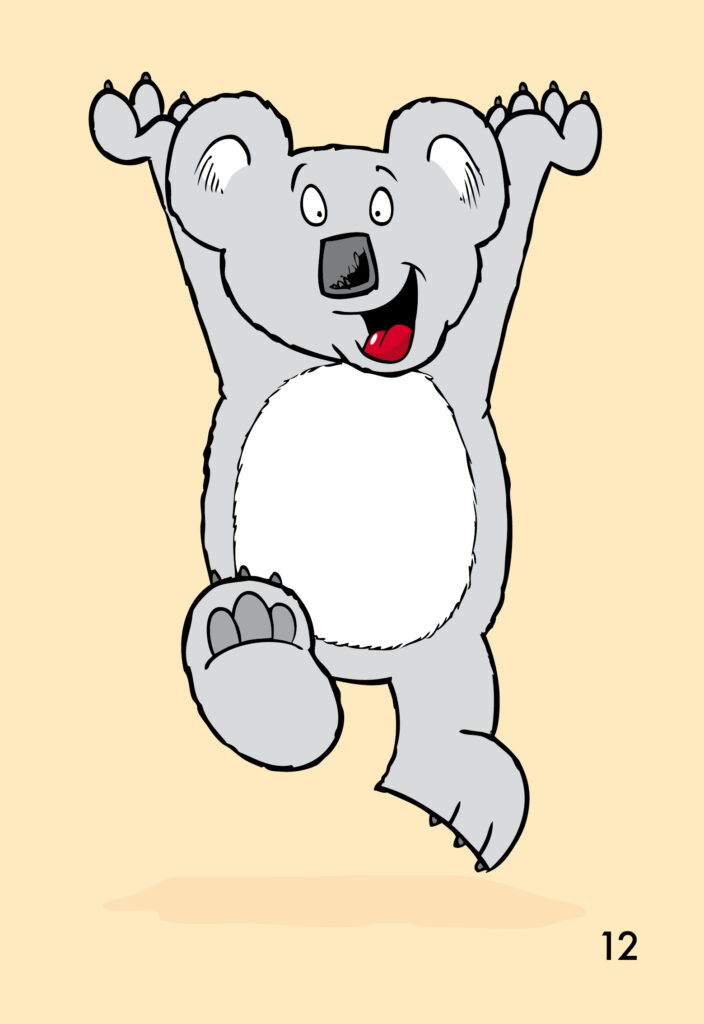
The Koalas is a set of 20 cards that are small enough to slip into your pocket, which makes them perfect to take with you to meetings with clients or when you are heading into the classroom. They are great for impromptu catch-ups or quick conversations on the run. You can also play games with them (they are small so they are easy for children to shuffle) or combine them with other card sets and resources, like story books or stickers.

They are not only small in size, but also in price! The Koalas were developed to be an affordable and accessible option for practitioners who wanted a condensed but versatile set of feelings cards.

While there are only 20 cards, they cover way more than 20 emotions. For example, the koala with smoke coming out of its ears could be angry, frustrated, overwhelmed, blowing off steam or just plain hot! The potential emotions and feelings are almost endless and it’s completely up to the person using the card to decide what the koala is feeling. Because these cards depict the whole body of the koala character, they are also perfect for talking about body signals and body language. The Koalas are for people of any age.

The 50 circular Koala Company cards include a range of zany characters, complete with punk haircuts, nose rings and sunglasses, which make them great for using with teens. Unlike The Koalas, these cards focus on faces so you can really hone in on their expressions.

Koala Company cards can be used as a communication tool, an evaluation tool or as a reflection tool. They can be used with individuals, in classrooms, families, or groups. So many possibilities!

Why don’t the cards have words on them?

As we know, it is rare that one single word can provide a complete description of our experience. If only life was that simple! While we often use single word labels as a shorthand way of describing our feelings (happy, sad, fine, cross, depressed, etc.) this can lead to an oversimplification of what we are feeling. Often feelings are actually a jumble of different emotions—they may have many subtle variations, differing intensities or confusing and competing layers.

That is why, when we are talking about feeling and emotions, it can be great to have a range of different images you can mix and match to create a more complete picture of an experience. This is where feelings card sets can be particularly useful. Spread them out and let people choose a range of cards that, together, help describe their experience. Ask people to imagine how they would like to feel in the future and select cards that provide a concrete image of those feelings. What emotions are getting in the way? What feelings would they like to feel more, or less?

Having no words on the cards also means that people can interpret them however they like. They are also great for people with low literacy or whose first language isn’t English.

The new digital Koala Company cards have some great extra features!

Now the Koala Company cards are available digitally so you can use them on your laptop or other mobile device. You can make notes on them with the pen tool, create bookmarks or send them to people. They are great for having remote conversations and are infinitely portable. And just like The Koalas, you can slip them into your pocket, but on your phone this time!


Koala Company digital cards              $39.50 inc. GST      Product Code: D3061

The Koalas                                               $19.95 inc. GST       Product Code: 2175

Everywhere we look these days, we see mindfulness touted as one of the wonders of the wellbeing world. Bookshops are overflowing with books on all aspects of mindfulness. There are books and blogs on mindfulness and running, learning mindfulness from your dog and mindful cake decorating. So many ways to be mindful!

The list of benefits associated with mindfulness is long and illustrious. And to be honest, these benefits cannot be overstated. According to the American Psychological Association, the benefits include:

  • stress reduction
  • reduced rumination
  • boosts to memory
  • more focus
  • less emotional reactivity
  • more cognitive flexibility
  • increase in relationship satisfaction.

I mean, what’s not to like!

But if mindfulness is so great, why aren’t we all doing it, all the time?

The reality is, it is easier to be mindless than mindful. Nearly all of us are pretty skilled at being mindless (I would even claim expert status)! And while mindlessness is usually painted in a pretty negative light, perhaps there are benefits to the occasional lapse into this much maligned state?

 What is mindfulness?

Headspace defines mindfulness as:

‘… the quality of being present and fully engaged with whatever we’re doing at the moment—free from distraction or judgment, and aware of our thoughts and feelings without getting caught up in them.’

When we are being mindful, we aim to be in the here-and-now. We try to look past our pre-conceived ideas so that we see things as they are rather than as we imagine them to be.

Mindfulness has come out of Buddhist meditation practices and traditions. Many people think that meditation and mindfulness are one and the same. But in actuality, mindfulness can be practiced in any situation at any time—it doesn’t require us to be yoga-panted, incense-infused or cross-legged!

In fact, according to long-time Harvard researcher on mindfulness, Ellen Langer, mindfulness simply requires us to actively notice new things. The Langley group summarise Langer’s position by saying, ‘The traditional concept of mindfulness sees meditation as an activity you try to embed into your life. In the Langerian approach life becomes embedded in your meditation.’

What do we mean by mindlessness?

Mindlessness traditionally has meant doing things without being conscious of what we are doing. We often talk about mindless eating or mindless violence, for example. It is also often associated with habits and things we do without thinking, like driving or ironing.

Langer describes mindlessness as ‘an inactive state of mind’ in which we rely on preconceived ideas about things so we don’t really see or engage with things as they actually are, only as we remember or have previously defined them.

This can include unexamined assumptions. For example, that the fork always goes on the left and the knife on the right, or that men should put the toilet seat down.

My son recently challenged me about this one, saying there was no logical reason that he should put the toilet seat down. All I could argue in defence of the ‘toilet seat down’ rule was that it was the ‘done thing’ and he would be considered rude if he didn’t do it—and most importantly, it was disrespectful to women to leave it up as women shouldn’t have to touch a potentially pee-covered seat! But he countered by saying that if men had to lift up and put down the seat, they, too, were touching a potentially pee-covered, and bum-touched, seat—so why shouldn’t women? It was ‘the rule’, I said!

Being a highly logical creature with an innate sense of fairness, he decided that, actually, I had no good reason for telling him to put the seat down, so now it is routinely left up. And even though I find this highly irritating, I have no logical reason for making him put it down—it is a mindless rule that has simply persisted. (Sorry to all the women out there—please forgive me for busting this one!)

How can mindlessness be damaging?

All jokes aside, there can be some downsides to mindlessness and habitual behaviour. When mindless habits become a way of drowning out negative feelings and experiences, they can become unhelpful and potentially damaging. For some people, these habits can become addictions, like alcoholism, gambling or over-eating. When violence is used against others, it is often done in an impulsive and ‘mindless’ way—this is never helpful or constructive.

When mindless thoughts become ruminating or anxious thoughts, they can undermine people’s mental wellbeing. In fact, negative unexamined or unchallenged thoughts, feelings, beliefs and self-talk can become debilitating and may lead to serious mental health issues.

Mindlessness can also be problematic when we make unexamined assumptions about people or situations. When we fall back on what we ‘know’ we may not be open to seeing the world as it is, which can lead to us having a limited, and limiting, world view: As described in ‘Mindfulness v mindlessness: the art of noticing new things’:

‘When we are committed to a predetermined mindset, the next time we encounter the same thing, we do not explore other ways of seeing things or applications. We miss new perspectives and emerging possibilities. For leaders in the workplace, this can create blinkers that block innovation and prevent people from pivoting in new, more effective directions.

‘By not interacting mindfully with the world around us, we can perform far below our actual levels of intelligence or potential. For example, we can create mindless categories about people that make it acceptable to harm others under certain circumstances; or we make unintelligent choices and experience a loss of control. In extreme cases it may lead to learned helplessness.’

How might mindlessness be helpful?

The general consensus seems to be that mindlessness is the opposite of mindfulness, and mindfulness is helpful while mindlessness is not.

However, I’m not sure this is entirely true. Sometimes, completing repetitive tasks like driving to work or doing the dishes without consciously thinking about what you are doing, makes the task seem less onerous. While on autopilot, we may also resolve many other problems unrelated to the task at hand–an added bonus.

As Sarah Monk says in her article ‘Mindful versus mindless’,

‘…the unconscious mindless processes we all possess should not be underestimated. Being able to use these effectively is key in good decision making and optimal performance especially in complex situations and in promoting creativity. Being constantly mindful simply requires too much cognitive processing power to allow us to do all the things we need to do to function in daily life. We need the mental shortcuts of mindless thinking otherwise we’d never get anything done. Contrary to our instincts, unconscious thinking processes are better at handling and analysing large amounts of complex data, so believing that mindful analysis is always preferable may lead to less effective choices. So mindlessness is good and necessary, sometimes.’

Another reason mindlessness can be valuable is that it gives us a break from our highly outcome-focussed culture. Pizza and a cheesy movie, social media rabbit holes or watching the clouds go by, can all be mindless activities that are great for relaxing at the end of a busy day. A bit of old-fashioned escapism can sometimes be just what the doctor ordered.

(While mindfulness can do this too, it takes practice to get ‘good’ at it, which can make it, paradoxically, another outcome-focussed activity. We may feel pressure to learn, develop, build our ‘mindfulness muscles’. These are great muscles to have, at least as important as the other kind! However, until we have those muscles sorted, it can feel like another thing on the to-do list.)

Daydreaming is another form of mindlessness that is often underrated and undevalued. We chastise children for not paying attention in class and ‘being good at staring out the window’ is definitely not something we would add to our resume. But maybe it should be. While we do need to be able to control our attention at times, allowing our minds to wander can also be highly productive. As the authors of Wired to Create, Scott Barry Kaufman and Carolyn Gregoire say,

‘Many of us know that our best ideas come seemingly out of the blue when our minds are off wandering elsewhere. Idle though it may seem, the act of mind wandering is often anything but mindless. Research suggests that an incubation period of mind wandering leads to improvements in creative thinking.’

So there you go. Mindlessness has its uses after all!

Are mindfulness and mindlessness that different?

Sometimes mindless activities are actually mindfulness in disguise. When we are very focussed on an activity we know well, something that includes repetitive action, like knitting or gardening for example, the repetitive action can feel like a form of meditation—our thoughts are calmed and our mind takes a pause.

An occupational therapist working at a pain clinic once told me that for teenagers, very loud music can function in the same way as mindfulness as it drowns out the negative thoughts and lets the mind rest. Listening to loud music is often viewed as a fairly mindless activity (especially by parents trying to get their teenagers to do their homework!) but maybe we need to rethink this assumption?

In other ways, mindlessness could be considered an aspect of mindfulness. Mindfulness encourages us to let our thoughts drift by without engaging – we just observe and notice. It doesn’t matter what those thoughts are – they could be completely mindless. What is Kim Kardashian feeding her fish this week? What is your nephew’s girlfriend’s last name? Are there sausages lurking in the freezer and will they kill everyone if you cook them for dinner? (OK, that one is a bit important.)

Perhaps, then, mindfulness and mindlessness are just different sides of the same coin?

So what does all this mean?

Let’s be honest. Most of us don’t need much practice at being mindless—it’s a skill most people have mastered. And as we have noted, mindlessness has its place and uses.

Mindfulness, for many of us, takes practice. Our world is geared for mindlessness—it is full of distractions and opportunities to be on autopilot. It feels comfortable and familiar. However, mindfulness has been shown in study after study to offer a multitude of benefits.

So maybe the takeaway from all this is that, like eating green vegetables, we should aim to load up our plates with mindfulness and try to reduce our consumption of mindlessness, treating it like it is…well…take-away.

 Dr Sue King-Smith


Useful resources:

Signposts: exploring everyday spirituality

Note to self

Life Tweaking

Self-care for home and work


I was talking to a few members of my team this morning via ZOOM, with my hot water bottle on my lap, my coffee on the window sill, and the chickens pecking at my feet in my makeshift office (baby chicks–it’s cold outside) when I realised I have become a bit weird during this on-again-off-again dance we are doing with the rona.

Case in point–I’ve developed a bit of a vegemite toast addiction over the past few months (I haven’t really eaten vegemite toast since I was a kid). I’m also using a lot more ‘enthusiastic punctuation’!!!!  My hair has a new style, which can only be described as…well…woolly. And I’ve become a little twitchy every time I have to have a real life conversation with someone. I mean, what do you do with your hands when you’re talking IRL?

I’ve also fallen down some pretty deep internet rabbit holes. Like the model train miniature people rabbit hole (I don’t even like model trains!!! But seriously, have you seen Tanaka Tatsuya’s artwork?) and the ‘food that looks like the body part it’s good for’ rabbit hole (yes, it’s actually a thing). When I started to take a slippery slide down the ‘how to make the perfect slice of vegemite toast’ rabbit hole, I decided it was time for some self-imposed boundaries.

So I decided to ask around and see if it was just me or is everyone doing the weirdie dance now that no-one is looking. Here’s what people told me.

                                    *********************************************************************

My friend Nikki said that life is now one long pyjama party, except when she has to leave the house, and even then, sometime she forgets about the Elmo slippers…
Karen’s daughter, Alice, has bought retro roller skates and is circling the lounge room roller-disco style. Her friends have all bought skates too and they plan to roll in (virtual) packs, at appropriate social distance, using the retro names of the skates as their skating-avatar names.

Karen also said she couldn’t get masks early on so she bought beautiful hand-made baby bibs and added elastic. She said there is an added bonus–they catch all the mushy bits of food that miss her mouth and they are very absorbent—I mean, no one is watching, right? (I have noticed a number of friends have become a bit obsessive about making masks–they are churning them out like there’s no tomorrow.)

Kimberly is having glow stick parties in her living room, light sabre battles in the kitchen and nerf wars in the hallways. At night, her husband builds them a cosy blanket fort to bunker down in (ok, so they do have kids).

Michelle is painting her walls with blackboard paint. She was reluctant to give details, except to say she is doing it for ‘motivational reasons’. (I’ve been imagining her creating Michelangelo-inspired chalk frescos, or perhaps she’s a quantum physicist in her spare time and her walls are covered in mind-boggling equations?)

Mat has family members camping out at Aldi when the new tracksuits come out. I guess trackies are the new iPhones?

Kate is slurping smoothies while dancing like no-one is watching. Messy, but fun.

Gillian has cooked, and eaten, more Sour Cream Apple Slice than hot dinners—so delicious. She also had a new lawn planted and can regularly be found sitting out on her back deck, quite literally watching grass grow.

Moira has discovered her inner introvert (before all this, she was a dedicated extrovert and was rarely home). She is walking the Camino de Santiago virtually, studying Clinical Hypnotherapy plus a bunch of other courses, binge watching all the Andrew Lloyd Webber productions, knitting two new rugs and several shawls, unearthing the cooking equipment that has been languishing in the back of the cupboard (pies, anyone?) and wrangling her garden into shape, all in the company of her new Cavoodle puppy, Missy. Phew—impressive! (She also admitted to binge-watching other not-to-be-named cheesy 80s shows, but I’m sworn to secrecy…)

                                    **********************************************************

I guess none of this is surprising. We are in a kind of surreal altered reality at the moment.

And ultimately what I realised is that, mostly, people are hanging on to their marbles pretty well and actually it is…well…just me… !!!!!!!!!!

Have you been engaging in any wonderfully weird behaviour to keep yourself sane during the various lockdowns? We’d love to hear about it (as long as it’s rated PG, and is legal, of course)!


Written by Sue King-Smith

When we are trying to make a change in our lives or we are supporting someone else to make changes, it can be easy to forget how far we’ve come. It can also be hard to measure progress when it is slow or non-linear. By losing sight of what we’ve already achieved, we can easily become disheartened and lose motivation to continue on the journey.

This is where scaling tools can be really valuable. Scaling tools can be used to measure and record even the smallest steps in the right direction. They can also be used to plan next steps. When we use them regularly, they can be used to create a map of our progress.

Scaling tools are nothing new. They are all around us, from thermometers used to show how much money has been raised for a fundraiser to the smiley face rating scales we are asked to complete whenever we buy something or use a service. In fact, the thing that make scaling tools so engaging is that they are familiar, easy to use and often very visual.

How scaling tools work in practice

Several years ago, I was reminded how powerful a simple scaling tool can be. I was working with a young person who wanted to move out of home. Every time we met, he’d set a small goal and we used a simple paper scaling tool to track his progress.

A few months in, after a fight with his dad, he told me he was feeling incredibly frustrated that nothing had changed and he felt like he was no closer to moving out. We sat down and looked back at the scaling tools we’d been using over that time. They captured the fact that in those few months, he’d gotten his driver’s licence, written a resume, applied for a tax file number, started a job and, for the first time, had some money saved. While these things weren’t directly relate to moving out, they were all steps in the right direction.

Once he realised how far he’d come in such a short period of time, he decided he wanted to create a new scale to capture everything he had done so far. I asked him, on a scale of one to ten, where he thought he was when we started—he said, ‘I think I was a two’. I asked him how far he thought he’d come towards reaching his goal of moving out—he thought he was now a seven.

Then we talked about what he could do to move to an eight. We also talked about how he would feel when he hit ten. He decided to put this new scale up on his notice board in his room as a reminder of how far he’d come already. After going through this process, his mood lifted and he felt more motivated to keep going.

In this situation, I used a simple one to ten scaling tool but scaling tools come in many shapes and sizes. And it is very easy to make your own! You can use any number of different visual metaphors, like tanks, ladders, a temperature gauge, scales-of-justice or a pathway.

Some typical scaling questions might be things like:

  • On a scale of one to ten, with one being when things are at their worst and ten being when things are at their best, where are things now?
  • How full is your tank? What fills your tank? What drains your tank? What is one thing you could do right now to increase the water level in your tank by a couple of rungs?

Scaling tools can also be great for collecting feedback from the people you work with. You might ask questions like:

  • On a scale of one to ten, how useful was our conversation today?
  • What’s one thing I could have done to move up one point?
  • If today’s conversation was a ten, what would have happened?

By asking for feedback at the end of every conversation, you not only build a strong picture of what the person values and what works for them, you are also supporting them to build the skills they need advocate for themselves—self-determination in action, one small step at a time!


Social change comes about for a range of reasons. It happens when people become enraged, emboldened, when they feel they have nothing left to lose, or when something happens that they can no longer ignore.

It also happens when they feel inspired or moved. Think Martin Luther King’s ‘I have a dream’ (1963) speech, Julia Gillard’s, ‘The Misogyny Speech’ (2012),  Malala Yousafzai’s Nobel Prize acceptance speech (2014) or Greta Thunberg’s speech last year at the U.N.’s Climate Action summit (2019).

There are also forms of inspiration that not only motivate people to take action, but also invite them to imagine a better world and leave them feeling full of wonder.

Wonder is an emotion that we often don’t talk about. The Merriam-Webster dictionary describes it as ‘the quality of exciting, amazed admiration; rapt attention or astonishment at something awesomely mysterious or new to one’s experience’.

It is a feeling that uplifts and creates a spark. It is a recognition, at a deep level, that something is worthwhile, unique and valuable. Wonder can motivate people to want things to change, not by creating outrage and anger, but by inviting them to imagine that the world has the potential to be an inspiring and beautiful place.

 What is ‘disruptive wonder’?

A few years ago I came across the concept of ‘disruptive wonder’ and I had an ‘aha’ moment. It perfectly describes the feeling of being inspired to see the world from a different perspective and to notice new and hopefully possibilities.

The term ‘disruptive wonder’ was first used in 2011 by Kelli Anderson–she talks about it here in a Ted talk. Kelli is a graphic artist and proponent of ‘wonder’ as a unique motivator for creating change. She has worked on many projects but one of the most notable was in 2008 when, with artist Steve Lambert and the Yes Men (amongst others), Kelli and her collaborators created and distributed hundreds of thousands of counterfeit copies of the New York Times.

The counterfeit paper was set six months in the future in an alternate reality, where the most pressing social and political issues had been resolved (even the advertisements were redesigned). All you need to do is watch the footage as people start reading their counterfeit newspaper (in front of the NY Times building no less!) to see ‘disruptive wonder’ in action.

People literally stopped in their tracks (in the middle of crossing the road in one case), their mouths dropping open, as they smiled with awe and disbelief at the headlines: Iraq War Ends; Nation Sets Its Sights On Creating A Sane Economy–True Cost Tax, Salary Caps, Trust Busting Top List; Saudi Monarch Grants Women Right To Vote. It even included an advertisement (in IKEA style) selling a flat-packed personal windfarm.

As we watch the footage, we can see the readers’ dawning awareness that this can’t be real, but by that point, the idea has been embedded in their minds. The ‘future picture’ Kelli and her accomplices created became a ‘possible future’. They had planted a small seed of hope.
This simple act went viral and appeared in news programs all over the world.

Other examples of disruptive wonder

There are examples of disruptive wonder everywhere. Community art, flash mobs, yarn bombing, anything that elicits that sense of awe and disrupts our perception of reality, could be described as an act of disruptive wonder.

In Edenborough, Scotland, in 2011, there was a particularly beautiful example this kind of ‘disruptive creativity’ when someone anonymously left intricate and stunning paper sculptures all over the city to protest the closure of libraries. They began in the Scottish Poetry Library, leaving a tree carved from paper and mounted on a leather-bound book (which became known as the ‘poetree’), with a tag that read:

“It started with your name @byleaveswelive and became a tree…We know that a library is so much more than a building full of books…a book is so much more than pages full of words…This is for you in support of libraries, books, words, ideas…a gesture (poetic maybe?)”

At the base of the tree was a paper egg, broken in half and lined with gold, with individual scattered words that when combined, made up a poem by Edwin Morgan called ‘A Trace of Wings’.

Ten more sculptures were found in locations across the city, all left anonymously and all made from repurposed books, including a gramophone and a coffin, an intricate scene of a cinema, a dragon hatching from an egg, tea and cake, a tyrannosaurus rex bursting from a book and a wren’s wing.

It was such a beautiful and simple idea and a powerful protest at the same time. And it inspired people to take positive and constructive action to preserve their local libraries.

How is disruptive wonder useful day-to-day?

While many of the examples above are larger scale projects, wonder can be a powerful tool for change in our everyday lives.

For Kelli Anderson, disruptive wonder is often something quite small and intimate. She describes it as:

“…creating absurdist/surreal work that disrupts our preconceived notions about the world through small, intimate experiences…In these very places of non-examination, the tiniest of subversions can open up small, alternate realities and become amplified into (modest) conversion experiences about our surroundings.”

In many ways, now is the perfect time to be thinking about how we can bring more wonder into our lives. The virus itself is a massive disruptor, leaving uncertainty, stress, anxiety and chaos in its wake. It has also created opportunities for reflection on what is important, what we value, what we want the world to look like after this is all over. As Jeffrey Davis says his article in Psychology Today, times of chaos and upheaval are the perfect time to focus on wonder. He suggests that times like these require us to be flexible, adaptable and creative and notes that ‘a call to wonder is about being more creative than reactive in this time of collective fertile confusion’.

COVID-19 has forced us, as human beings, to step back and take stock. For some of us, this has enabled us to retreat from the usual busyness and clutter of our lives and find the wonder and joy in small things. Perhaps it has unwittingly become a type of disruptive wonder?

How could I use the concept of wonder with clients or students?

Disruptive wonder is a process of encouraging people to consider life-affirming possible futures by disrupting their preconceived assumptions about the world. In terms of strengths-based solution-focused approaches to working with people, it is about inviting people to be playful and open when thinking about possible futures.

So often, when we are supporting people to move through a challenging time in their lives, it is serious business. What if, instead, we encouraged people to be creative and imaginative, exploring left-field and quirky possible futures? What if planning and goal-setting was fun and we encouraged people to imagine a range of possible outcomes or futures, some of them wild and wonder-ful? Supporting people to laugh, feel positive and imagine a more hopeful and empowering future for themselves can be an incredibly powerful call to action.

When working with students or clients around future planning and goals setting, try including a few of the following questions, just to see what happens:

  • Think of a time you felt really inspired. Where were you? What were you doing?
  • When have you experienced joy, happiness or wonder?
  • How did it feel in your body? What were you thinking?
  • When was the last time you were genuinely surprised (in a good way)?
  • Have you ever had a great big belly laugh?
  • What do you do for fun? What silly or quirky stuff do you enjoy doing when no one is watching?
  • Would you like more moments like these in your life? How could you make this happen?
  • If you had a superpower that could transform the world into a happier place, what would you do first?
  • What would you do differently if you could fly?
  • If you were the happiest person in the world, what would you day look like? What would you have for breakfast? Who would be there with you? What would you do first? Second?
  • Who supports you to feel like anything is possible?
  • What are some things you could do that would bring more wonder and lightness into your life?
  • Who inspires you? Who helps you see the world through new eyes?
  • If you woke up tomorrow and life felt magical and alive, what would have changed?
  • If you could do one fun thing right now, what would it be?

Creating a sense of wonder is an amazing way to motivate people to create change, on a small scale and also on a grand scale. Wonder invites people to see the world through fresh eyes. It also brings a playful irreverence and lightness, which are key ingredients for challenging entrenched ideas and inspiring people to change their picture of the future.

When do you feel wonder? Have you had any experiences of disruptive wonder? We’d love to hear from you.


Written by Sue King-Smith

Note to Self                                           $44.50 inc. GST                       Product Code: 5040

Ian McBurney partnered with Innovative Resources to create the Talking ecoLogical cards in 2013. A lot has changed in the world since then. We asked Ian to spend some time reflecting on the last 20 years.

Can you tell us a bit about the work you do?
It’s an interesting time to ask me that question. For twenty years I have worked as an environmental educator with all levels of government, businesses, manufacturing plants, hospitals, communities and schools, with a focus on change practice. I have been an MC, facilitator and speaker for hundreds of sustainability focussed events and conferences. I’ve worked with over 20,000 people on sustainability and change, reducing power bills, waste bills, water bills and petrol bills, improving products and services, establishing organisational green teams, working with executive teams on strategy and even delivering environmental theatre in schools.

Five years ago, I hooked up with a brilliant group of people and we began work on a digital platform called bHive Cooperative. www.bHive.coop aims to create a local economy that looks after people and the local place. This work has now eclipsed the former; I’m spending all my time gearing up for the launch of bHive in October. Our first platform is called ‘Villages’ and it will connect neighbours for mutual aid and enable us to share access to stuff and skills. Keep an eye out for it! With COVID-19, ‘Villages’ is becoming more important every day as we now need digital tools to connect with each other and to look after each other. My work began in ecological sustainability; I now believe that we must solve our social and ecological issues together as they are one and the same.

You’ve worked in this space for a long time. What changes have you seen in the past 20 years?
The most positive change I have seen is the exponential rise in research on the many impacts of nature on the brain and on mental health. We have always known that we feel better after a walk in nature, but the studies were few. Connection to nature is good for our mental, physical and spiritual health, for our physical development, balance, eyesight, concentration, study scores, white blood cell production, mood and much more. In many countries, doctors are now prescribing nature for all sorts of mental health conditions. (Google it to find out more.)

Solar power and wind power have gone from small niche possibilities to the major players in the world energy system, now outperforming fossil fuels on the open market. Electric vehicles are following the same path, about to go mainstream and outcompete the petrol engine. Building regulations have improved, ensuring more energy efficient homes are built.

The biggest change I have seen over the last 20 years, however, has been in the divisive debates being played out in politics and the media. Having clean air for example, should matter to the entire political spectrum. Indeed, it was the right wing politician Richard Nixon who signed the clean air act in 1970—the most powerful and impactful piece of environmental legislation ever created. The last twenty years has seen runaway climate change and biodiversity loss, huge growth in the numbers of people living in poverty, and the number of billionaires. This political collapse has been bought about by the largest and most highly funded PR campaign in the history of humanity. Largely funded by the fossil fuel industry (who have much to lose), its aim has been to create doubt about science and to protect the status quo.

Twenty years ago the changes we needed to make to ensure that nature could sustain human civilisation were eminently achievable over a 50-year timeframe. We now have 20 years to totally remake every pillar of our society so that they are socially and ecologically restorative, or we will move to a situation where our society cannot function.

What do you believe are the key elements that enable change to happen?
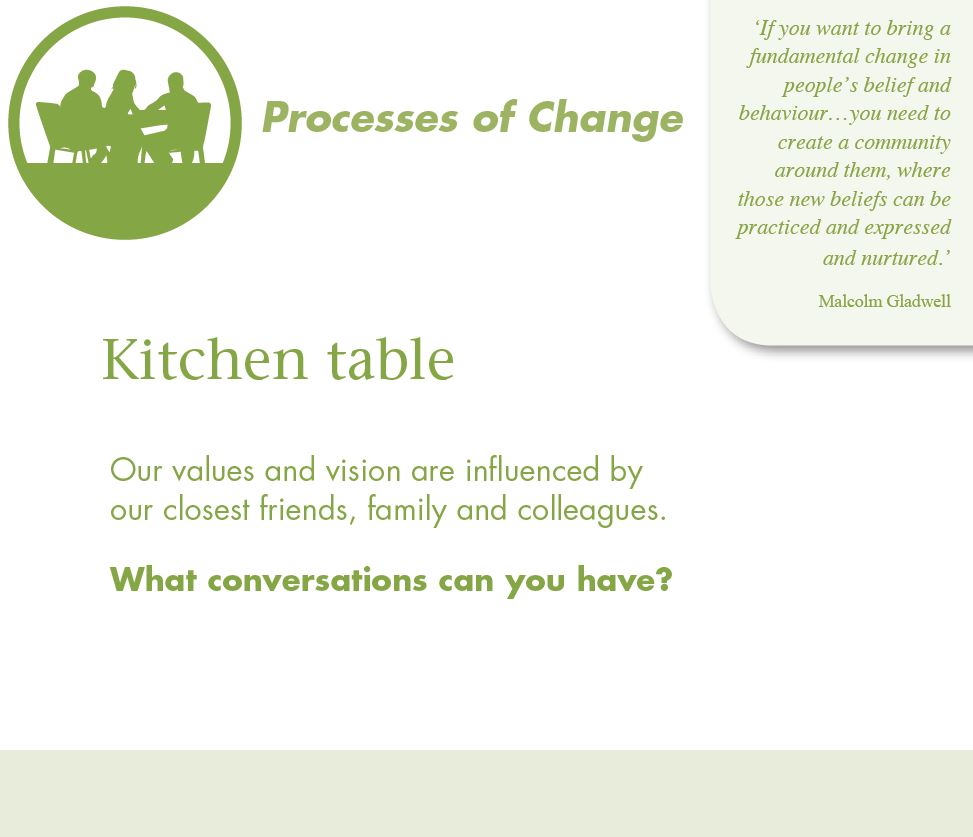
I have been writing a six-part blog series on Leadership and Change Practice, called ‘From the Campfire to the Kitchen Table’. You can see the long answer to this question at www.ianmcburney.com.

The short answer?

The reason I created Talking ecoLogical was that the answers to our sustainability challenges almost all rely on cultural change, and conversations are the bedrock of culture. Almost everyone knows that ecological sustainability is a good thing. But we lack the ability to have deep conversations about the journey and what is required. We don’t need ‘experts’, we need to find each other and have conversations for change.

Find others: There are always others out there who want the same change that you do. Find them and work with them.

Time: Time to think, build relationships, try new things, adjust and improve, contemplate and achieve real results. We are far too short-term focussed.

Trust process over outcomes: For real change to occur, we need to create powerful processes rather than lists of outcomes. In my experience, good processes will always create far better outcomes. This approach is hard to navigate when it comes to grants and government funding and short-term reporting. But do it anyway!

Leader-full: We all need to act like we are leaders. Everyone needs to step up and work together to bring out the best in each other. We need to get rid of the stereotypical ‘older, white, privileged male standing on a hill telling everyone what to do’ model of leadership.

Readiness: The biggest moment on a journey of change is enabling and encouraging others to be really ready to change themselves. If we’re not really ready to change, there is no point moving forwards.

Purpose: What are you aiming to achieve in one sentence? What is the inspiring end-goal you are working towards? What greater purpose do we have to work together on?

Perseverance: All meaningful change requires work and perseverance. We need to be prepared to put in the hard yards.

Can you give an example of change that you found inspiring or encouraging?
The East Keilor Sustainability Street began in 2003 with its first meeting in a bus shelter, because the local community were unsure of each other. The only thing they had in common was a vacant block of land.

Sustainability Street was a community development and environmental education approach that bought communities together around sustainable living. Within a few years they had created a brilliant community garden with hundreds of members. They worked with the council, the water board and local community groups. They built a shed, water tanks, planted a shared orchard, compost systems and a playground.

After two years they also had members reporting improved mental and physical health. Nearly 20 years later they are going from strength to strength. When people come together with a shared purpose they can totally change the world around them.

Most of our readers are social workers, psychologists, counsellors or teachers. Why is it important for them to think about environmental sustainability in their work with clients/students?

Connection to nature should be an integral part of social work. The impacts of nature on mental and physical health are huge. Being in, caring for and restoring nature should be a key focus of the social sector. Our homes, streets and cities need to be full of nature and our wild places protected.

Looking after people and the planet are two sides of the same coin. They are both about care for the other and thinking about something bigger than the self. We rely totally upon nature to provide the clean air, water and soil that life requires. Our bodies are ecological systems and we are fundamentally social beings—we just need to look at the way a virus spreads to see this.

But the ecological and the social are even more deeply entwined. One of the key findings of the Drawdown project, which ranked all climate change solutions globally in terms of impact, was that the number one climate solution in the world was a social solution—educating girls and giving them access to family planning has a greater impact on the climate than all of the wind or solar power in the world.

The impacts of ecological breakdown on mental health and social cohesion, from recent natural events like floods, bushfires, heatwaves and global pandemics, is a taste of what is coming if we do not create an ecologically restorative society.

It’s worth stating clearly that increased frequency and scale of pandemics have been predicted for over thirty years as global temperatures rise and biodiversity is destroyed. We can expect more in coming years until we reverse these trends.

Reducing power bills, water bills, waste bills, paper bills, petrol bills and more are good things to do for the planet and can also free up cash to spend on social services.

Sustainability is everyone’s job, every day. Every sector of the economy needs to play its part. Every nurse, builder, teacher, politician, accountant, social worker and CEO needs to work actively to ensure that their workplace, their home and their community is moving from environmentally damaging to ecologically restorative. No one can buy out. Civilisation is at stake.

If you could give people one piece of advice, what would it be?
Prioritise everything in your life to ensure that we build a socially- and ecologically- restorative economy. The alternative is unconscionable.


A survey of over one thousand primary teachers done by Melbourne Graduate School of Education at the peak of the COVID-19 outbreak found that teachers faced significant challenges in moving to remote learning. The majority of teachers were working longer hours, sometimes up to an extra day a week, and many were finding the steep learning curve around technology stressful. They also found that most teachers were concerned about the wellbeing of their students and families.

However, the survey also found that teachers reported a number of benefits of working remotely, not only for themselves but for students and parents also.

‘Teachers report that they were finding creative, new ways to teach traditional lessons and, for many, the transition is a boost in their digital literacy.

‘The COVID-19 changes also led to the rapid development of broader professional networks – sharing expertise and working collaboratively.

‘Many teachers report greater communication and, in some cases, stronger relationships with parents and carers during COVID-19. The time at home also gave parents a deeper insight into their child’s capabilities, learning challenges and the work of the teaching profession more broadly.’

We decided to talk to one teacher about her experience of teaching remotely during the lockdown.

Teacher, Sharon Hynes, shares her story.

Sharon works in a primary school in a suburb southwest of the CBD of Melbourne and specialises in supporting students with additional needs.

‘My initial experience was a feeling of uncertainty as my role involves supporting students with learning or social difficulties. I ensure they can access the curriculum.

‘I am not a regular classroom teacher. I was not sure how I could be of service while the students were learning within the home environment. This lack of clarity was quickly resolved when our school set up routines and structures so that I could continue my role remotely. I realised there were an abundance of opportunities for supporting students, families and fellow staff members.’

Sharon says that while she, personally, was finding the move to remote working challenging, she was aware that some of her colleagues and the families she was supporting were also juggling additional commitments.

‘My children are all young adults, one lives in the UK and the other three live in the inner suburbs of Melbourne. Therefore, I did not have the double pressure that many parents faced with children learning from home. However, I missed them greatly.

‘Working from home was a bit of a personal roller coaster. Many of the usual stressors of work were significantly reduced, such as managing student task avoidance, reducing sensory overwhelm for students and teaching social skills to help them deal with conflict. These were no longer front-and-centre issues as the students were in their own homes without the social contact with their peers.

‘However, I was faced with a different set of challenges. The major challenges I faced were upgrading my technological knowledge (that had to be done fast), keeping myself disciplined, as home has many distractions, and separating work life from home life as switching off was not as easy.

‘During lockdown, I would begin my day by visiting a virtual classroom and being a presence, as I would during a normal school day. I could easily scan the group, check who had logged on and notice any students who looked to be struggling.

‘I would then check emails and prepare to call families to make sure that students had the technology they needed for their learning. I would also check that the students’ wellbeing was tracking ok, support students who were having trouble understanding their learning requirements and support parents who were having trouble supervising the remote learning of their children.

‘I would then meet digitally with other teaching and wellbeing staff to plan for future learning, troubleshoot and to support each other during the pandemic.

‘It became excruciatingly clear to me how difficult the social side of school is for some students. These students thrived learning from home. They were so relaxed and happy and enjoyed being self-directed in the learning process. They no longer had to navigate the social aspects of school life or deal with the stress that this normally placed on them.

‘Another small group of students did not do so well learning remotely. These students have learning difficulties and require many supports to access the curriculum. It was difficult for parents to supervise their learning remotely as they would refuse. This was highly stressful for parents.

‘The main benefits were flexibility with managing time, regular contact with families, easy access to student’s learning, reduced noise level and more time for professional learning.

‘When we eventually went back into the classroom, it was amazing! There was a buzz of excitement and appreciation for just being in the presence of others. Everyone just seemed to be grateful to be back at school again. The sense of connection and belonging was strong.’

Sharon said that several learnings that came out of working remotely.

‘I learned that change can happen extremely fast and being adaptable is crucial. Also, no matter what change we face, we have strengths that we can draw on to get us through. All of our staff and students know their strengths and this helped us all significantly in successfully navigating this historical change. Teamwork, where we combine a variety of strengths, added to the quality of our response.

‘We are now using some of our new learnings to set assignments for students so that they can work independently, when this is helpful for them. We have also started videoing teachers who are leaders in particular areas so that all of the students and their parents can benefit from the particular strategies that these teachers are expert in. These videos seem to be an efficient way of teaching at various times.

‘Finally, our students are now sharing their learning digitally with more staff members for additional feedback and support.

‘In this second wave of lockdowns, we are feeling more confident that we are able to successfully manage any challenges that arise. I am setting myself goals to maintain motivation, and endeavouring to keep a positive mindset so that I can support our school community during this difficult time.’

Sharon is the lead author of Tell A Trusted Adult, a resource for teachers, social workers, counsellors and psychologists, due for release later this year.

Often in human service work, we are focussed on supporting people to find solutions and answers. After all, that’s what we are paid the big bucks to do!

But there is a lot that can be said for taking a step back and spending a little time in the company of our questions.

What does it mean to live inside a question?

Living inside a question means that we resist the urge to move straight to solutions. Instead, we spend time pondering our question; we inhabit it, we are curious.

We might become an observer of our question. We might take a step back and notice its shape, its texture, its tone. We might examine it for assumptions or hidden beliefs. We might interview it, buy it a drink, ask it about its childhood, or its footy team. We might sit with it in companionable silence.

Put simply, we don’t try and solve it. We just let it be.

Why is this helpful?

When we are in the midst of a crisis, it can be a relief to be given permission to stop and take time to reflect. Examining our questions and situation without feeling pressured to find solutions can be a crucial and invaluable part of the journey.

In his book Dark Nights of the Soul, Thomas Moore suggests that we learn more about ourselves in times of pain than in times of comfort. Our job is not to flee from these experiences but inhabit them and mine them for their gifts (Piatkus Books, Great Britain, 2004: pp.xiv-xv).

To do this, he says, we need to immerse ourselves in the intensity and insights that come when life is pared back to essentials and we are feeling everything intensely. In other words, we need to live inside the uncertainty.

Questions are inherently uncertain. That is the very nature of a question. By living inside a question for a while, by being curious and open, we can start to understand the complexity and layers in the question we are asking. There are many benefits to doing this.

Sometimes, when we are immersed in a challenging situation, we don’t even have a clear picture of the question we are trying to answer. What if we are asking the wrong question? If we are asking the wrong question, we are likely to be looking in the wrong places for answers. This may leave us feeling frustrated and lost.

Sometimes the question we are trying to solve is only a surface question. The real question lives a bit deeper, is more profound. For example, we may think that our question is, ‘Why can’t I stop procrastinating?’ If we reflect more deeply, we might find that our question is, ‘Why am I scared to succeed?’ or ‘How is my childhood experience of shame tripping me up in the present?’ By jumping straight to solutions or answers, we may miss the opportunity to explore the subtleties and nuances hidden beneath the original question.

Often taking the time to just ‘be’ also gives us the space to consider better quality questions. Instead of ‘Why me?’ for example, we might begin to ask, ‘Who else is experiencing something similar?’ or ‘Who can help?’ Instead of ‘What is wrong with me?’ we might start to ask, ‘What can I learn from this?’

It is also important to recognise that sometimes the answers or solutions to questions aren’t always related to the question. If someone is experiencing depression, for example, we may think that the solution lies with counselling, medication and psychoeducation. While these may be important, the person may have the biggest breakthrough when they find a part-time job or they learn to paint. So the question may be, ‘How can I recover from depression?’ The answer may be, ‘I am building a creative practice into my life.’ Or ‘Having a job gives me a sense of purpose.’

For workers and teachers who are supporting other people, enabling people to live in their question can be an empowering act of trust and encouragement. It tells the person that they are the ‘expert’ in their situation and you believe they have the capacity to reflect on their problems and find their own solutions. You simply need to listen and be present, to witness and provide an empathetic ear. Once a person indicates they are ready to move to a space of action, you can support them to think about what actions will be most helpful.

What kinds of questions can we live inside?

There are many complex, multifaceted or ponderous questions that may benefit from reflection. Sometimes asking a question stirs up an ant nest of other questions. Some questions have no answers, multiple answers, conflicting answers or answers that are hidden from view. When these complexities arise, rushing in to an action-focussed, solution-focussed space can undermine the process of change.

There are so many questions we might live inside. Some are big, like:

  • Should I stay or go?
  • How can I transform this debilitating self-doubt?
  • How can I move past this?
  • How can I make it stop?
  • What should I do now?
  • How can I overcome inertia?
  • What do I want my future to look like?

Some are more focussed:

  • What is a tiny first step I can take?
  • Who can I talk to?
  • What will help me get out of bed today?
  • What is one thing that will make a difference?

All of these questions are important and valuable and they all benefit from introspection and exploration.

How can we support people to ‘live inside their questions’?

When we are supporting people to navigate their way through big life challenges, sometimes the best thing we can do is walk alongside them as they explore the implications and ‘edges’ of the challenge. They may need to sit with the experience (and the accompanying questions), meditate on it, rage at it, reflect on its density or porousness, play with it, make and unmake it, be vulnerable in the face of its uncertainty, reside within the flux of it.

Sometimes, it is about us giving people permission to sit quietly, holding their questions gently in their hands.

Workers and teachers may find this challenging if their funding requires that they create a plan to resolve the issue as quickly as possible.

Life-long questions

Life isn’t always neat and tidy and often answers are elusive. Sometimes we may live inside a question our whole lives. Such questions may define us.

Questions like:

  • How can I move past my childhood trauma?
  • Why do I always…?
  • What is my purpose?
  • How can I overcome my fear and do what I am here to do?

These are the big questions, the ones that shape us, that curve around us as we move through our lives. The quality of the questions we ask ourselves may make us who we are.

What are your life-long questions?


Written by Dr Sue King-Smith


Have you ever noticed that when we are nervous, stressed, unsure or anxious, we tend to fiddle? We may scratch our head, pull on our earlobe, pick and unpick the sleeve of our jumper, play with our phone, pen or keys.

When we feel uncomfortable, it often comes out in our hands—we just don’t know what to do with them!

In our work, it’s not unusual for us to have challenging conversations on a regular basis. These conversations can sometimes be intense and uncomfortable. A great way to lighten the mood and introduce some fun and humour is to introduce a tactile resource. This not only gives us something to do with our hands but also gives us something else to focus on.


Having an object to squeeze can also take some of the tension out of the conversation. Directing our anxiety into a physical action or movement can help calm our mind and soothe our body.

What are tactile resources?

Tactile resources have been used by human service workers and teachers for many years. They can include things like soft toys, balls, figurines, puppets, dolls, clay, sand trays, card sets, stickers, musical instruments, cultural or symbolic objects and objects from the natural world such as stones. Tactile resources are especially effective for visual and kinaesthetic learners.

Innovative Resources has a number of different tactile resources including the Koala Company Therapy Ball, The Bears Cube and Pocket of Stones. But it is very easy to make your own tactile resources or use things you find around the home.

Who are the Mood Dudes?

The name says it all—they are bunch of dudes in all sorts of moods! Happy, sad, angry, frustrated— these squishy fellas have a range of expressions that can be interpreted in all sorts of ways.

While we often use animal characters in our card sets and tactile resources, sometimes it can be really useful to have human faces. For some people, animal characters can be hard to understand. They may not be able to connect to the feelings expressed by an animal character. Human faces are more familiar and recognisable, making it easier to interpret the expressions and empathise with those feelings.

Mood Dudes are a great tool for teachers and human service workers to talk about feelings and emotions with children or adults. They can also be used as part of a game or in conjunction with other tools, books or resources. Check them out by following the link below.

Mood Dudes                $39.90 inc. GST                                         Product Code: 0725

During the ‘COVID-19 journey’, many stories emerged about the increased rates, and changing face, of family violence. We also heared many stories about the creative and innovative ways people are found to connect with adult survivors and their families.

What changes did we see in family violence during the pandemic?

Our Watch is a national leader in the primary prevention of violence against women and their children in Australia. Their CEO, Patty Kinnersley, says:

‘While road deaths and traffic incidents decreased during COVID-19, it appeared the opposite was true for incidents of violence against women, particularly for those isolated at home with their perpetrators.’

However, despite the fact that Google searches on domestic violence were up by 75%, there was a drop in people contacting family violence services.

The CEO of Central Victoria’s Centre for Non-Violence (CNV), Margaret Augerinos, says it is always difficult to know the true number of domestic violence victims, but the silence during this global pandemic was telling.

‘Because we were being asked to socially distance and remain at home unless it was essential to go out, women had limited opportunities to make calls away from their abuser, or access services.

‘We saw fewer calls, but many were in the high-risk category – which means women were not in a position to be able to reach out for the help they needed until they were in crisis.

What were the challenges?

CNV notes that one of the biggest challenges for practitioners and support services working remotely was finding ways to assess for safety.

Some men were changing their tactics of abuse during COVID-19.

‘Some men working from home were not giving their partners respite from their demands, and others were stopping their partner leaving the house for essential items. In some cases, vulnerable children were being prevented from attending school.

‘Other tactics of abuse included restricting or monitoring someone’s movements, monitoring conversations with others, or stopping a woman calling support networks; monitoring devices or social media accounts or taking them away; withholding money or food; using misinformation about the virus to scare someone or using the virus as an excuse to ignore parenting or intervention orders.’

One of the other big challenges facing workers who were supporting families experiencing family violence was staying connected with adult survivors and their children.

Karen Piscopo, lead trainer at Anglicare Victoria and facilitator of the Safe and Together program, says workers were had to change the way they connected with people.

‘When practitioners made contact with the adult survivor in the COVID environment they always had to assume that the perpetrator was in the room or able to monitor the call.

‘The advice I gave practitioners was to keep conversations general by focussing on family functioning, asking questions like Who is in the home? What are the routines in the house? Have these changed since the pandemic started? What is everyone’s role in the home and have these changed? These kinds of questions can give us a lot of information about what is happening in the home.

‘We asked about the adult survivor’s hopes and fears, How were they getting some “me” time and privacy in the home? Were they in contact with family or friends? Had this changed and why? How were the children? Who was supporting the children with home schooling?

‘Although these questions seemed very general they helped us gauge what the home environment was like and if we listened for changes in the tone and language of the adult survivor this could also tell us if things had changed.’

She says workers found some really creative ways to stay connected to families during this time.

‘I heard of practitioners dropping groceries and craft packs to families to be able to sight their clients and the children. If practitioners weren’t unable to see the children, they asked parents to take photos of the child doing the activity. They had home visits in the driveway or garden, or engaged with children through windows.’

Hearing the voice of infants

One of Karen’s greatest concerns was that the ‘voice’ or experience of the infant was being lost in the COVID climate.

‘When engaging with families it was important that we made sure we included the voice and the experience of the infant in our conversations as they are entitled to be heard and have a right to be included. It’s often believed that because infants cannot speak that they cannot tell us anything, but their body language, presentation and the way they interact with their parents can tell us a great deal.

‘During the pandemic this could be challenging as we were not able to enter the home and when we were talking to parents over the phone the infant was often not in view.

‘Practitioners who were working with parents and their babies told me they used many strategies such as asking for videos or pictures of the infant. Whilst on the phone they asked questions such as Tell me what the baby is doing now? Describe your baby to me. Or they asked the parent to send them a video of the infant walking or playing.

‘We could also ask a parent curious questions that could bring the infant into the space and conversation. We asked things like, I wonder what your child would say if you were to ask them how they have been going since the pandemic started? What would your baby say about how you are going during the pandemic? What have you noticed is different about your baby’s behaviour since the lockdown started? If your baby felt unsafe, how would you know? What would your baby say about what it is like to be in your family at this moment?

Supporting those experiencing family violence during the pandemic?

CNV CEO, Margaret Augerinos, acknowledges it was difficult to know how to safely support people during lockdowns, but suggested the following strategies were helpful:

  • Listen without judgement.
  • Don’t make excuses for the abuse, which can be physical, but also psychological.
  • Don’t question the person’s choices—understand that for many reasons, they may not be ready to leave. For many people, leaving a relationship is the most dangerous time.
  • Find practical ways to help—for example, deliver groceries or keep copies of private documents, and offer your home as a safe place to escape to.
  • Help the person prepare a safety plan.
  • In an emergency, call 000.

Karen Piscopo from Anglicare Victoria said it was more important than ever that services worked collaboratively.

‘Collaboration was crucial during the pandemic. We observed that although practitioners were calling their clients regularly, some clients were not answering the phone. It was important for these clients that we worked with other services who were also engaged with the family. By working in collaboration with other services, we knew it would lead to better outcomes for children and families.’


No Room for Family Violence cards $55 inc. GST

Product Code: 4945


If you in Australia and are experiencing family violence and need urgent medical or police help, call triple zero (000).

Contact a local domestic violence support service or call 1800RESPECT (1800 737 732) 24/7.

If you are outside Australia, contact your nearest family violence support service.


With many kids in Australia (and around the world) struggling with isolation, loneliness and disengagement from learning, we thought it was a good time to do a quick roundup of the resources we have available for supporting kids to build their social and emotional literacy.

By helping children develop the skills and knowledge to recognise, interpret and appropriately respond to feelings and thoughts, we are giving them tools they can use in every area of their lives. Having a vocabulary around personal strengths, resilience, body signals and emotions can also support children to stay safe and build respectful relationships with others.

Noticing Strengths

Children thrive when their strengths are valued and their efforts are acknowledged. Often, the best way to tackle a problem is to start by noticing and naming our strengths. By supporting children to focus on what they can do and the skills, abilities and resources they already have, we can help them mobilise these strengths to deal with any challenges that come their way.

Strengths help children learn, grow and become the best they can be. For these reasons many family counsellors, welfare coordinators and support workers encourage parents and carers to notice children’s strengths.

Strengths Cards for Kids: 40 cards featuring a diverse range of colourful animal characters to help kids talk about their own strengths and the strengths of others.

Can-Do Dinosaurs: Ideal for helping children overcome fears, develop confidence, build friendships and make good decisions, by focusing on what they can do, rather than what they can’t.

Feelings and emotions

Wherever you find people, you will also find feelings and emotions. And feelings are important! Learning to recognise and manage our feelings—and respect those of others—is at the heart of building emotional intelligence. How we feel affects not only our relationship to ourselves and others, but also our ability to learn, grow and contribute. In short, our feelings affect our whole life.

Funky Fish Feelings: Each card includes an observer character to help children externalise their feelings. Great for icebreakers, storytelling, family sculpting exercises and therapeutic conversations.

The Bears: A classic, much-loved resource for talking about feelings and body signals. The cards have no words so they are great for use with people who speak a language other than English or have low literacy.

Stones…have feelings too! : Describing feelings is at the heart of emotional literacy and therapeutic work. Each card features a stone on one side, and three words on the reverse to describe the emotion shown.

Cars ‘R’ Us: Inspired by Choice Theory and Reality Therapy, Cars ‘R’ Us is an interactive tool for exploring both emotions and the significance of choices in our lives.

Managing anxiety and staying safe

Learning to recognise, interpret and manage our body signals is an incredibly important skill. Our body communicates its wisdom to us long before our conscious mind can get a word in. That’s why body signals are sometimes called our ‘early warning signs’.  For example, we may not know consciously that we feel unsafe, but our body may be giving us a clear warning sign through a tight tummy, sweaty palms or a beating heart. Body signals are an important key to staying safe and building social and emotional wellbeing.

With practice even very young children can learn to recognise their body signals (and those of others) as strong indicators of emotions. This skill is crucial for developing protective behaviours or simply for navigating everyday life.

Body Signals: 40 bold and colourful cards for helping children tune into their body signals and build a vocabulary to describe them.

Once kids have learned to identify these early warning signals, it can be useful to have a ‘toolkit’ of strategies they can draw on to help sooth worry and calm anxious thoughts. They also need to have a plan of action if they feel unsafe.

Anxiety Solutions for Kids: 50 strategies to help children manage worry and anxiety.

Tell a Trusted Adult: A resource for exploring safety with children. Includes 9 activity cards and a booklet full of suggestions for early learning educators, primary teachers, parents and anyone who supports children and families. Also comes in a kit with 10 lesson plans and 6 posters.

Respectful Relationships

Making friends comes absolutely naturally to many children. But even young children may find forming friendships a highly complex business, overlaid with social rules and expectations imposed by adults and their peer group.

Young children are highly influenced by the people and environment around them. The early years is when stereotypes relating to gender, race and class are laid down. Children begin to internalise concepts about their own and others’ potential, role and place in life. They tune into power dynamics and mirror the language, behaviours and attitudes of the significant adults around them.

With the guidance of caring adults, children can begin developing empathy for others and an understanding of what respectful and inclusive behaviour looks like.

Respectful Relationships: Cards for exploring what makes great relationships tick, how we can model respectful relationships for our kids, and how diverse human relationships can be.

The Wrong Stone: A picture book that celebrates diversity and inclusion.

Play together, learn together: A set of fun, simple activities for parents to do with toddlers and babies.

Tactile resources

When conversations turn to tricky subjects, our hands are often clear indicators of discomfort.

Whether it is hands thrust deep into pockets in defiance, or nervously rearranging hair, or biting fingernails, or any other kind of flicking, tapping, picking or squeezing we may be doing, our hands speak volumes.

Having something to occupy our hands seems to help us externalise or transfer some of the intensity of our emotional state to outside. This is one of the understandings that sits behind the use of tactile resources in therapeutic work.

We have a range of tactile resources for children. These can be used by themselves or alongside the relevant card set/book.

The Bears tactile characters

Stickers

Bundles

We also have several themed bundles of resources.

If you would like to learn more about using our tools to talk to children about social and emotional literacy, our Tools for Building Social & Emotional Literacy in the Early Years workshop is now available as 4 video conference sessions of 1.5 hrs each. For more information, please contact training@innovativeresources.org

A few years ago I was involved in a project that asked people from various non-Aboriginal organisations (including my own) to self-rate how safe they believed Aboriginal people felt either working in or accessing their service.

We then asked Aboriginal colleagues and staff from Aboriginal Community Controlled Organisations (ACCOs) to rate how safe they felt working with or accessing these same non-Aboriginal organisations.

The results were sobering.

Nearly all the non-Aboriginal organisations significantly over-estimated their cultural competence.

This result was surprising for many of the individuals and organisations who participated in the survey. Most really believed their teams and organisations were practicing in culturally safe ways and many were actively involved in challenging white privilege and racism within their services.

But herein lies the problem. Unless you ask the right questions, white privilege is often invisible. (Except, of course, if you are the person or group on the receiving end.)

What is white privilege?

First coined by Peggy McIntosh in 1988, the term ‘white privilege’ describes:

…the unquestioned and unearned set of advantages, entitlements, benefits and choices bestowed upon people solely because they are white. Generally white people who experience such privilege do so without being conscious of it.

(McIntosh P; ‘White Privilege and Male Privilege: A Personal Account of Coming to See Correspondences Through Work in Women Studies’ 1988)

It is important to note that this is not privilege that comes from wealth (class privilege)—often people get the two concepts confused.

In her article, ‘Identifying White Race Privilege’, Jenny Tannoch-Bland describes 47 advantages white people can take for granted as a result of their race, including:

  1. I can, without material loss, choose to be surrounded by people of my race most of the time.
  2. I can avoid spending time with people who oppress me on the basis of my race.
  3. I can be reasonably confident that in most workplaces my race will be in the majority and in any case, I will not feel isolated as the only, often token, member of my race.

How can we challenge white privilege in our organisations?

If we are to be truly inclusive and culturally safe, we need to go beyond the obvious stuff of putting posters up on the walls, featuring an Acknowledgement of Country in the entranceway and celebrating NAIDOC Week, although all of these things are important.

Sometimes, we need to take a step back and ask ourselves what our practice, organisation or school would look like if it was a culturally safe and respectful place for Aboriginal and other First Nations peoples. Often, the best place to start is by reflecting on what we are already doing well, and what we could be doing better.

We need to ask ourselves:

  • What would Aboriginal and other First Nations people see, hear and feel walking into a respectful and safe organisation? How would they know they are safe? What would they say about our service if they felt respected, heard and safe?

What can I do?

There are also many practical things that individuals, organisations and schools can do to increase their cultural safety.

As individuals we can:

  • Regularly ask Aboriginal clients and students curious questions about what we can do to be more respectful and inclusive of their culture. Be open to receiving feedback. Be open to changing our practice.
  • Be willing to make mistakes. Often people avoid talking to Aboriginal people about their culture and cultural safety as they worry they will unwittingly say or do something offensive. Learning requires us to be vulnerable and not have all the answers. This can sometimes feel really uncomfortable. We need to give ourselves permission to feel uncomfortable and to get it wrong sometimes.
  • Reflect on our assumptions, values and beliefs. If we are part of the dominant culture, we may never have had to examine where our beliefs and values come from. As a consequence, we may unknowingly impose our assumptions, values and beliefs on the people we work with, including colleagues, clients and students.
  • Actively educate ourselves. Learn about Aboriginal culture, Australian history, local Aboriginal services, local Aboriginal elders and leaders. It is not Aboriginal people’s responsibility to educate us—that’s our job!
  • Be willing to call out racist or exclusionary behaviour. Yes, this may be challenging, but isn’t it a fundamental part of our job as social justice workers and teachers?
  • Think about how we can become advocates, champions, leaders in the cultural safety space.

What can our organisation do?

It is important for individuals within organisations and schools to challenge their own white privilege, however, there also needs to be a parallel process at an organisational level. Otherwise it can be very disheartening for staff who are trying to build a culture of respect, inclusion and understanding, as their efforts are undermined by the organisation’s culture, policies and procedures

There are a number of things that organisations and schools can do to challenge white privilege and establish a culture of safety for Aboriginal staff, Aboriginal colleagues from other organisations, clients and students.

Here are a few ideas.

As organisations, we can:

  • Create a culture of feedback so that all staff feel confident, supported and comfortable speaking up about white privilege and racism. Staff need to know that their feedback will be valued and acted on in a respectful way.
  • Actively seek feedback and advice from Aboriginal or other First Nations staff, clients or students on how the organisation can become more inclusive, respectful, safe and celebratory of First Nations cultures and experiences. Act on this advice. (*Note: this will only be successful if Aboriginal people feel they are safe, respected and their advice will be taken seriously.)
  • Examine intake and employment processes to see how welcoming and inclusive they are. For example, do intake forms ask people if they are Aboriginal or Torres Strait Islander? Why? Is this explained to people? How could these questions be asked more respectfully?
  • Acknowledge that culture isn’t just expressed through spirituality, beliefs, values and practices. Culture may also include collective experiences of intergenerational trauma, exclusion and violence. Be mindful of this when working with Aboriginal colleagues, clients or students. They may need different types of supports or they may need to work in different ways to other staff or clients.
  • Actively learn about how Aboriginal organisational processes and practices may be different to non-Aboriginal processes and practices. When we are part of the dominant culture, we expect that everyone works, and should work, using our processes and practices. However, Aboriginal organisations and staff may work differently. (Many organisations have found that these processes and practices are better than the ones they were using and have consequently adopted them within their organisation or team.)
  • Create regular opportunities for people to reflect on their own assumptions, values and beliefs and how they might be different to those of staff from different backgrounds. Self-reflection is an important tool for exploring unexamined assumptions and beliefs. Support staff to regularly reflect on culturally safety and white privilege.
  • Examine the way policies and procedures are developed. Do Aboriginal people have a voice in the decision-making process? Is this simply consultative or are those voices a fundamental part of the process? Who holds the power regarding decisions being made about services aimed at Aboriginal staff, clients or students? Is there a strong Aboriginal voice in the development of policies and procedures?
  • Re-evaluate existing processes, policies and procedures. White privilege and racism can be hidden in policies and procedures in the form of hidden assumptions or biases. It can be easy for people to justify practices that are unjust because they have ticked all the HR boxes. Always implement processes and procedures with a willingness to be flexible and responsive to the needs and culture of the individual.
  • Develop or revisit the organisation’s Reconciliation Action Plan (RAP). (If there isn’t one, follow this link to find out how you can develop one.) Make sure this is an active plan that is reviewed regularly.
  • Co-design services and programs wherever possible, especially any services that are specific to Aboriginal or other First Nations peoples.

Lastly, remember that Aboriginal people have successfully lived and thrived on this land for tens of thousands of years. They have learned a thing or two in that time!

First Nations people around the world have incredibly complex and comprehensible knowledge systems. Approach every interaction with an open mind and a willingness to change your practice or adapt your service based on the knowledge and wisdom that Aboriginal colleagues, clients or students bring to the table.

Reconciliation Week – a great time to re-evaluate

This week (27 May to 3 June) is Reconciliation Week in Australia. It is a great time to take a deeper and more reflective look at what we, and our organisation, are already doing well, and what we could be doing better

As Reconciliation Australia state on their website, the most important thing we can do to move towards reconciliation is to respect and value each other.

‘Reconciliation must live in the hearts, minds and actions of all Australians as we move forward, creating a nation strengthened by respectful relationships between the wider Australian community, and Aboriginal and Torres Strait Islander peoples.

If your organisation would like to ‘up-the-ante’ in this space, check out this great article on organisational white privilege.

Dr. Sue King-Smith


Useful resources:

Talking Up Our Strengths