Explore our wide range of 2023 training opportunities
In 2023 we will be running a series of free 30 minute online workshops where our highly skilled trainer, Alison Krusec, will share a range of tips and tricks for using our most popular card sets, starting with Strengths Cards® Unlimited.
Strengths Cards® Unlimited—the first in a series of FREE 30-minute online sessions
Strengths are more than personal qualities. Strength Cards® Unlimited expands the notion of what a strength is, enabling us to talk about strengths in different ways. It is perfect for enabling conversations about different types of strengths, including a person’s resources, skills, relationships and experiences.
In this 30 minute FREE online session, we will explore:
how the images on the cards can prompt conversations
how to choose cards to talk about specific issues or topics
why talking about strengths is a powerful place to start therapeutic conversations
why encouraging curiosity can empower people to explore their stories
how the cards can be used to help create respectful and safe spaces
some great activities and ideas other practitioners have shared with us.
This session is perfect for social workers, health professionals, school counsellors, teachers, wellbeing staff, parents and carers.
Training
We have an exciting range of training coming your way. Here is a taster of what’s on offer:
The training is available in a range of modes – in-person, online workshops, eLearning and blended. For more info, check out our Training Calendar.
Have a wonderful holiday break and we look forward to seeing you in the New Year!
Navigating Depression cards
‘There are countless struggles and sources of pain in our lives. It can be tough. However, there are things we can do to help us navigate through challenging times, and not only survive but thrive and grow stronger through adversity.’ Kate Skilbeck
Drawing on the metaphor of the journey, these 40 beautifully-illustrated cards include five characters exploring the challenging terrain of depression.
Featuring a word and image on the front and a range of questions, sentence starters and evidence-based exercises on the back, the Navigating Depression cards have been designed to help people work with low mood or emotional distress.
You can use the cards to help people:
share their stories and experiences
build social and emotional literacy
proactively notice and address early warning signs
create healthy, protective habits
recognise when to seek support.
Great for teachers, counsellors, social workers, psychologists, parents or anyone supporting people experiencing depression, and perfect for use with adults and young people in one-on-one therapeutic conversations, groups or classrooms.
The set also includes an in-depth booklet with lots of ideas for activities.
Introducing the latest edition to our suite of strengths-based tools and resources—Strength Cards Unlimited!
Everyone has strengths. But did you know that strengths are more than just personal qualities? They also include your relationships, culture, health, community, the natural world and access to supports.
Every day, we see people drawing on their strengths. We may hear inspiring stories of people overcoming adversity or doing great things. Or we may notice people using their strengths in quiet, small ways.
They may use individual strengths or they may combine their strengths. Sometimes they borrow strengths from others.
While the types of strengths people have is almost endless, they all have something in common. Noticing and drawing on our strengths, and the strengths of others, creates a sense of hope and possibility.
Strength Cards Unlimitedexpands the notion of what a strength is, enabling us to talk about strengths in more nuanced, yet expansive ways. These 40 visually-engaging cards are perfect for talking about the vast range of different strengths people can draw on to overcome challenges, reconnect with others and imagine a positive future.
Why talk about strengths?
There are many benefits of talking to people about their strengths, capacities, resources and skills.
While everyone has strengths, when people are feeling disempowered, they may not recognise these strengths in themselves. This is why it can be valuable to encourage people to notice their strengths and resources.
Additionally, many services and support are designed around deficits (as this is often how funding is allocated)—family violence, mental health, homelessness, drug and alcohol, sexual abuse, etc. As a result, services often spend a lot of time focusing on what isn’t working rather than what is which can feel overwhelming and disempowering for the people accessing these services.
By shifting our focus to what we can do, rather than what we can’t, we help create a space for new possibilities to emerge. When we decide to notice our strengths, resources, skills, and the strengths of the people around us, we are more likely to see a way forward and imagine a more positive future.
People may already have a number of resources they are drawing on, including friends and family, services, community groups, sports clubs, online networks and groups, religious communities and workplaces. These resources may provide material, emotional or spiritual support. Sometimes people may feel very alone as they haven’t noticed the number of people who are happy to offer support. It can be useful for them to name these resources or supports.
Use the cards to encourage people to:
notice, name and celebrate all their different strengths
appreciate the people who support and care about them
focus on the positive things in their lives
explore how they can build, borrow and choose different strengths
grow new strengths, skills, capacities, connections and resources.
Encouraging people to identify strengths and resources can be an important step in realising that they have useful tools to draw on. They can then consciously mobilise these strengths and resources from different parts of their lives to help them address other issues. This can also feel much more motivating and hopeful, which helps create the conditions for sustainable change.
Strength Cards Unlimited are perfect for social workers, psychologists, teachers, counsellors and parents for use with adults and young people in one-on-one, group or classroom settings.
When it comes to dealing with big emotions, not everyone has the language to describe how they’re feeling. Today we talk with school counsellor, Judith, who co-created a story to accompany the tactile Bears. What began as a story to help one young student has been welcomed across the classrooms.
How did the story come about?
One of the primary students I was seeing spotted my tactile Bears and they sparked an idea of a story about the Bears tackling an issue the student was dealing with. The narrative developed over our sessions as the Bears tried to help Angry Bear be less grumpy and, in the process, discover something important about themselves. The result was a lovely little story, complete with the student’s illustrations.
I’m interested in working with children to develop their emotional language, so they have words to put to feelings. Children know how they feel but they can’t always express how they feel. The process of creating the story and the illustrations helped this young student, and we shared it with her class.
The story was a hit with her classmates (and family!), so I decided to introduce the story to other primary classes, alongside the tactile Bears. It has continued to prove a popular way to introduce talking about emotions and how to tackle ‘big’ feelings.
How do you use the story and the tactile Bears?
I pop the tactile Bears in a box, and then I say to the class ‘I’ve got a family to introduce to you, some little characters who are hiding in the box’. This immediately gets everyone curious and interested, and I get them out one at a time and hold them up to ‘Oohh, they’re bears’! I ask, how do you think this bear is feeling today? And hands shoot up and the children have a range of ideas.
These little bears are a really safe way for them to make a guess and they don’t have to be right and they don’t all have to think the same thing. There are two bears who could be feeling sad or they could be feeling a bit afraid, I’m not sure, maybe they feel a bit of both, and that’s ok because feelings are never quite the same for all of us. And it’s just a lovely way of getting that language of emotions going, and you can make a list of all the words the children come up with to describe feelings.
I read the story and often the children want to tell me about a time in their life when they got really mad, or when they got sad. It’s a really lovely gateway to do that exploratory work around feelings, and what to do with big feelings, and ask what ideas have you already found that help you to just calm down little bit.
The Bears and wellbeing
I’ve done a couple of health classes with Year 7 students. I gave each of them a Bear card and asked them to have a look and think about how their Bear might be feeling and come up with a word or phrase. We go around the class and they hold up their card and say, for example, ‘I think my Bear is feeling really pleased with himself’, and they might add a little backstory ‘… because he’s just come top in the spelling test’. It’s a really good way of collecting this shared vocabulary around feelings and how vast a range of feelings we all have – sometimes even in one day. For example, anger isn’t a bad emotion, it’s just another emotion.
What advice would you give your peers?
Use the tactile Bears and the cards across the curriculum. They are easily transferable to writing exercises as a starting point for stories or creative writing. Encourage children to recount a time when they felt big emotions.
The Bears fit so well into the health component of the curriculum and help schools support mental wellbeing in creative and safe ways.
And they’re useful for adults to use, to acknowledge that we’ve all been brought up to believe things about different feelings and to get a sense of what different people think about anger or sadness or whatever.
Feelings of shame can be heightened as children and young adults start to compare themselves to others. As children grow, they become more aware of what is considered normal—if their experiences and feelings don’t fit into this version of ‘normal’, this may result in feelings of shame.
Shame and mental health
Shame underpins many mental health issues. As mental health issues often emerge in the teenage years, Exploring Shame an ideal resource for supporting conversations about mental health in schools. Use the cards to talk about things like the impact of the media—including social media—on identity, negative self-talk, perfectionism, idealised images of attractiveness and gender stereotypes, and how this feeds into feelings of shame. The cards can also be used in educating students about social and emotional literacy—this can include recognising the symptoms of shame and how to manage these feelings.
In school settings the cards can be a valuable tool:
as part of the curriculum related to health and wellbeing, sociology and psychology
in English classes as inspiration for creative writing, dialogues, character profiles
in sessions or workshops related to self-esteem and wellbeing
in sessions with school counsellors and wellbeing staff
in staff meetings or professional development sessions to help staff build their understanding of shame, how it presents in students and how to manage it.
The cards can be used to talk broadly about shame and the different ways that shame manifests. One activity to try would be divide the class into small groups. Give each group three cards and ask them to respond to the questions on the back of the cards. Invite them to consider how these concepts and questions relate to the theme of shame.
At the end of the session, invite the students to reflect on what they have learnt about shame and invite them to suggest some things they could do at school to reduce experiences of shame for students.
**Some of these cards could be triggering so make sure you have created a safe space and there are supports for students during and after the session.
At any given moment in a supervision session, we may find ourselves wondering, ‘What is the most useful question I could ask right now?’
This, however, begs another question: ‘What do we mean by a useful question?’
Questions are fundamental in constructing—and changing—social realities. All questions carry particular assumptions and invitations. There is no such thing as an innocent or neutral question.
One variety of strengths-based work, the field of Appreciative Inquiry, has provided a number of guiding aphorisms including the following:
We live in the worlds our questions create.
The choice of topics and questions is vital
As plants grow towards the light, human systems grow in the direction of their curiosity – toward what they persistently ask questions about.
The usefulness of strengths-based questions lies in the particular topics that they ‘persistently ask questions about’. The supervision cards encourage supervisors to persistently ask questions about practitioners’ hopes, priorities, achievements, strengths, resilience, resourcefulness, creativity, and ongoing professional developments. They invite both supervisors and practitioners to live in a world which values collaboration, affirmation, mutual respect, careful reflection and constructive challenge—irrespective of the topic under discussion and the circumstances in which supervision occurs.
This resource can support creative practice in the wide variety of supervision contexts. Strengths-based approaches and assumptions provide the foundation for the cards, and they can make a contribution to your practice irrespective of whether you explicitly identify with a strengths-based perspective.
We also encourage supervisors to tailor the questions to their own circumstances; to reword and rework them, or develop new cards and questions, if necessary. We need to remember that, while supervisors can ask a question with a particular intent in mind, the actual effect of the question is always unpredictable.
As Steve de Shazer, the pioneer of solution-focused therapy, often said: In the end, only the client can tell us if a question was useful.
This month we launch our latest resource – Exploring Shame– a game changer for therapists, counsellors, carers and teachers.
We talk with lead author Michael Derby on his motivation for producing the resource.
1. Can you tell us a bit about yourself and the work you do?
I’m accredited mental health social worker and a clinical family therapist. I migrated to Australia from Scotland in my early 20’s and have enjoyed the Australian way of life ever since. My current role is very adaptable and changeable. I provide secondary consults, clinical supervisions, training and reflective practices for practitioners. I have spent many years working with children, young people and families who have faced significant trauma, to improve relational difficulties and heal from the trauma.
2. As the author of the Exploring Shame cards, you clearly have a deep interest in the field of shame research and how shame impacts of people? What drew you to thinking about shame initially?
I started to acknowledge and see the effects of shame when I was working with children and young people who were victim survivors of sexual abuse, or who had engaged in problematic or harmful sexual behaviours. Shame was often discussed in the team and how to work with it.
I remember the first time shame hit me. It was during a session where I was working with a young person who was a victim survivor of sexual abuse but had also engaged in harmful sexual behaviours. We needed to discuss certain issues, and I remember the young person producing a strong shame response to the behaviour they had engaged in, and also to the sexual abuse they suffered. The shame response was so strong that I remember the body signals that I picked up through transference. This triggered my own shame story and got me reflecting on how to work with shame.
The more I reflect on my own shame, and the shame of others, the more I see it within my work and within wider society. Most people don’t understand shame and often people’s behaviour is misunderstood as a result. When shame isn’t understood properly, it can actually make the person’s shame worse.
3. Why do you think we should be focussing on shame in the work we do with people, either as social workers, psychologists, counsellors or teachers?
This is THE big question!
At the core of it, shame is attached to who we are, our identity, but in a very negative way. Shame undermines our sense of self and can cripple us with silence and stop us taking action. It’s highly erosive and impactful, both on us and others around us.
When a person has done harm and is trying to make a change in their life, shame can be a barrier to that change and perpetuate the unwanted behaviour. We need to be able to focus on and work with shame, and support people to acknowledge the harm they have caused and face up to their behaviour.
Working with shame has the added bonus of potentially reducing the burden on the person who has been harmed. Often people who have been harmed carry the shame of the person who has caused the harm. So by focusing in on shame we can support people to heal past hurts.
4. If you are working with someone, how would you identify that they may be experiencing shame?
There are several ways in which you can do this.
Firstly you may pick up on the other person’s nervous system being activated. There will be an emotional affect during the conversation, this might lead the practitioner to feel frustrated, sad, angry and annoyed. If this happens, get curious and ask yourself what is going on here with these feelings? And where have they come from? It’s quite a difficult thing to do in the moment, but take a breath and pause before reacting.
Shame can present as a defence mechanism, a way to deny responsibility. Responses here include blaming, denying, justifying, distracting and avoiding the issue. By getting curious about what is going on for the person, you are more likely to open up a dialogue about what’s happening.
You might also see the opposite where the person in shame presents as inward facing, head down and not talking with you about the subject. If the person presents this way, it probably means that there is safety within the relationship which can allow the practitioner to connect with the person more easily.
5. What advice do you have for workers or teachers about how to name and explore shame with people they are working alongside?
First of all we need to know our own shame story, and how it might show up in relationships, because we can activate it when we start to work with someone on their shame. We may need some techniques to help manage our shame response, and remain grounded.
Secondly, in the words of Dan Siegel, you need to ‘name it to tame it’, which means cutting through or getting behind defences and naming the vulnerable parts that are being protected. Naming shame is difficult and people can feel very exposed so it has to be done in a delicate way where emotional safety is upheld. Cutting through blaming, for example, and acknowledging that the situation sounds difficult or hurtful can create safety and allow the practitioner to start working with the shame.
The final thing is to externalise the shame and create some distance between it and the person. This allows the practitioner and the person to become curious about the shame. As shame is highly entangled with our sense of self, externalising it can reduce a threat response as it’s not seen as a personal attack.
6. How do the Exploring Shame cards help?
Exploring Shame helps by supporting practitioners and teachers to think about the different manifestation of shame that could come up during a conversation. They also provide questions that could help people understand and work with their feelings of shame. By naming shame, and removing the secrecy that accompanies it, shame will often reduce naturally.
Using the Exploring Shame cards in groups or classrooms can help people realise that everyone experiences shame at some time. They can help to create a ‘common third’ where the practitioner and service user, or teacher and student, come together to explore and learn how to recognise and manage shame experiences.
As shame focuses on our identity, Exploring Shame can help externalise it, providing space to explore the impacts of shame on us and our relationships.
For more information on creating safe spaces, view the video: Creating Safe Spaces
Creating Safe Spaces video
Maybe not in the wilds of nature, but in the wild world of our feelings many unexpected things can go together. Look inside on any typical day and you may notice a swirling mix of emotions and body signals.
The limitations of language mean that we tend to talk about feelings as if they are linear—as if one feeling happens first and then another. But we know from our own experience that several emotions can happen at the same time—even seemingly opposite emotions. For example, we may be very sad when a relationship ends, and at the same time, we may be relieved. We may be really excited about an upcoming change, and scared too.
Along with a cocktail of emotions we can be experiencing a variety of body signals such as a tight tummy, dry throat, raised shoulders and clenched jaw. We may also experience a few involuntary gestures or movements such as blinking eyes, biting nails and jiggling leg.
This mix of emotions and body signals arises out of the interplay of body and mind. This is why using The Bears cards and Body Signals cards together can be so useful. The Bears, a set of 48 cards with expressive bear characters, is the go-to resource for talking about emotions. Body Signals consists for 40 cards featuring a mob of marvellous meerkats depicting body signals—the involuntary physiological responses of the body such as butterflies, trembling, blushing and goose bumps.
Pick a card from The Bears that is you when you feel angry (or sad, or any other emotion you want to work with).
How does the bear’s face indicate the emotion?
Can you show me how your face looks when you feel that way?
Now, can you pick a meerkat (from the Body Signals cards) that shows what else your body is doing when you feel angry? (It could be ‘clenched fists’ for, example.)
Can you show me your ‘clenched fists’ now?
Can you clench your fists even tighter?
Can you slowly release your clenched fists now? Ask the person to clench and release a few times so they can practise choosing to unclench in the midst of anger. (Releasing the body signal helps release the emotion.)
What other meerkats would you chose for what happens in your body when you have clenched fists and feel angry? These could be clenched jaw, staring eyes, tight lips—explore these body signals as well. (This strengthens ‘interoception’ or internal noticing and supports self-regulation.)
Here is a fun ‘externalising’ technique to help people learn to regulate an emotion: Match up a bear (emotion) with a meerkat (body signal). Make up a name for the body signal. For example, an anxious tummy could be ‘Wormy Wiggles’. Then you can talk with WW and find out what would help. It can be very useful to work with the body signal rather than the emotion directly.
So yes, bears and meerkats can team up to support people in learning to identify and navigate emotions, as well as self-soothe unwanted body signals such as those triggered by anxiety.
By Karen Bedford
Shame is a common emotion experienced by almost everyone at some point, it can feel painful and uncomfortable. Shame can erode our sense of self, creating feelings of humiliation, embarrassment or unworthiness. It can also lead to harmful or destructive behaviours and yet we don’t usually talk about it directly.
When people are seeking support, they will rarely tell you they are wanting to treat feelings of shame. In all likelihood, they will talk about feeling worthless, unlovable, judged, excluded or angry at the world. Underneath all of these feelings, there are likely to be deep feelings of shame.
Exploring Shame has been designed to enable conversations about the anatomy and purpose of shame and how shame can distort our thinking. The cards can help support people to build a toolkit that enables them to recognise, engage and transform feelings of shame into more constructive and hopeful emotions and actions.
What is shame?
Shame is that uncomfortable emotion characterised by feelings of humiliation, embarrassment or unworthiness. While it is often associated with a particular experience or series of experiences in which people believe they have behaved in a dishonourable, unethical or disrespectful way, it can also be attached to experiences in which the person had no power to change the situation, as in childhood abuse, bullying or family violence. Shame is often accompanied by feelings of fear (particularly fear of judgement), rejection and exclusion.
Because oppressors are experts at setting up the conditions for the oppressed to feel ashamed about who they are, people who have experienced exclusion, oppression or violence as a result of race, gender, religion, sexuality, disability or culture nearly always have underlying feelings of shame.
Some people experience a highly judgmental inner-critic, or what might be described as a ‘voice of shame’. This critical voice can be relentless and can significantly undermine a person’s capacity to grow and change.
There are also a quite specific set of physiological symptoms or physical sensations associated with shame including things like a nauseous feeling in the pit of the stomach, a wave of heat moving up the body, racing pulse, constriction of the throat, dry mouth and hot cheeks.
How can the Exploring Shame cards help?
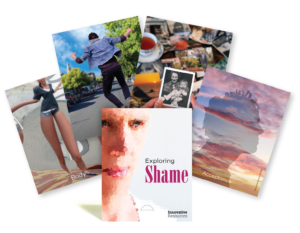
The 30 evocative, photo-based cards in Exploring Shame can be used to gently name, unpack and work with feelings of shame. They are designed to open up constructive and respectful conversations about things people may prefer to keep hidden or things they don’t like about themselves.
Use the Exploring Shame cards to talk about:
how we can learn to recognise shame
what shame feels like in the body
how shame can be contagious or can be passed down through families
the difference between shame and guilt
our inner-critic or ‘voice’ of shame
whether the shame is ours or someone else’s
how causing harm to others can generate feelings of shame.
Who are the Exploring Shame cards for?
Exploring Shame cards are ideal for counsellors, social workers, psychologists, counsellors, teachers and parents who want to create respectful and safe spaces for conversations about things that may be uncomfortable or difficult to talk about. They are designed to be used with adults and young people in one-on-one therapeutic conversations, groups or classrooms.
The cards also come with an in-depth 54 page booklet with lots of ideas for activities in a range of settings.
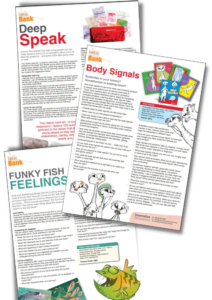
Many of the Innovative Resources card sets have an accompanying Ideas Bank – a quick list of things to try in different settings.
So whether you need a handy quick reference, a nudge or some inspiration, click through to download some ideas for getting the most out of your card set.
(And don’t forget to have a look through the booklets that come with many of the card sets – they are stuffed with information, tips and suggestions.)
Also, watch the video for tips on creating safe spaces for conversations:
Creating Safe Spaces
Over the weekend I read Austin Kleon’s book, Steal like an artist, in which he says that creative people are excellent burglars. He reckons they steal everything—ideas, structures, techniques and inspiration. This is not plagiarism because they take the ideas of others and remix them, trying to make them better. All creative work, he suggests, is built on the work of the artists who came before them.
‘What a good artist understands is that nothing comes from nowhere. All creative work builds on what came before. Nothing is completely original.’
And it made me think about how this is also true for social workers and teachers. Over the years, I have often borrowed (stolen?) ideas from other social workers and teachers about all sorts of things. For example, I’ve pinched ideas on how to more effectively build rapport with students. I’ve also picked colleagues’ brains about the best questions to ask people when they are in the midst of a crisis and I’ve mimicked other people’s strategies for running client conferences so that they are more client-centred.
I’ve also modelled my practice on the people I respect and admire, blatantly stealing their practice approaches. The way I now run meetings is a direct rip-off of two of my mentors. One mentor was a local Aboriginal leader who said that meetings begin when people start talking, not when the agenda kicks in (stories that connect and give us insight about each other, she said, all contribute to us being more willing to listen and learn from each other). The other mentor simply listened more than he talked.
Some of my biggest ‘thefts’ have been from the clients and students I’ve worked alongside. I remember a person I was working with who had schizophrenia describing a technique she used for getting herself to work on the days she was really struggling. It was a great strategy and I asked her if I could share it with other clients, which I did.
Another time, I was working with a highly skilled and successful vision-impaired student who took me on a tour of his school, describing in detail how he navigated his way through the campus. His experience was so different to my own—I could never have gleaned a fraction of that knowledge without his generosity and insight. He was happy for me to share his strategies and techniques with other newer or less confident vision-impaired students (I always credit him when I share his tips with others).
When I thought about it more, I realised that the people I’ve admired over the years have all been out-and-proud thieves. Whenever they saw a model or a practice approach that improved the lives of the people they worked alongside, they made a plan to pilfer it. (In their defence, they generously shared their spoils with the rest of us.)
Of course, these are more like Robin Hood-style heists, but still…
The best thing about stealing as a social worker or teacher? Unlike creative work, there is no copyright on stealing best practice. We have free rein to take what we like and use it wholesale.
We often think our learning comes from attending training, conferences or doing other types of professional development. But the reality is, most of what we learn comes from copying the people we admire—our mentors, colleagues, clients or students.
What practice could you ‘steal’ today from someone you respect and admire?
Dr Sue King-Smith
What can parents and carers do to create a strengths-based, nurturing environment for their children to play, learn and grow?
The team from the Bendigo Home Interaction Program for Parents and Youngsters (HIPPY) have a few tips and tricks. Here are their top three suggestions.
Behaviour specific praise
Often children are given more attention when they behave in ways that are considered undesirable or unhelpful than when they behave in constructive, helpful ways. When children get attention for undesirable behaviours, this can have the unwanted effect of making the child do that behaviour more often.
Behaviour specific praise is when you focus on specific desirable behaviours and give positive feedback to the child when they behave in that way. You may also aim to ignore undesirable behaviour (whenever it is safe to do so).
Not only do you praise the child, you give very specific praise so that the child knows exactly what they did and what you liked about what they did.
Examples of behaviour specific praise versus general praise:
Behaviour Specific Praise – Thank you for helping me set the table for dinner. The table looks great and is ready for dinner.
General Praise – Good job!
Behaviour Specific Praise – You put your socks and shoes on by yourself. I knew you could do it without my help.
General Praise – That’s fantastic!
Knowing exactly what is being praised can feel very reassuring for children and can help build their confidence.
The 3C’s—confirm, complete, correct
Children can be easily discouraged if they feel that they don’t understand something or are repeatedly getting things wrong.
Instead of telling children that they are right or wrong when answering a question or responding to a problem, it can be more supportive and encouraging to use the 3C’s – Confirm, Complete, Correct.
Confirm – when a child gives the correct answer to a question or problem, the parent or carer repeats the answer back to the child.
Complete – when the child responds with a partial answer, the parent or carer repeats what the child has said adding the missing information.
Correct – if the child has no response, says they don’t know or gives an incorrect response, instead of telling them they are wrong, the parent or carer simply responds by speaking the correct answer.
The 3C’s help parents respond positively to their child’s efforts. By using this process, children feel safe to have a go, make mistakes and feel confident to try again.
Everywhere learning
Many parents and carers will have been unconsciously doing ‘everywhere learning’ this past few years, with so many being thrust into the world of home schooling.
At its essence, everywhere learning is finding opportunities in everyday life to teach your child.
Examples –
When you are at the shops, help your child to count how many apples you’re putting in the bag. Point out different shapes around the shop. What shape is the cereal box? What shape is the tin of tomatoes?
At the park, talk about the tall trees and small trees, or the different textures around them—rough, smooth, sharp, prickly, soft.
When you are cooking, talk about the different colours of the vegetables. Introduce the idea of fractions—half a cup, a quarter of a carrot, 250ml of water.
There are so many opportunities for teaching your child. The most important thing is to make learning fun by supporting children feel safe to make mistakes and encouraging them to feel confident to have another go.
HIPPY is a two-year, home-based, early learning and parenting program for families with young children. Over two years (in the years before and after starting full-time school), HIPPY children work through weekly or fortnightly packs of play-based, educational activities with their parents and family. They are encouraged to ask questions and try new things; developing their confidence and passion for learning, which enables school-readiness.
For more information about the HIPPY program, please visit their website.
Here are some other resources that can support parents take a strengths-based approach to learning: