Join the conversation! SOON (Seriously Optimistic Online News) keeps you connected with everything Innovative Resources – subscribe today!

If your situation is urgent, you can contact these services 24-hours a day, 7 days a week

CLOSE (X)

Interview with nature-based therapist and social worker, Kit Kline

This month, we talk to Kit Kline, Nature Based therapist and founder of Nature Based Therapy, counsellor and educator, about some practical ways we can support clients to connect with the natural environment.

Kit has almost 20 years’ experience working as a counsellor and educator in the social and community services sector with both public and private health services and specialises in mental health and addictions.

Born in Canada and arriving in Australia when she was 8, Kit is a descendent of the Wampanoag people on her paternal side and a member of the Sou’West Nova Metis Council. Kit says she has always felt a strong connection to her Native American ancestry and believes her philosophy on health and wellness derives from this connection.

As a descendent of the Wampanoag people, Kit also has a deep interest and respect for the relationship that First Nations peoples have with country. She believes there is a lot we can learn about healing, ourselves and the environment, from the vast knowledge of First Nations peoples around the world.

We started by asking Kit a bit about herself.


Where does your interest in nature-based therapies come from?

I guess everything goes back to childhood, doesn’t it. I grew up in Vancouver, Canada, and spent a lot of time in nature. Our backyard backed onto a forest. What I remember are the treehouses we made, the trees we climbed, in winter the ponds would be frozen over and we used to skate on them. We used to make mud cakes and pick berries, we were just always outdoors – we knew to come home at night time. So just kids being kids and playing in nature. That kind of set the scene for me, for what I enjoyed and valued.

When I was 8, we moved to Australia, where we continued to play outside or at the beach. I remember going through some difficult times and I always connected to nature as it seemed to ground me. Even though I was removed from my place of birth and in another environment, I always had the sense that nature was a part of me and I was a part of the natural world. It was still the same sun and moon. We were still close to the ocean that is ultimately connected with all other oceans in the world. So this whole concept of the interconnectedness of the natural world that was inside me gave me a sense of personal healing and I guess that’s how I coped with everything that was going on.


How did you get into nature therapy?

After spending some time travelling as a young person, I came back to Australia and decided to get into youth work in 2002. What I found in all my work (mainly as a Drug and Alcohol counsellor, in Aboriginal Health and in residential rehab) was that I would automatically use nature as a metaphor when I was trying to understand what people were telling me.

I also used to take people in rehab on bush walks. Every morning, before we’d start the program, we’d start the day walking through the pine plantations. I found that while they were walking, people would start to open up, more than if they were in a counselling session with me. And the relationship was very different, more relaxed. That’s when I started to notice that there was a kind of healing happening for people just by being in nature.

Through all the roles I’ve had over the last 20 years, I’ve always tried to incorporate nature, by going out into nature or by bringing nature in to the counselling space, either physically or as metaphor. I’ve developed programs, workshops and even assessment tools and support plan tools around a connection to nature. I always ask, how can we look more holistically at the information we are gathering?

I established Nature Based Therapy due to the success I was having with the people I was working with when I incorporated ‘nature’ into my work practice.

In some ways, it’s very instinctive. When people go on holidays or they want to reduce their stress, they automatically go to nature. They go to the beach or the mountains—who goes to the city to destress? It’s kind of innate in us. I’m finding more and more people, not just in human services, are looking for more nature-based activities to ground themselves and their teams.


You have a masters in Indigenous studies. How does this and nature-based therapy cross over for you?

Indigenous philosophy is at the core of Nature Based therapy for me. The Indigenous view is that we are not separate from the natural world. Nature is our family and everything has a place, a purpose and a story. It’s about creating a deep respect, like you would for your family or community. Nature is not a commodity, it’s not to be exploited or misused.

When I do an activity in nature with students, we always ask permission and show gratitude. We only take things that are fluid and have movement, like shells or feathers, but not rocks or trees as they are grounded in place.

I think we don’t really respect the knowledge of Indigenous peoples. For example, I always think about this when it comes to floods. In many cases, if the planners had spoken to Indigenous people they wouldn’t have built where they do as they are flood plains. Management of the land is so important but you can’t manage the land if you don’t have a relationship with the land. I find that Indigenous perspectives are always mindful of the future and future generations, whereas Western perspectives tend to be about the now.


Can you give an example of how you have incorporated this philosophy into your social work practice?

Sure. I work in a youth drug and alcohol rehab part time now, and I created a therapy garden there. It’s kind of ‘ever-evolving’ and we get the young people who come in to the resi unit to create the therapy garden. They help us sand and paint all the old furniture and do all the planting. It is really powerful for people to watch something they planted as it grows—it can be a really positive and healing experience.

I’m also working to develop innovative programs working with Indigenous peoples and knowledges in order to bring these knowledges into everyday practice. I call it planting seeds. We can be respectful of Indigenous knowledges, and include them in our practice by finding simple ways to connect and learn about the world around us, especially the natural world.


What are some of the things you think non-Indigenous people can learn from First Nations peoples?

The main thing I think we can learn is respect for the natural world.

I also think we have a lot to learn about community and connection to community. Things like having a sense of shared responsibility for raising children. We also have a lot to learn a lot about extended family and supportive communities.

I think we could also learn a lot about diet. I would love to see us bring back Indigenous foods and reconnect diet to the land. Indigenous people all over the world had very few health issues before being introduced to a western diet. In fact, we have already taken on lots of things from Indigenous peoples’ approach to health, like fasting and plant-based diets—we just don’t realise it!

We could also learn a lot about the grieving process and how to deal with loss. In many western communities, we have day off for a funeral, then you are expected to get over it.


If you could give organisations one piece of advice about how we could learn from nature or First Nations peoples, what would it be?

One of the most valuable things you can do is take your staff out onto country and to get them to learn about the real history of the land on which they are living and working. Go on country, walk on country, take photos of the native plants, connect with the traditional owners.

Go to events that celebrate First Nations peoples and traditional owners, and get involved (not just in Reconciliation Week and NAIDOC week) – it should be all year round. We can’t wait for Indigenous peoples to come to the schools and organisations, we need to take responsibility for learning about our Indigenous knowledges.


Useful resources

The Nature of Strengths  –  $55.00

Taking Up Our Strengths  –  $49.95
When people are accessing services, they are often disempowered in at least one area of their life. They may be experiencing poverty, exclusion as a result of mental health issues, addiction or family violence. Or they may be experiencing oppression or exclusion as a result of their gender, race, culture, sexuality, religion or economic situation.

When we use the term ‘disempowered’ to describe someone, it usually means they have lost their agency or capacity to act in a way that enables them to live in a hopeful, meaningful and future-focussed way.
In other words, they have lost their power.

Services often describe people experiencing powerlessness using specific terms. They may describe them as being disenfranchised, disengaged, disadvantaged, overwhelmed, and challenged, amongst other things.

By contrast, people who are ‘empowered’ may be described as hopeful, proactive, confident, resourced, future-focussed, engaged or active.

Our jobs often involve working alongside people to help create the conditions for them to move from a position of powerlessness or disenfranchisement, to a position that is more empowered.

Despite the fact that lack of power is such a fundamental driver of disadvantage, we rarely talk about it directly. So how can we open up a conversation about power in the work we do?

Understanding and naming power dynamics

A good place to start is to identify, understand and talk about the different places we find power. We can do this by doing some background research, talking to colleagues and inviting the people we work alongside to reflect on when they feel empowered or disempowered.

There are several different types of power that we, and the people we work alongside, experience every day. Some of the types of power that may regularly impact people include:

  • the power dynamics in personal relationships
  • the power exerted by services and institutions (sometimes that includes our own services)
  • socio-cultural and ideological forms of power.

Often these kinds of power overlap. For example, a woman experiencing family violence may be experiencing power-over behaviour from her partner, gender-biases embedded in services and patriarchal social structures that exclude her from well-paid, permanent employment. Naming these different sources and sites of power can be helpful in and of itself.

Intersectional forms of oppression

Additionally, some people experience multiple sites of oppression which all create unique types of disempowerment.

If the woman in the example above is also of Aboriginal decent and is transgender, these may create multiple distinct, and overlapping, sites of disempowerment. (Of course, they also create powerful sites of insight, awareness and identity.)

We can also simultaneously be oppressed and an oppressor. For example, a woman of Anglo-Saxon decent may feel oppressed as a woman but may oppress others economically or culturally.

Can we ‘empower’ people?

The short answer? No, we can’t.

But we can create the conditions to help people empower themselves. To ‘empower’, in strengths-based practice, is about working alongside people to create the conditions for them to feel stronger, more confident and hopeful, more capable of exerting control over their lives and more skilled at enacting their rights.

Here are a few suggestion for ways you can support the people you work alongside to do this:

  • Name the different sites of power

Often power likes to be invisible. Just having an open discussion about different kinds of power can be empowering in and of itself. (If you are a worker or teacher, you are automatically in a position of authority or power, so this may be something you name and talk about with the people you work alongside).

  • Deliberately talk about social structures and their impact on people

Often, as social workers and teachers, when we are supporting someone to manage a challenging issue, we focus on the personal context—the people directly involved, the personal interactions and responses—without talking about the broader context.

For example, if someone is struggling financially, we may talk about budgets and how to get better quality jobs. We are unlikely to talk about how growing up in poverty may have impacted on the person’s ability to get a well-paid job, or on other aspects of their life such as their mental health or their capacity to care for their children.

Poverty is a social construct, over which we have very little control. Some people are born into wealth and some aren’t, and despite what the media tells us, it is difficult to move between economic classes—it is the exception rather than the rule. By naming the privilege inherent in wealth, we can help people feel less ashamed or guilty about their circumstances and support them to find ways to address any barriers they face in an informed way.

  • Support people to understand their rights

Again, when we work with people in services or schools, we often focus on supporting people to access the resources they need in the moment. We don’t often take the time to support them to understand their rights, how the system works, how to advocate for themselves, how to talk to politicians or organisational leaders to initiate change.

Most of the time, if one person is experiencing disempowerment as a result of a particular issue, so are others. By supporting people to develop the skills to advocate for themselves, they are also supporting others, which also helps create a sense of empowerment!

  • Educate yourself about power

Power dynamics are often hidden, especially if we come from the dominant culture. We only understand our own perspective so it is important to be curious and learn about other people’s experience of oppression, exclusion and disempowerment, so that we become sensitive to it. Try and become more aware of various types of power, both overt and covert, and to do what you can to reduce power imbalances.

This is fundamentally important if we want to support people accessing services to become more empowered in their lives.


** Have you supported people accessing your service to advocate for themselves? What has helped you feel more empowered in your life? We’d love to hear your stories and thoughts in the comments below.


Useful resources:

Rainbow Talk 

Taking Up Our Strengths 

Gender Fairness

Shadows and Deeper Shadows 

When we are in the midst of a challenging conversation—a supervision session, a finely-balanced meeting with a family or a conversation with someone struggling with their mental health—having a few simple, practical and visual reminders to help guide the conversation in a positive and solution-focused direction can be incredibly useful.

Enter the tried and true, the humble yet mighty … POSTER!

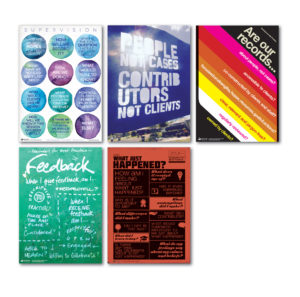
This set of five ‘Reminders for Best Practice’ posters is designed to be visually engaging and full of prompts for reflective conversations.


Why posters?

  • Posters create culture

The simple messages contained in these posters help communicate, to people accessing services and to staff, the strengths-based culture of your organisation, community service, school or business. Imagine them in your reception area. What might they communicate about the values and practice of your service? The posters might just make all the difference to people as they read that they will be welcomed as ‘People not Cases, Contributors not Clients’.

  • Posters create dynamic conversations

These posters work as reminders of some key values, skills and principles of strengths-based practice—working with people in ways that share power and build on strengths. They are designed to be talking points and sources of inspiration. People may find the messages reassuring, inspiring, challenging. Depending on where the posters are placed, people can glance at them from their desk, take inspiration from one in the middle of a meeting or discuss them with a colleague in the kitchen over morning coffee. These are the kinds of conversations that build reflective practice in organisations and teams.

  • Posters are highly visual

Whatever happens, these posters won’t fade into the background. The unique, interesting and highly creative designs by Tim Lane (graphic artist for several of Innovative Resources’ card sets including Reflexions and Choosing Strengths) include a hand-made stencil; an industrial, Eastern-block-style label; a grid of watercolour circles on absorbent paper and a mind-map of scribbles on a turquoise wall (Tim photographed the wall in the ‘happiest place in the world’—the school in the middle of the largest slum in East Africa).


Each poster focusses on a different subject including …

Recording: This poster challenges us to reflect on strengths-based ways of record keeping. It asks seven pivotal questions to remind us that how we keep records has the capacity to fundamentally change power dynamics and therefore the service we offer.

Supervision: Do you give or receive supervision? Whichever role you find yourself in, this set of 12 great questions can help guide strengths-based supervision sessions.

People not Cases: Contributors not Clients: This poster challenges labels that we may take for granted. It asks how practice could be different if we changed the way we see people, and the words we use to describe them. It is crucial to remember that even though someone may be accessing a service, they are first and foremost a person, not a case.

Feedback: Giving and receiving feedback are fundamentally important skills in human services, and ones that need regular honing. Here are a set of very good questions to keep in mind as you prepare to give or receive feedback.

What just happened? As a human service worker, have you ever finished a conversation with a family, young person or individual and wondered why things went so differently to how you’d planned? This poster includes 12 great questions to help you navigate challenging interactions with others and extract the learning that lies within these situations.


Reminders for Best Practice posters                                                                     $24.50

Social worker, Elise Birthisel, uses reflective letters in her work, and here she shares some insight into why. She also shares some tips and ideas on how to include reflective letters in your work.

But first, we thought we’d give you some background on what a reflective letter actually is!

What is a reflective letter?

Reflective letters are used to record conversations in such a way that they acknowledge the person’s story and experiences, notice strengths and exceptions, and focus attention on the person’s future picture and solutions. They are also used to ask curious questions and invite the person to think in terms of possibilities.

You might write a letter at any stage but it may be particularly useful at key change points or on completion of the interaction with the person. The letter is sent to the person, who can then keep it as a record of the conversation or as a reminder of the things you have discussed. They can reflect on it, share it or keep it private, or even use it to advocate for themselves within other services or situations. A letter is an enduring record that the person can keep and that documents a particular period in their life.

Writing a letter can also help you, as a practitioner, to focus your attention on reflective listening and on validating the person’s experience. It can also help you to remain focussed on the person’s strengths and goals and is a valuable record of your interaction with the person. Writing a letter that summarises your interpretation of a situation or conversation is a good way to check in with the person, to see if your interpretation aligns with theirs. Asking for feedback on the letter can help to clarify if you have read the situation accurately.

And here’s what Elise had to say about reflective letter writing!


First things first, tell us a bit about yourself? How long have you been a social worker?

My degree is in psychology and I’m currently studying my Masters of Social Work part time (I’m doing my last year). For many years, I worked in home-based care. I now work at a family violence support service, so I’ve primarily worked with young people.


When did you start using reflective letters with people? Where did you get the idea for doing this?

My years of growing up writing letters to my grandmother prepared me well!

I first learnt about reflective letter writing in Strengths Approach training. I still remember the trainer, Andrew Shirres, giving an example of reflective letter writing and how this can be used with clients. I was fascinated that this was a strengths-based tool. After the training, I purposefully tried to incorporate letter writing into my work practice.


Why do you think reflective letters are so effective?

Writing letters to me is about reflecting on a person’s nature but it is also about reframing and creating a different way at looking at a situation. This includes suggesting to the person the positive aspects of their character and is a way of giving them some empowerment over their life/situation.

I’ve worked with young people who have no idea that they possess strengths and the power to change their situation. Talking about strengths is not always a part of everyday conversations. In reframing and reflecting on strengths, a person can start to set goals using their strengths.

Letters can also be valuable as people then have something to keep, which they can look back on. Conversations can easily be forgotten.


How do people generally respond when they receive a letter from you?

Mostly positive, and sometimes surprised. Receiving handwritten letters can be a bit of a novelty. I have had the occasional letter back which was unexpected. Sometimes the reactions have been a mix of grateful and moved. Whatever the reaction, I find that they usually help my working relationship with that person.

The aim of my letters are to highlight someone’s strengths but the impact is sometimes that I get a better understanding of that person myself. My letters are about their strengths, as noticed by me, but also about getting to know that person better. They seem to be a good way of connecting to people on a different level.


Could you give us an example of when you’ve used a reflective letter? What feedback did you receive from the person you sent it to?

Recently, while working at a family violence support service, I used them with a young person struggling at home and school. After visiting her I wrote her a letter and photocopied four strength cards into the letter. I spoke about how this young person has demonstrated these strengths. I do believe taking a strengths-based approach with young people can be empowering through tough times.

A while back, I was working with a foster carer who was caring for a teen with high risk behaviours. This was a tricky time for the carer so I wrote her a letter with strength cards within the letter. I wanted to highlight to her that her strengths in caring for this teen were noticed and acknowledged and I wanted to do something more than just verbally telling her. I remember visiting the carer after sending the letter and noticed my letter stuck to her fridge. She told me it was so special to her and she loved to re-read it whenever she went to the fridge. I was struck at how my letter had affected her and realised the impact that my words had had on her.


Why do you add the strengths card images to the letters?

Adding a visual element takes a letter to another level in my opinion. Sometimes words aren’t enough to demonstrate to someone their strengths, especially children. In my mind, the words in the letter tell the story and the cards compliment and add depth to the story. Visual communication can be more powerful than words when connecting with someone.


What advice would you give to someone who would like to include reflective letter writing in their work, but aren’t sure how to start?

Have a go! Be genuine and provide examples of why you think they possess certain strengths. Try to capture and describe how you have noticed them using these strengths. Take care in what you write and be mindful of the impact of your words.


Is there anything else you’d like to share?

I would highly recommend the Strengths Approach to Practice training to anyone who hasn’t completed it. The Strengths Approach book by Wayne McCashen is also a great guide and starting point for learning about letter writing and other strengths-based tools.


If you would like to learn about some other client-centred recording tools, our Strengths Approach to Client-Centred Recording online course might be just the thing for you!


Useful resources:

Strength Cards®

Strengths Cards for Kids

Why are LGBTQI+ resources are needed?

Because everyone deserves respect. We share spaces with people whose ideas, beliefs and stories differ from our own. Our interests, languages, bodies and styles are many and varied, and this rich diversity is reflected in our experiences of gender, sexuality and biological sex as well.

People who are lesbian, gay, bisexual, transgender and gender diverse, intersex and queer/questioning (LGBTIQ+) have always been part of every society but their stories and experiences have often remained hidden and untold.

Unless we all build our knowledge and understanding of the natural diversity that exists in terms of gender, sexuality and biological sex, we are unlikely to take the next step forward on the journey towards fairness for everyone.


How Rainbow Talk can help

Rainbow Talk encourages safe and respectful conversations with young people and adults about the broad spectrum of human experiences related to biological sex, sexuality and gender.

The cards provide an engaging focal point for discussing topics in ways that each person can be in control of what they share, and encourage conversations that promote understanding, empathy and celebration of diversity.

Everyone’s identity includes their gender and sexuality and, as such, these cards are for everyone. They invite us to explore our own attitudes, experiences and understanding of identity, as well as those of others, in ways that are inclusive, curious and thoughtful.

Rainbow Talk includes

  • 40 cards each with a sentence starter
  • 8 of these cards are OPENERS – to help establish the guidelines for a respectful conversation
  • A ‘Reminder for Facilitators’ card
  • A booklet of suggested uses and background information

Rainbow Talk 

Try our eLearning free sampler: Introduction to LGBTIQ-Inclusive Practice

Every family is unique. Some families are big and rowdy, some a small and quiet. Some are extended, some are nuclear and some families have just one person and a cat. Families can be scattered all over the world or can all live in one town, or house. People of all genders are parents, and children, in families. Some families are united by one culture or belief system while other include people of different faiths and ethnicities.

While every society, culture and religion has slightly different ideas about parenting and the place of the family in the community, pretty much all agree that the family, in all its diverse glory, is of fundamentally importance.

So how do we make sure, when we are working with families, that we are respectful and inclusive of all different types of families, not just the ones that look like our own? Here are a few ideas.

Don’t make assumptions

We are now quite used to families that include step-parents or children living across different households. But we may still make a range of other assumptions about what a family looks like. For example, we may assume that there is a mum and a dad in the family, when in fact the family may consist of two mums or dads, or people of different genders, or it may be an extended family where many people have the parenting role. Or a child may be in foster care or live with people outside their biological family. So when meeting with a family, invite them to tell you what their family looks like and how they would like to describe themselves

Of course, there are many other places we may make assumptions about families too. We may make assumptions about things like their parenting philosophy and practices, who does what, what they value, how and when they celebrate, what they believe, ideas about discipline, amongst other things.

The best way to avoid making assumptions is to reflect on what your own family looks like and what is ‘normal’ to you. By examining your own values and beliefs about family, you are more likely to be aware of your assumptions and values, and less likely to impose those assumptions on others.

Be respectful of privacy

A common question on many intake forms in Australia is ‘Are you of Aboriginal or Torres Strait Islander decent?’ While this may seem like a simple question, it can feel very loaded for some Aboriginal or Torres Strait Islander people, for good reason. Identity can be a site of pride and it can also be reminder of trauma and oppression. This can be true for other groups in the community too, especially those who have experienced racism, violence or exclusion because of their identity.

If you do ask people about their culture, identity or experiences, ask in a way that allows people to choose what they share. You might ask something like, ‘Is there anything you would like me to know about your family culture/identity?’ If they chose not to talk about their identity with you, respect their privacy. You may find that as trust builds, they may choose to talk more about their identity or culture.

Be curious about what is important to the family and what they value

Identity isn’t just a tick box on a form — it is the heart of who we are.

If people do want to talk about their culture or identity, be genuinely (but respectfully) curious. Knowing what is important to people can help build rapport and understanding, and can give you insight into what they value. This can be helpful when you are supporting a family to make changes as you have a deeper understanding of what motivates and inspires them.

Invite them to share stories about celebrations, family gatherings and what they enjoy doing together. Spend some time researching the culture, history, practices or beliefs of the families you work alongside. Show interest in the things that are important to them.

Be respectful of family spaces

When we are going into people’s homes and talking to them about highly personal or difficult things, we want them to feel as safe and respected as possible. One way to demonstrate respect is to ask, or notice, how they do things in their home. Do you need to take your shoes off? Is it polite to bring food (or not) if you are visiting? Are there certain times of the day that people have cultural or religious commitments? Do they have certain chairs allocated to certain people? What is considered polite or impolite?

Sometimes families are not even conscious of these practices—they are just ‘the way things are done’. Be on the lookout for facial expressions that tell you that you may have inadvertently breached a ‘hidden’ household rule. Ask if you aren’t sure and encourage people to tell you if are doing something that makes them feel uncomfortable.

For some families, it can feel overwhelming or unsafe for people to come into their home. Be open to meeting in other places.

Be respectful of how families allocate time

Often, families are expected to fit in around systems, rather than systems fitting around them.  When you are working with a family, build an understanding of what their day and week looks like in terms of their various commitments.

When setting meetings, try and be aware of things like school drop-off or pickup, play dates, nap times, meals times and parent or community gatherings. It is also important to respect the time needed for religious or cultural events as well as things like celebrations and funerals (or other grieving processes). By showing that you respect a person’s time, you are demonstrating that you value them and their family.

Invite regular feedback

The reality is, even if we have the best intentions, sometimes we are going to get it wrong. Many people won’t feel comfortable telling you that you’ve said or done something offensive, especially if they can see you are trying to be respectful. Instead, they may just start cancelling appointments or stop engaging in other ways.

One way to avoid this is to build time for feedback into your catch-ups. It may just be a five minute chat at the end or regular use of a scaling tool but it can make a big difference to people feeling valued and heard.

If you ask for feedback, you need to be open and receptive to hearing it, which may take some getting used to if it hasn’t been part of your practice before. You can ask a few simple questions like, ‘What was the most useful thing we did today?’ and ‘What’s one thing you would like me to do differently?’

Some people may initially feel uncomfortable giving feedback, especially if they have experienced systemic oppression or violence. But by doing it regularly and telling them they are actually helping you to become a better worker or teacher, you will gradually teach them how to give constructive feedback, which is a great skill to have in all areas of life!

Do you have other suggestions for ways we can work in a more inclusive and respectful ways with parents and families? We would love to hear your ideas in the comments below.


Useful resources:

Positive Parenting cards    

Talking Up Our Strengths    

Rainbow Talk    

When we are supporting families, it can be easy to fall into the trap of focussing on deficits. This can feel difficult to avoid when we are supporting a family around a particular issue. However, creating the space for parents to notice and celebrate all the things they are doing well can be a really empowering and motivating for the family, and for the practitioner or teacher!


Taking the time to reframe our thinking by focussing on a family’s strengths is not just a ‘feel good’ exercise, it can actually enable positive change.

So how can we support the parents we know and work alongside to notice all the great things they do and celebrate the incredibly important role they play in their children’s lives?

Here are a few suggestions for celebrating the parents you are working with:

  • Before you meet with a family, think about what you already know about them. What do they do really well? How do they show their love for their children? What are their strengths, as individuals, parents and as a family? By focussing on the strengths of the family before you meet with them, these strengths will be in the forefront of your mind and you are much more likely to frame your meeting around strengths rather than deficits, which can completely change the tone and quality of the meeting

(This works just as well in your own family. If you are having a family meeting or a chat to one of your kids, give this a try!)

  • Ask them how they celebrate milestones or important events as a family.
  • Actively listen for strengths and capacities when talking to any parents, especially those managing challenges. Reflect those strengths back to them
  • Deliberately ask questions that invite parents to notice what they are doing really well
  • By the time a family is seeking support, they have probably tried lots and lots of other things. When talking to parents about a challenge they are managing, acknowledge the difficulty of the situation then invite them to celebrate what they have tried, done well or has enabled them to get this far. You might say, ‘Wow, that sounds tough. You must be incredibly strong/resilient/caring to have survived that. How did you get through that day/challenge?’ or you could ask a simple question like, ‘What have you tried in the past that has helped, even a bit?’
  • Use a prompt or tool, like the Positive Parenting cards can be a great way to encourage parents to reflect on the things that are important to them, what they do well and why they parent the way they do. Tools give parents something to focus on which can reduce the pressure of having a direct conversation about their parenting. As they are tactile and visual, they can engage parents in new and interesting ways. Encouraging parents to self-select a card also invites reflection on what they value and on things you may not have thought to ask.

If you are working with a family, this can be an ideal place to start every conversation – by encouraging them to give themselves a pat on the back! This helps build rapport and trust as the family will appreciate that you are looking for the things they are doing well. And it can also build a sense of hope and motivation if parents feel like they are doing lots of things right, as it creates a sense of context ie. not everything is bad, many things are good!

This is particularly powerful to do with parents who are struggling or who are managing additional challenges (as if parenting isn’t challenging enough!). Often these parents focus on the things they aren’t doing well or their perceived deficits, which can be demoralising and undermine their capacity and confidence to make changes. When parents feel like they aren’t doing anything right, it can feel even harder to look after their kids.

You may have lots of strategies you use in your work with families to help them notice their strengths, capacities and skills. If you do, we’d love to hear from you!

Of course, if you are a parent yourself, don’t forget to notice all the great things you do too! What’s one thing you can do to celebrate yourself as a parent today?


Positive Parenting cards

Strengths cards

When we are working with people in therapeutic spaces, we often focus on the practicalities—making sure people are safe and have the resources they need to look after themselves and their families. We are likely to give most of our attention to things like reducing stressors, supporting mental health and connecting people to the supports and services they need.

While these things are all necessary, spending some time talking to people about what they value and what is important to them is also incredibly valuable, for a number of reasons:

  • Knowing your ‘why’ can be highly motivating and can help give people the energy to create change.
  • By focussing on what people value, we are letting them know that we are interested in them as a whole person. It also contextualises whatever challenge they are currently facing within the broader context of their life, which can help give perspective and make things seem more manageable.
  • Often supporting people to identify what they value helps them notice their strengths and resources. For example, if they value their friendships, friends may be a great source of support and comfort. Additionally, the qualities that makes the client a great friend—empathy, loyalty, respect, having a sense of humour—may also be qualities they can draw on to get through their current challenges.
  • Consciously acknowledging your purpose and prioritising the things you value is fundamental to creating a sense of hope.

There is a growing body of research showing that people with a strong sense of purpose and meaning are more resilient, hopeful and do better on a range of health and mental health measures.

What does ‘having a sense of purpose’ actually mean?

Zoryna O’Donnel from Psychreg summarises the most current research in this space and concludes that four key factors were found to promote meaning and purpose in life:

  1. Physical and mental wellbeing (taking care of our body and mind, using stress-reduction techniques and building mental resilience).
  2. Belonging and recognition (being part of something much larger than ourselves, feeling valued and validated).
  3. Personally treasured activities (things we do that make us feel good—hobbies, spending time with our family and friends).
  4. Spiritual closeness and connectedness—a feeling that all living things in the world are interrelated (It should be noted that religion can be part of spirituality, but spirituality is not religion).

So having a sense of meaning and purpose doesn’t mean you have to disappear into a monastery or give your whole life to a cause you are passionate about (although for some people, this might be exactly what a having a sense of purpose looks like!). It can be as simple as noticing who is important to you (key relationships), what you love to do, or things that give you a sense of peace, and how you give to others.

So how can we start to talk to the people we work with about what they value?

When working with people going through a challenging period, it can be easy to get caught up in the problem or issue. After all, that is what is ‘front and centre’. But you might be surprised how powerful and transformative it can be to introduce a few curious questions about what is important to people.

Here are a few questions you could ask to get you started:

  • Who are the important people in your world? What do you value about them? What would they say they value about you?
  • What activities in your life bring you a sense of peace or joy? How could you bring more of those things into your life?
  • How do you support other people in your life? How do you feel when you do this?
  • What are you passionate about? Why is this important to you?
  • What do you believe? What gives you hope?
  • How could the meaningful things or people in your life to help you get through this challenge?
  • How could you do more of the things that are meaningful to you?

Be aware that some people may never have been asked questions like these before so make sure you give them time and space to reflect.

Have you asked the people you work with these types of questions? We would love to hear your stories and experiences!


Useful resources:

Signpost – Exploring Everyday Spirituality

The Nature of Strengths

Everyday Strengths


Kim Billington, a counsellor, clinical supervisor, trainer, author and presenter, recently contacted us to share some of the ways she has used Innovative Resources cards and other tools over the years. She very generously agreed to share these experiences. And we also talk about her new book!

 Kim starts by talking about where her inspiration comes from to do the work she does. While she has two masters degrees in counselling, she says that her most profound teachers have been the people she walks alongside in her work.

‘I have learnt everything of significance about counselling from those that seek a safe place to reflect and understand their life situations. The clients are my professors and have stimulated the most change in me as a therapist!’

Over the year, Kim has used a range card sets and other resources in her work

‘I began to use the Strength Cards with adults when I was working with the City of Melbourne Parenting Services and training in narrative therapy over 12 years ago. I find the Strengths Cards are especially helpful when exploring and populating “the trunk” part of the Tree of Life exercise, where a person lists all their strengths and skills.

‘I have used Cars’R’Us with groups of 8-12yr olds in a family violence setting, and Deep Speak with adolescents in groups.  The Bears cards have been essential to my work with children who have come for Child Informed Mediation, as well as those in residential care, foster care or out-of-home care. They were also most useful in training parents in Tuning Into Kids.

‘When working with adults, even in Men’s Behaviour Change programs, I found that choosing one of the Shadows and Deeper Shadows cards was helpful in sparking a change in perspective. This was especially true when a person found it hard to articulate their problem or were overwhelmed with problems and stuck in the hopelessness of a situation. The visual metaphors they chose in these situations helped them to see their difficult situation more clearly, which often resulted in unexpected narratives and meaning making.

‘I may end a series of sessions by asking a person to choose a card from Next Steps. It is all very individual, and there is no formula for choosing which cards to use with which client.’

Kim believes there are many benefits from using card sets and other tactile resources in creating safe and engaging spaces for people to share their experiences.

‘After years of practice using the cards with clients, I now see there are several benefits.  Often it is the re-positioning that takes place that helps people feel more comfortable. When the client can talk to the card, rather than me, this minimises arousing feelings shame, or fear of being judged. The cards often prompt valuable insights for the client.

‘I find cards can be useful as prompts for unanticipated musings and reflections. Holding one in the hand, or seeing it on the ZOOM share (as a digital resource) seems to help clients externalise their problems in a way that makes difficult conversations more accessible. The cards also seem to help clients open up new ideas for coping with current challenges and future possibilities. Even cards picked randomly when they are face-down have proven to be resonant and helpful in advancing new perspectives.

‘I tell all my Masters of Counselling students on placements to get a hold of the Strengths Cards asap! For new counsellors, these cards can help facilitate identity development conversations, and promote a deepening of therapeutic work in an engaging and playful way.’

Kim is selective about when she uses the cards, and finds that different card sets are useful in different situations.

‘When I come across a reluctant hero, who feels they have failed more than they achieved success, I may ask them to choose 3 Strength Cards for each member of their family, and then ask them which cards each of them would choose for themselves. This identity exploration exercise has been of significant help to many clients from 8-yrs-old and upwards. This works well with family groups too.

‘In the Tree of Life exercise, I always begin by asking clients to list all their strengths and skills, which we put on the trunk. Starting with naming strengths can be the catalyst for change as it stimulates the client’s curiosity about how these strengths came to be part of their identity, and encourages them to think about where they have they may have come from. The strengths form the core of conversations about the individuality that sits between the past and future.

‘For example, I might ask: Who saw this strength in you as you were growing up? Who helped you develop these strengths further? Why is this strength important to you, and who would understand why you value this strength? How do you use or express this this in your day-to-day life?’

Kim shares a few tips for using the cards.

‘I mostly say ‘choose 3 (or more)’ if they are choosing from The Bears or Strengths Cards, so the person does not feel they have to find the perfect one description of themselves.

‘Also, I may demonstrate the many stages of enquiry and exploration in my own identity development so they can get more deeply into why they chose their cards. So I might choose a card and say something like:

I am selecting the Patience card, as I can see myself even this morning not becoming rattled by slow traffic. I know I have developed this from my mum’s skillset. However, the flip side of patience is that others may take advantage of my calm behaviour and dismiss my wishes. My earliest memory of practising patience is being about 5yrs old, sitting in front of a mirror for what seemed like hours, watching my mum putting my hair in a bun. I value this strength because I also value peace, and when I am around impatient people their energy can disturb me and others.

‘Talking about this flip side is crucial to using the cards. For example, if they choose Caring or Helpful, their main problem may be related to struggling with compassion fatigue from being TOO caring and helpful to a family member they are caring for, leaving little energy or time for self-care. The cards can help reveal just such situations. This can then help open up therapeutic conversations about where and when they learned this behaviour – maybe modelling from a parent or trying to meet expectations that they would be the caring and helpful one.’

Kim has just released a new book called A Counsellor’s Companion: Creative adventures for child counsellors, parents and teachers is a Masterclass in working and living with children, which was illustrated by award-winning artist, Tamar Dolev.

‘Inspired by narrative therapy’s founders, Michael White and David Epston, I have been developing the art of asking quirky questions, woven with metaphors for years, with all ages of clients. This adventurous style of counselling seems to stimulate new perspectives and ideas that can make “The Problem” look quite different and not as daunting.

‘As a counselling trainer, clinical supervisor and counsellor, with over 30 years’ experience working with families from all walks of life, this book celebrates and demonstrates ‘what works’ with children and young people. ‘The book includes a variety of simple, expressive arts interventions and includes real-life examples of how to facilitate sensitive, imaginative and playful conversations about serious problems.’

Kim’s book can be purchased form my website: kimbillington.com.au or https://tinyurl.com/acounsellorscompanion


Strength Cards     

Cars’R’Us     

Deep Speak     

The Bears     

Shadows and Deeper Shadows     

Next Steps     

The research into the psychology of optimism is based on studies into a condition called ‘learned helplessness’. Psychologists and other researchers have discovered that people or animals show changes in behaviour when they decide they can do nothing to improve or change a situation they find themselves in. These changes include lowered mood, alterations in brain chemistry, increased or decreased appetite, lowered sex drive and decreased motivation.

While the majority of people and animals respond to adversity with a ‘learned helplessness’ or ‘giving up’ response, a smaller percentage were able to persist despite setbacks. Further research into how these people were able to display resilience and persistence revealed that their thinking processes were different from those who had given up or felt helpless. The optimistic responders talked to themselves differently, asked themselves different questions and continued to take action until something improved. When these optimistic responders were studied over time, results suggested that optimism helps us achieve better results at school, maintain better health, succeed in sport and do well in the workplace.

While our tendency towards optimism and pessimism is partly genetic, many studies have demonstrated that we can increase our level of optimism by learning the skills that natural optimists use, and that this can actually help overcome and even prevent depressive episodes. These skills form the basis of the questions used in the Optimism Boosters card pack.

What are ‘optimism skills’?

Through extensive research into the different skills used in creating and maintaining optimism, three patterns emerged.

Thinking our way into the future

The first pattern is the ability to ‘think into the future’ and clarify an effective goal. This is an extremely important skill that is under-utilised by many people facing difficulty.

The act of focussing on the goal generates changes in brain chemistry that increases motivation, drive and clarity. Focussing on how we want things to be (instead of how they are now) encourages our brain to accept the idea that things can and will improve. It also helps ensure that when we choose an action strategy, we choose one that moves towards the goal we have chosen.

For example, many people initiate action without first clarifying their goal, and this can lead to disappointment. Many of us initiate action when we are upset or angry, and our action can make a bad situation worse. By stopping to clarify our goal, we can focus on what effect we would like to create, and hopefully choose an action that supports that goal.

There are ten ‘Goals’ cards in the Optimism Boosters set. These cards provide questions that can help people consider what they actually want to achieve and develop a clear and realistic goal for their chosen situation.

Challenging our stories

The second pattern in creating and maintaining optimism is the ability to listen to the stories we tell ourselves about good and bad events in our lives. Some stories (‘I failed the exam because I needed to do more preparation’) suggest possibilities for change. Other stories (‘I failed the exam because I’m not smart enough’) suggest that lack of success is permanent and unchangeable.

Studies demonstrate that the stories we tell ourselves about why things happen are quite powerful because we then act as if those stories are the truth. Learning to challenge unhelpful stories (‘I can’t because I’m too busy’, ‘I’m just no good at this’, ‘Everybody thinks I’m a loser’, ‘That just happened because I was in the right place at the right time’) by questioning the evidence to support those stories is very effective and provides a ‘reality test’ for some of the unhelpful things we say to ourselves.

There are ten ‘Possibilities’ cards in the Optimism Boosters set. They are designed to help to generate possibilities in the way we are viewing our situation. The aim is to see the situation as changeable, as well as gaining some perspective. This promotes changes to brain chemistry by providing a sense of control and wellbeing.

Strategies, actions and next steps

The third pattern emerging from many optimism and hope studies is the ability to use problem-solving skills to generate strategies that will improve or change a situation. Many people know what they want but are unable to think of what to do to change things.

The third set of questions (Strategies) is designed to assist people to think of things that they can do that will change or improve their scenario. For example, asking questions such as ‘What have you done in the past that might help?’ or ‘What are others doing in the same situation?’ can lead us to think of resources, actions and next steps we might be overlooking.

The ten ‘Strategies’ questions in the Optimism Boosters set remind us that we have many resources for initiating change as long as we ask ourselves helpful questions. The right question can change our brain chemistry by increasing possibility, control and motivation.

From Optimism Boosters Booklet

Author: Selina Byrne M.A.P.S.

Optimism Boosters     $44.50 inc. GST     Product Code: 3775


Other resources to increase a sense of hope and possibility

Life Tweaking     $49.50 inc. GST     Product Code: 4934

Choosing Strengths     $52.50 inc. GST     Product Code: 2400

Note to Self     $44.50 inc. GST     Product Code: 4750

Developing a language around feelings and body signals is the first step in learning how to manage emotions. But teaching children about feelings and body signals can feel tricky. If we are in a classroom or group setting, we may worry that they reveal something personal in front of other children. Or we may be concerned that we don’t have the skills to talk about uncomfortable feelings or body signals.

The good news is, there are many fun and simple ways to support children to build their social and emotional skills. One easy way to make these conversations fun is to use tactile resources.

Here are a few suggestions for ways to use The Bears and Stones…have feelings too! stickers to have conversations with children about feelings and emotions. Or check out these ideas for using other tactile resources.

  1. Recognising feelings and body signals

Write a list of common feelings on a large sheet of paper (or A4 sheet if you are working one-on-one with a child) – this could include things like happy, sad, angry, tired, calm, frustrated, bored, excited or scared. Ask the child or children to choose 1-2 The Bears or Stones…Have Feelings Too!  stickers to represent each feeling in the list. Stick them on the paper next to the relevant feeling.

Talk about each emotion or feeling and the body signals that might be associated with each. How does our body tell us we are feeling angry? What might we feel in our tummy if we are feeling excited? What is one thing we might notice in our body if we were feeling scared?

  1. Use pairs of stickers to make games to talk about feelings

Using pairs of the same stickers (cut them up and create small packs of ‘cards’), create games like Memory, Snap or Go Fish. These games are great because they are familiar and you can use them again and again. Because the stickers are small, they are great for little hands.

This is also a fantastic way to support children to build a vocabulary around feelings and body signals in an indirect, incidental way.

  1. Use them as a storytelling tool

Ask children to choose any sticker they feel drawn to. Write a story where the character on the sticker overcomes a challenge.

Once they have finished the story, do a story summary using stickers. Use the stickers to represent what the character felt and did at the beginning, middle and end of the story. You may choose to include strengths stickers here too, so that the children can identify which strengths their character drew on at different points in the story.

  1. Create a feelings journal

Keeping a feelings journal is a great way to help children build their social and emotional literacy.

At set times of the day, ask children to choose a sticker that represents how they are feeling at that moment to add to their journal. Encourage them to write about the feeling and any associated body signals or triggers.

At the end of each week, revisit the feelings journal, encouraging children to notice any patterns or changes. Invite them to reflect on what helped, what didn’t help, what strengths they drew on to manage their emotions and what they learned about themselves.

This activity helps children build emotional intelligence by encouraging them to be more aware of how emotions change over time and how their body gives clues about how they are feeling (even if they’re not aware of them consciously).

  1. Problem-solving 

Ask children to think about a problem they are dealing with at the moment. Invite them to choose 2-3 The Bears or Stones…Have Feelings too! stickers that represent how they are feeling about the situation.

Then ask them to choose a sticker that represents how they would feel if the problem was gone or was less prominent. Invite them to reflect on how things will be different when the problem has been resolved. How will it feel in their body? What will other people notice is different about them?

Encourage them to think about some strategies or actions they could take to get from where they are now to where they’d like to be.

If you have strengths stickers, you could also ask them to choose 2-3 Strengths Cards, Strengths to the Max or Strengths Cards for Kids stickers that represents strengths that they have or strengths that they could borrow from someone else—a friend, a family member, a teacher, a coach or a counsellor—that could help them address the problem.

Have you used the The Bears or Stones…Have Feelings too! stickers with children? We’d love to hear your stories!

The Bears stickers  (480 individual stickers!)

Stones…have feelings too! stickers  (520 individual stickers!) 

Strengths stickers  (540 individual stickers!)  


Food is everywhere. For many people, it is a source of pleasure. We meet over food, we celebrate with food, and we buy cookbooks by the truckload. But what happens if your relationship with food is ambivalent, or even downright dangerous?

ANAD estimates that approximately 9% of the global population will be affected by an eating disorder in their lifetime. While this is shocking enough, these statistics exclude the many people experiencing ‘disordered eating’ patterns. While disordered eating may not meet the criteria of a specific eating disorder such as anorexia nervosa, bulimia nervosa or binge-eating disorder, they share many characteristics and are concerning and potentially dangerous.

So when does an interest in food and dieting become something we should be concerned about?

According to the Academy of Nutrition and Dietetics, some of the signs and symptoms of disordered eating (which can be precursors to an eating disorder) may include:

  • Frequent dieting, anxiety associated with specific foods or meal skipping
  • Chronic weight fluctuations
  • Rigid rituals and routines surrounding food and exercise
  • Feelings of guilt and shame associated with eating
  • Preoccupation with food, weight and body image that negatively impacts quality of life
  • A feeling of loss of control around food, including compulsive eating habits
  • Using exercise, food restriction, fasting or purging to “make up for bad foods” consumed

They go on to suggest that the consequences of disordered eating can include ‘a greater risk of obesity and eating disorders, bone loss, gastrointestinal disturbances, electrolyte and fluid imbalances, low heart rate and blood pressure, increased anxiety, depression and social isolation.’ If disordered eating becomes an eating disorder, there are many additional risks for both physical and mental health.

Why do I need to be thinking about this in my work?

Eating Disorders Victoria says that at any given time, approximately 16% of people are experiencing an eating disorder or disordered eating patterns.

Let’s break that figure down a bit further.

That means that in every classroom of 25 students, 4 of them (on average) will have an eating disorder or disordered eating patterns. It means that approximately 1 in every 6 people has either an eating disorder or is experiencing disordered eating at any given time. Those people are our daughters, our sons, our sisters, our work colleagues, our students. Based on these figures, everyone is likely to be directly or indirectly impacted by an eating disorder or disordered eating at some point in their lives.

What can I do to support people if I suspect they have an eating disorder or disordered eating patterns?

The lead author of Eating Disorders & Other Shadowy Companions, Danni McDougall, an art therapist and senior mental health practitioner, says that we need to build our understanding of the actual experience of having an eating disorder. In order to develop that understanding, we need to start by listening.

‘Many people say that having an eating disorder is like being stuck in a prison of your own mind that feels impossible to get out of. I believe that this experience needs to be heard and validated before the focus can shift to recovery’.

‘An eating disorder is an illness, like a broken leg. No-one feels shame about breaking a leg or how long it takes to heal. In creating these cards, I wanted to open up conversations about what it’s like to have an eating disorder, and challenge some of the isolation and shame that people living with eating disorders often feel.’

NEDA suggests that if we are concerned about someone’s eating patterns, we can start by learning as much as we can about eating disorders and disordered eating. They go on to say that we should be honest with the person about our concerns, use respectful and supportive language that avoids stigma, encourage the person to get help and tell someone who has the knowledge to support us (there are many services available who can provide that support).

Prevention is better than cure

The Butterfly Foundation believe that there are also many things we can do to support people to develop a healthy self-image and reduce the risk of eating disorders developing, including encouraging them to:

  • Focus on body function (how their body is useful) and practice body gratitude
  • Be media savvy, limit exposure to highly stylised and flawless images of fitness, beauty and appearance and diversify what they see
  • Combat unhelpful and toxic negative body talk
  • Resist the temptation to engage or buy from the diet industry
  • Nourish their body in ways that make them feel good
  • Be realistic: No one feels great about their body all of the time. Poor body image moments happen but they don’t need to respond to negative feelings with unhelpful behaviours.
  • Nurture the whole self and value the whole person: Practice body kindness, mindfulness, and self-care. Encourage people to notice the qualities, talents, strengths and attributes that make them who they are, and celebrate and nurture the things that are important to them.

How the Eating Disorders & Other Shadowy Companions cards can help

While the Eating Disorders & Other Shadowy Companions cards have been designed to be used primarily with people experiencing an eating disorder—any eating disorder—they can also be used to have conversations about body image, ideals of beauty, the impact of the media on our sense of identity, dieting and our relationship to food. They can also be used to talk about other ‘shadowy companions’ like anxiety or depression.

As psychologist, Adrienne, says about the cards:

‘I like how they are gender neutral and open to be used to people of any age. I think there is so much body obsession and weight focus in society that people who don’t have an eating disorder will also find them helpful. They relate to other mental illnesses such as anxiety, depression, trauma.’

Eating Disorders & Other Shadowy Companions includes a comprehensive booklet of suggested activities and tips for creating safe and inclusive conversations in a range of settings; one-on-one sessions with counsellors, psychologists or other health professionals, with families around the kitchen table, in secondary and tertiary settings, within family and community services, workplaces and groups.